
unchanged through wind and frost,
as if wrapped in armour,
so shall our resilient spirit.
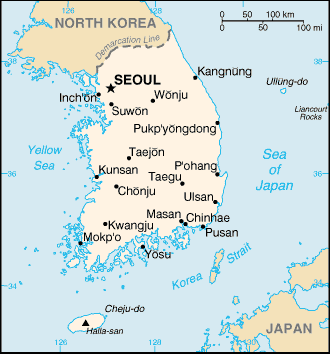
The Republic of Korea (Korean: 대한민국, Daehan Minguk), far better known as South Korea (Korean: 남한, Namhan) or simply Korea (Korean: 한국, Hanguk), is a country in East Asia. Its capital and largest city is Seoul. After spending thirty-five years under occupation by Imperial Japan, the Korean peninsula was divided in two after the Red Army showed up.
The most notable event (to the world, anyway) in the history of South Korea is The Korean War, sometimes called the Six Twenty Five War. Its first president and wartime leader, Syngman Rhee, was a horrifically incompetent and brutal dictator whose views bordered on fascistic and was extremely corrupt, still blamed for the problems plaguing the country's politics and society today. He was finally deposed in the fury of the student-led, pro-democracy April Revolution , where he had become so despised that the US stepped in to help remove him. The revolution briefly installed a civilian government that experimented with parliamentary rule for the first and only time in South Korean history, as mounting instability led to the first of many military coups. During his term, Rhee had so exhausted the patience of the US that he received very little financial aid as punishment, resulting in the humiliating situation where North Korea was wealthier and had better living standards than South Korea.
Out of the natural power plays that followed came the 17-year presidency of General Park Chung-hee, who was simultaneously responsible for not only major socioeconomic reform that practically rebuilt the impoverished country from the ground-up, but also some of the most brutal suppression of civil liberties and labor movements that the country ever saw, which escalated in severity as Park's tenure went on thanks to his growing belief that he was the sole linchpin of Korean stability. The defining event of his foreign policy was South Korean participation in The Vietnam War, done partially as a favor to the US for their help fighting North Korea, partially to obtain massive US investments. To this day, Park remains the longest-serving president in South Korea's history, coming to power under extremely dubious circumstances and running a cold and unfeeling military dictatorship, to the point where he's characterized in retrospect as more of The Generalissimo than an actual president.
After Park's assassination in 1979, the authoritarianism continued under a different form at the hands of his tactless and thuggish successor, General Chun Doo-hwan, who was already the de-facto head of state for nine months before his ascension to the presidency in September of 1980, but people kept protesting, demanding democracy and freedom. Chun sealed his fate by ordering the event that would define his entire career, the 1980 Gwangju Massacre, where many innocent civilians died defending themselves. The outrage over Gwangju exploded into the 1987 June Democracy Movement (which was aided in part by the global exposure brought about by the lead up to the 1988 Olympic Games, which were to be held at the capital, Seoul), Chun's hand-picked successor, Roh Tae-woo, implemented significant reforms to democratize Korea upon his inauguration in 1988 (with the preceding elections marking the country's first peaceful transition of power ever). In hindsight, the democratization of Korea also acted as a prelude to the downfall of the similarly authoritarian Soviet Union and Eastern Bloc between 1989 and 1991, as the transition and Olympic games acted as an icon of the greatness of democracy and freedom from dictatorship.
Since then, South Korea has remained a completely democratic country, currently in its sixth incarnation of the republic. It is also one of the "Asian Tigers", making a major economic leap in the 1980's after a shift in social structure from a mostly agricultural society to one based in tertiary industries in less than 40 years. It's seldom talked about, but in purely statistical terms, South Korea is currently one of the world's most powerful countries: it has the tenth largest GDP on Earth at market exchange rates according to the United Nations (above Russia) and the seventh strongest military on Earth according to Global Firepower, on top of being the world's fifth largest exporter in dollar value, with the world's sixth largest manufacturing base. It also has the capability to produce nuclear weapons, though it has not yet exercised it, not eager to escalate their ongoing cold war with the north.
South Korea is a close ally of the United States (who led the UN forces that saved the country in The Korean War), but has problems with Japan for some rather obvious reasons. These include the issue of "comfort women", women from Korea (plus China and a few other countries) forced into prostitution and sex slavery by the Japanese, which the Japanese government continues to deny. Then there's the issue of Japan's ethnocide against Korea during their occupation, during which they tried to stomp out all traces of Korean language and culture in favor of Japan's own. Even without World War II, Japan and Korea have never liked each other very much (see Toyotomi Hideyoshi's wars on Korea) with Korea viewing Japan as culturally backwards and Japan viewing Korea as militarily weak. Despite the heavy anti-Japanese sentiment in South Korea that continues to this day, the two countries now have a sort of Enemy Mine relationship due to their shared interest in keeping North Korea, Russia, and China in check. However, South Korea frequently supports China and vice versa on issues regarding Japan.
South Korea is not North Korea. South Koreans take great pains to refer to their country as "Korea," with no geographic distinction. In their minds, using the term "South Korea" gives an air of legitimacy to the totalitarian doppelganger across the border. The reverse is true on the other side. Nowhere else in the world is there a homogeneous group of people so starkly divided by ideology.
No non-offensive joke possible
It's a truism that dog meat was a popular delicacy in South Korea. A quick way to get an "Oooohhh!" from the audience in a Panel Show is to joke about it. Animal welfare groups scream "animal cruelty"; Koreans scream "cultural imperialism" back. Any argument goes nowhere fast (and hey, Hindus feel the same way about other people eating beef, sometimes with messy results in recent years). The Western aversion to eating dogs is so ingrained that it's ripe for Stealth Parody, as Joey Skaggs proved in a famous prank. On the other hand, there is evidence that younger Koreans are turning against it. Nowadays dog meat is mostly eaten by the older population, as the opinion that it is animal cruelty is getting more and more popular. Note that non-dog eating Koreans will be offended if another person implies that all or most Koreans like dog meat.
Koreans have been called the "Irish of the Far East" for enduring a lot from Imperial China, Japan, and the Mongols. The Japanese occupation of Korea was extremely brutal and actually made Korean nationalism stronger as the Japanese actively attempted to destroy Korean identity and even today many aspects of traditional Korean culture have been lost due to the Japanese occupation. The tension from the two groups could be considered the equivalent of Polish-Russian relations, due to the fact the Japanese population has a nasty habit of denying anything their country ever did to Korea (and pretty much everyone else).
Religion in South Korea
Also worth mentioning is religion, specifically the presence of Christianity. Just under 30% of all South Koreans are Christian; 1/3 of these are Catholic, while the rest are Protestants of varying description, but most prominently Presbyterian. The reasons for this include extensive proselytism in the late 19th century, the decrepit state of Korean Buddhism at that time, and the association of Christianity, particularly Protestantism, with leaders of the Korean nationalist movement. Korean Christians had worked hard to reconcile Christian and traditional Korean values and were at the forefront of the Korean independence movement under the Japanese. Ironically, Pyongyang was the major center of pre-1945 Korean Christianity, with the Christians fleeing south only after the Communists taking over the north.
Furthermore, of the twelve presidents of the ROK, four have been Protestant, two Catholic, with three Buddhists and three irreligious. As a result, South Korea is one of the most Christian countries in East Asia; it is certainly the most Protestant (the only Christian-majority countries in Asia are the Catholic Philippines and Timor Leste). As for other religions, the traditional Buddhism (or more accurately a syncretic mixture of Buddhism, Confucianism, and traditional beliefs called muism) of Korea has about 22% of the population; most of the rest are irreligious.
Popular Sports in South Korea
The most popular sport in Korea is football (soccer). A South Korean team has qualified for the FIFA World Cup finals nine times (more than any other Asian countrynote ), eight of them in a row, culminating in their first title in 2010 for their under-17 women's team. The Korea Professional Football League (K-League) is the oldest domestic professional football league in Asia. The country co-hosted the 2002 FIFA World Cup Championship along with Japan; they managed to make the semifinals that year (their best result so far).
Baseball is the second biggest international sport, where most of the teams are owned by large companies. They have their own eight-franchise league "Korea Professional League", and the Korean Olympic team won the gold medal at the 2008 Olympics in Beijing, China. Since 1994, there have been a total of 12 South Korean nationals that have played or are playing for Major League Baseball franchises in the United States.
The popularity of NBA stars such as Jeremy Lin, Ha Seung Jin, and Moon Tae Jong have given rise to the popularity of basketball in South Korea, although they are a powerhouse in their own right, ranked # 3 overall with 23 medals for the Asian Basketball Championship (now known as FIBA).
And of course, we have to mention the popularity of StarCraft. To say it has a professional sports-esque culture built around it would be absolutely accurate.
South Korea in fiction
A lot of South Korea's appearances in foreign fiction are to do with its relationship with the North. The country is occasionally inaccurately thought to be poor and technologically backward, which, understandably, annoys the locals to no end. But Korea was a pretty poor country during the 1950s: it only became rich and technologically progressive in the last forty years. In fact, according to Martin Meredith in his book The Fate of Africa, South Korea had a lower per capita GDP than Ghana during The '60s, but things have gotten a lot better. As described above, South Korea is one of the world's most dynamic economies. North Korea is more or less as depicted in the James Bond film Die Another Day. Come the 2010s and 2020s, South Korea is internationally famous for its entertainment industry which rivals Hollywood and Bollywood in fame, especially its TV and music scenes.
South Korea produces quite a few movies and shows of its own, not counting the considerable amount of American and Japanese stuff animated there to save costs. Korean cinema has become very popular all across eastern Asia for much of the past ten years and has enjoyed a small following in the west. The most notable recent film from the country to make it to the west is Parasite (2019). Other prior exports include Oldboy (2003) and The Host (2006).
South Korea produces comic books called Manhwa. Unlike Japanese manga, manhwa read like Western comic books (sort of like how Koreans drive on the right side of the road and the Japanese drive on the left). The general style is different from manga in that the art work tends more towards realism. Manhwa is also used to define animation. South Korea is home to several animation studios. They supply inbetweening work for American and Japanese animation studios as well as for home grown productions.
The most recent Korean media export, in a phenomenon known as the "Korean Wave" or "Hallyu Wave" (韓流 or 한류 in Korean). Initially these were their dramas, short Soap Operas that are either about contrived, tragic love, or pure romantic comedy. Sometimes combining both. The most famous from this wave was the metaseries Endless Love, which consisted of four dramas ambiented each one in a season of the year, namely Autumn in my Heart, Winter Sonata, Summer Scent and Spring Waltz. Most tragic dramas will inevitably (or, at least, used to) invoke one or more of the following: Easy Amnesia, someone Delicate and Sickly (usually cancer), Brother–Sister Incest, a car accident of some sorts, and blindness. But internationally, South Korea has become famous for its K-Pop scene, with the most successful band, BTS, treated as the nation's cultural ambassadors.
South Korea figures prominently in any Lost episode centering on Sun and Jin. These sequences are notable in that they are entirely in Korean (with subtitles) rather than employing a Translation Convention. Sun is played by Yunjin Kim, who achieved fame in South Korea before coming to the US. Jin, however, is a Fake Nationality, played by American Daniel Dae Kim.note
In strategy games, they tend to be Stone Wall turtlers: In Civilization III they received only peaceable civ bonuses, in Civ IV they received the Protective trait, the ultimate turtling benefit, and in Civ V they received scientific bonuses and a unique naval unit that can't venture beyond coastal waters but is insanely difficult to destroy, and is even called the Turtle Ship. In Age of Empires they received tower bonuses, in Age of Kings more tower and stone bonuses, in Rise of Nations yet more tower bonuses, building repair bonuses and La Résistance bonuses. Regardless of that, their unique unit in these games has been the Hwach'a , the Hwach'a, the Hwach'a and the Turtle Ship, and the Hwach'a and Hwarang, respectively.
Oh, sorry, right
- Hwach'a/Singjeon — a mobile rocketry platform that fires hundreds of arrows at once. That means, along the with udometer and metal printing, the Macross Missile Massacre was invented in Korea.
- Turtle Ship — An ironclad battleship invented in 1592* with a retractable and (occasionally) fire-breathing head (powered by a cannon inside the mouth). They were something of a Superweapon Surprise to the invading Japanese. The ship was covered in thick plating and studded with metal spikes, which made it impossible to get on the deck (because there was no traditional deck as such). The flat, keel-less bottom made the ship exceptionally agile, being able to make sudden turns (a dramatic contrast to the Japanese ships, which were faster but could only go in a straight line at top speeds) A favoured method of attack was to use the superior durability and maneuverability of the Turtle Ship to ram the more fragile Japanese ships.
- Hwarang — A monastic knightly order of warrior-poets, name meaning "Flower Knights". Membership was restricted to aristocratic male youths of the Silla dynasty.
- The character Hwoarang from Tekken is named after them, being a Tae Kwon Do-using South Korean.
Other notes about South Korea:
- Hermit Kingdom
- Empress Myeongseong
- Korea under Japanese rule
- Korean Wave: The international popularity of Korean pop culture starting in the 2000's.
- Thirty Divisions of the Peninsula
Korean Culture
Korean History
Korean Media
- Hanguk Manhwa Aenimeisyeon (Korean Animation)
- Animation studios based in South Korea include:
- AKOM
- Big Star
- Dong Woo Animation, established in 1990. Has been Studio Gallop's Korean subsidiary since 1994.
- DR Movie and Moi Animation, two studios owned by Madhouse.
- Edge Animation
- Hanho Heung-Up
- Heewon Entertainment
- JM Animation
- Moi Animation
- Rough Draft Studios: The South Korean arm of a California-based animation company.
- SAMG
- Saerom
- Studio Animal: One of the most expectant animation companies of Korea, made famous by their latest work, Ghost Messenger.
- Studio Mir
- Sunmin Animation
- Sunwoo Entertainment
- Yeson Entertainment
- Animation studios based in South Korea include:
- Korean Pop Music (Korean Idol Singers, Boy Bands, Girl Groups and others)
- Korean Video Games
- Video Game Companies based in South Korea include:
- Bluehole Studios : Developer of TERA and PlayerunknownsBattlegrounds.
- Com 2 Us
- NCsoft
- Creator/Nexon
- Video Game Companies based in South Korea include:
- Korean Movies (Live action)(this page includes North Korean movies)
- Korean Series (Korean produced live action television)
- Korean Drama (tropes common to South Korean series)
- Manhwa - Graphic novels, read Western-style (left to right)
- Korean Webtoons - manhwa online but in a long strip format
- Oathean, a Black Metal/Death Metal band.
- Eat Your Kimchi
Works of fiction set (but not produced) in/about South Korea:
- Analogue: A Hate Story: A Visual Novel about a Korean Generation Ship that had undergone a regression back to a Joseon-like Feudal Future, complete with horrifying misogyny. A sequel, Hate Plus, focused on the events that created said reversion, and included an implicit critique of modern Korea as having tendencies towards destructive materialism and lax morals permitted by anti-democratic forces to maintain order.
- Battle Born, Dale Brown's twelfth novel, is a fictionalized account of the reunification of the two Koreas.
- Black Panther: A major action setpiece of the film is set in a casino and on the streets of Busan, where the title character apprehends a notorious arms dealer.
- Lost: The US series had two Korean characters. Since they were Korean-Americans, their Korean pronunciation was a bit... off-sounding for many native Korean watchers.
- Mash (the original novel)
- M*A*S*H (The Film of the Book)
- M*A*S*H: A US television series, based on both of the above works, all of which are set during The Korean War. However, in the film and series the description is far from accurate (even considering the state of Korea back then). This is largely a result of the fact that the film and the series began as allegories of The Vietnam War and, in early TV episodes especially, the writers seemed only vaguely aware that Korea and Vietnam were actually different places.
- Overwatch features Hana Song aka "D.va", a professional gamer who was drafted into the Korean military to help stop a massive robot crisis.
- The Silence of Bones: The novel takes place primarily in Hanyang (Modern day Seoul) in 1800, just a year before the infamous Catholic persecutions. It also features areas such as Mount Inwang, Inchon, Mount Yongma, and the island of Heuksan.
- Sense8: One of the eight cluster members is Sun Bak, played by Doona Bae. All of Sun's scenes with her various family members take place in Seoul, and there are large swathes of (subtitled) Korean spoken.
- Battlefield 2042: One of the base map, "Kaleidoscope" is set in the South Korean smart city of Songdo, not too far from Incheon.
- Splinter Cell: Chaos Theory sees North Korea launch an all-out attack on South Korea. After the mission in which Sam Fisher infiltrates a North Korean missile battery to obtain intelligence, the next mission takes him to war-torn Seoul.
- Turning Red: Abby is Korean-Canadian and switches to Korean whenever she gets angry or frustrated.
The South Korean flag
 , a Taoist symbol of the fundamental principles of reality, symbolizing Heaven and justice (upper left), Fire and fruition (lower left), Earth and vitality (lower right), and Water and wisdom (upper right).
Emblem of South Korea

The South Korean anthem
—
Government
- Unitary presidential constitutional republic
- President: Yoon Seok-youl
- Prime Minister: Han Duck-soo
- Speaker of the National Assembly: Kim Jin-pyo
- Chief Justice: Cho Hee-dae
- President of the Constitutional Court: Lee Eunae
Miscellaneous
- Capital and largest city: Seoul (서울시)
- Population: 51,709,098
- Area: 100,363 km
- Currency: South Korean won (₩) (KRW)
- ISO-3166-1 Code: KR
- Country calling code: 82
- Highest point: Halla-san (1950 m/6,398 ft) (129th)
- Lowest points: East Seanote /Sea of Japan (12,276 ft/3,742 m) (-) and Yellow Sea (152 m/499 ft) (-)
