The Cultural Cringe is an internalized inferiority complex that causes people in a country to dismiss their own culture as inferior to that of other countries. Such people will thus tend to discount a lot of their own culture and embrace another country's 'better' culture instead. In fact, it's common for people suffering from Cultural Cringe to disavow that their own country has a legitimate national culture at all. There are many possible reasons for this, but one is due to it being true what they say: familiarity breeds contempt. Other cultures can seem so much more exotic and interesting when you don't know much about them, and don't have to actually live with their more negative aspects day in and day out.
Australian literary critic and social commentator A. A. Phillips named and codified the trope with his 1950 Meanjin essay "The Cultural Cringe", in which he observed this behavior — specifically feelings of inferiority towards Britain — in rampant abundance among his contemporary fellow Australians. (This is also why it's a part of Australia's Useful Notes, along with Tall Poppy Syndrome.) This trope is at least Older Than Radio, though, enough so that among the people Gilbert and Sullivan felt "would not be missed" was:
This isn't necessarily the opposite of Patriotic Fervor, though it may of course arise as a (possibly overcompensatory) reaction to it. Nor is it quite the same thing as Boomerang Bigotry. Someone with the Cringe may still love his/her country and national heritage despite its supposed inferiority. As one may put it, their own culture may suck, but it's still their culture.
The flip side of (and often combined with) Foreign Culture Fetish. Compare Internalized Categorism, in which the character starts hating themselves for being a part of a culture perceived by others as "bad," rather than merely seeing their culture as inferior to other cultures. See also Boomerang Bigot, where the character might feel anything from their own ethnicity to their species is inferior, rather than feeling their country and its culture specifically is inferior, in comparison with another country and its culture. See also Cultural Rebel, who may or may not suffer from this trope. Compare Cargo Cult and My Country Tis of Thee That I Sting. Also compare Stop Being Stereotypical and Cultural Personality Makeover, as something unique to a specific culture can often end up being dismissed as a negative stereotype by members of that culture. Hated Hometown and Never Accepted in His Hometown may also contain elements of this. Contrast Cultural Posturing.
Examples:
- Sakigake!! Otokojuku, an anime that frequently lampoons Japanese nationalism.
- Hetalia: Axis Powers. The author makes fun of everybody, his homeland included.
- During his stand-up special, comedian John Oliver quips that it's "impossible for me as a British citizen to go into any museum in any nation on the planet Earth without, within five minutes, starting to feel guilty."
- In the Top 10 Spin-Off Smax, Smax has this in spades for his home realm — traveling there requires the use of arcane rituals, the locals play up rustic stereotypes to appease visiting tourists, and adventuring is a bureaucratic hassle that includes mandatory quotas and compliance with various fantasy tropes. Not to mention his twin sister having the hots for him...
- The Hidden Blade portrays Bakumatsu-era Japan as turning its back on traditional Japanese culture in favor of the new European style. The general perception among the samurai is that Japanese culture is being proven inferior time and again to European technology and customs. One Westernized Japanese man even organizes a footrace to prove the superiority of Western-style running over the Japanese style.
- This clip
 from The Newsroom in which an American gives America a "The Reason You Suck" Speech (combined, in the end, with a large dose of Nostalgia Filter about how it used to be better).
- The Kids in the Hall: This sketch. Scott Thompson transfers this trope to Canada (where KITH is produced) saying that Canadians burn their flags all the time—to keep warm. He then proceeds to pull a tiny Canadian flag out of his pocket and blow his nose into it.
- Last Week Tonight with John Oliver:
- The English John Oliver says in this video that Prime Minister David Cameron, a posh Southern Tory, "embodies all the things I hate about England and I'm English."
- In an interview with Stephen Colbert on The Late Show with Stephen Colbert, on the topic of American World power, Oliver said, "You get blamed for everything when you're number one" and most of the world's problems can be traced back to a British man drawing a line over a map.
- The English John Oliver says in this video
- The Americans: Philip and Elizabeth cozy up to a Soviet defector in the fifth season who almost constantly lambasts the USSR in favor of the US. This annoys not only them (privately) but also his wife, who didn't want to defect.
- Sense8: Mahendra hates Indian food, almost gets assassinated due to his efforts to ban Hindu ceremonial rites, and is never seen wearing traditional Indian garments. One of the Hindus who had a hand in his assassination attempt says Mahendra wants India to be like America.
- The Man in the High Castle: In an Alternate History where Germany and Japan won World War II, Childan often disparages American culture in favor of German or Japanese culture. When a Japanese man asks him about rock & roll, Childan says he dislikes "negro music" and prefers Wagner. He also says that American idioms are stupid in comparison to the more elegant Japanese. When living in the neutral zone, the only place where American culture isn't dominated by Germany or Japan, Childan gripes about not being able to get any sushi.
- Top Gear (UK) is actually very popular in the United States despite the presenters, Jeremy Clarkson especially, taking a very Type 2 stance to the Eagleland trope. The presenters never miss a chance to make fun of Americans or their cars, but they can be positive about them sometimes.
- From the Vietnam special, the punishment for having your motorbike break down was to have to use a bike painted in the colours of the US flag, playing "Born in the USA" at full volume.
Clarkson: Children, if you are watching this at home... and you don't know why this is inappropriate... ask your parents.
- In one Cool Wall segment, Clarkson is joking around with the audience and gets to a rather attractive young lady with an American accent. Asking about her accent, we get this exchange:
Clarkson: You're American!?
Girl: ... Oh...
Clarkson: [looks her up and down for a moment] You can't be, you're nowhere near fat enough! - In one challenge, they have to rescue Hammond on a snowy mountaintop and Clarkson/May are given American pickup trucks. Traditionally, they have had very poor views of trucks, like in the challenge with driving cars to Louisiana and constantly mocking Hammond's Dodge truck. In this challenge, they fall in absolute love with their trucks with Clarkson remarking that they "were properly besotted" with the vehicles. Clarkson adored his Ford Velociraptor because of its insane horsepower and mentioning how even a base line vehicle is exceptionally cheap for its horsepower rating (mentioning that for the price of a Vauxhall diesel one can get a truck with a 350HP V8) and May loves his diesel Chevrolet Silverado because of its high torque at low RPMs and being a general workhorse.
- From the Vietnam special, the punishment for having your motorbike break down was to have to use a bike painted in the colours of the US flag, playing "Born in the USA" at full volume.
- "American Idiot", a song by American band Green Day. The title says all you need to know.
- "America (Fuck Yeah)", the theme song to Team America: World Police, lists several "American" things including porno, fake tits, McDonald's, and slavery.
- Brazilian group Casseta & Planeta had a song called "Tribute to Bob Marley" that subverts this, as the narrator wants to leave the country and is told to go to Jamaica (the song is a reggae) and says he won't as he expects the worst:
If Brazil is like this, imagine Jamaica
If the DMV is like this here, imagine in Jamaica
If the Paraguayan whiskey is like this here, imagine in Jamaica
If my mother-in-law is like this here, imagine in Jamaica!
- Dominican Boy of WWC is so named because he hates admitting to being Puerto Rican.
- Dragon Age: Due to being a Deconstructor Fleet to High Fantasy, this comes up a bit.
- Dragon Age II: Hawke's Best Friend Varric Tethras is a surface dwarf whose family are exiled dwarven nobility. They were born underground and lost everything when they were banished to the surface, and miss the family glory that he never got since he was born on the surface. As a result, Varric is very vocally critical of Orzammar dwarven culture, finding them all to be rigid, haughty, stuck-up elitists who think they're better than everyone else because they "live in a hole in the ground" and that "their great-great-grandfather made a water clock or something." He often extols the virtues of surface human culture, finding it much more fun, casual, and laid-back than dwarven culture.
- Dragon Age: Inquisition:
- Neighbourhood-Friendly Gangster Sera is an elf who hates and distances herself from other Enslaved Elves. Part of it is due to internalized racism due to humans looking down on her for being an elf and elves looking down on her for being raised by humans. Part of it is that she's a Satisfied Street Rat who prefers playing pranks and robbing nobles to trying to revive the elves' dying culture, which she finds "backwards and boring." Her vitriol is so strong that she constantly badmouths elven culture whenever it's brought up in conversation, vocally prefers human "commoner" culture, and if the Player Character is an Elf then Sera will berate them whenever they act "too elfy" for her liking, and even dump them as a friend/lover if they claim they believe what they saw at an ancient elven temple.
- Played with for Dorian Pavus, a member of the Tevinter Emperium, a tyrannical slave-holding empire ruled by magisters who often freely abuse blood magic, human sacrifice, and demon-summoning for power. He's well aware of his country's problems (to the point that he defected from his decadent lifestyle on moral grounds) and will rant about their shortcomings when brought up (particularly the more stereotypical and fanatical groups). However, he'll also admit several times that his culture has its good points, and if he really thought it was beyond saving, he wouldn't miss it so much. The culmination of his Character Arc actually comes with him deciding to return home and be an Internal Reformist.
- Genshin Impact: The game's title is written in Japanese (Genshin) rather than Chinese (Yuan-Shen) even though the game was made in China. According to Accented Cinema, this is because even the Chinese developers are aware of China's reputation for Shoddy Knockoff Products.
- Unsounded: Quigley has no love for any government, but he despises the one of his homeland he once worked for and which killed his wife the most;
"'Son of Alderode.' Ha, son of Alderode! I'd rather be son of a whore. Alderode is a Hell."
- This essay, which went viral on Sina Weibo (the Chinese Twitter), satirizes Chinese culture by comparing it to American culture.
- The Onion: 'Captain Actual America' Overweight, Hopelessly In Debt.
- Captain America Statistics.
- Accented Cinema has discussed this a few times
- This video essay discusses Chinese people's frustration with their country's reputation for cheap knockoff products, especially movies.
- This video suggests that the success of Kung Fu Panda in China is because it better captured the golden age of kung-fu cinema better than recent Chinese movies. In his words "This movie loves China more than China loves itself."
- This video essay
- Philosophers such as Roger Scruton and Benedict Beckeld have referred to this phenomenon as "oikophobia", postulating that it is a natural consequence of civilizations becoming more peaceful and prosperous. Long story short, when a society is either at war or simply "young" in terms of socio-economic development, the citizens will elevate their sense of national pride in order to "rise above" their neighboring countries. Once said civilization becomes peaceful and prosperous (meaning that international conflicts have ceased and everyone's existential needs have been satisfied), however, the conflict subequently turns inward and the individual citizens will attempt to "stand out" from each other by either implicitly or explicitly denouncing their own nation and culture. Oikophobia thus becomes a means by which individuals seek to appraise themselves as being more "enlightened" than their fellow citizens, indicating that the phenomenon is primarily the result of pride and/or vanity.
- As strange as it might seem given the national stereotype, in the early phases of the Meiji Restoration, Japan entered a period of a complete and absolute inferiority complex toward Western world and culture, trying to discard its own at the same time. Precious works of art and handcraft were sold for cheap or simply cast away, with very strong emphasis on Japan becoming as Western as possible being made on every step and field. Not just in terms of economy or culture, but up to the point of discussing eugenics and similar silliness to make Japanese people more "Western". This rebounded heavily in the opposite direction of inflated national ego after about a decade, when the Japanese government and high society realised that nobody in the "West" took them as anything but inferior based on race alone, and being treated like children due to the recent ascent of the country into the "civilised" (by European standards) world. Ironically, this particular cultural cringe and resulting massive export of Japanese artworks and handcrafts caused increased (and overly romanticised) interest in everything Japanese by late 19th century, further bolstering the feeling of national pride in Japan and factoring into the more familiar emphasis of own uniqueness done by Japanese people.
- The dynamic described above with Japan has repeated in many countries dabbling in Western-inspired modernisation projects. Those that entered modernisation processes after the loss of an empire (such as post-Ottoman Turkey, post-Czar Russia or Shah-era Iran) were especially prone to this trope, as there was a prevailing view that the "backwardness" of the local culture contributed to the downfall of their empire.
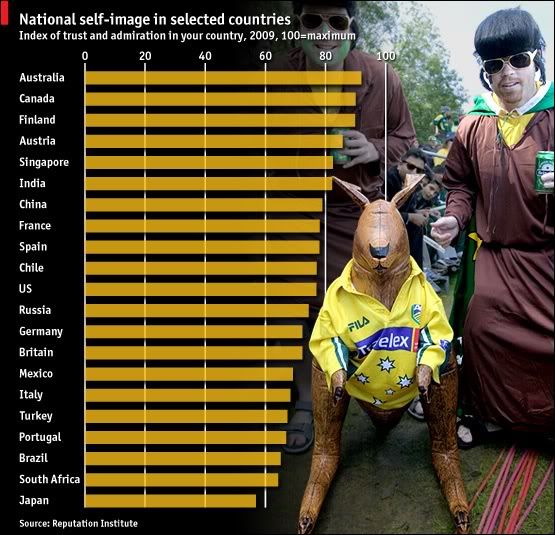
- This survey conducted by the Reputation Institute shows how cultural cringe among nations has changed in recent years; it appears now that Canadians and Australians lead the pack for those who have the most Patriotic Fervor for their country, while Americans (who are traditionally mocked for having "a flag on every building") are actually in the middle of the pack, near Russia in terms of national pride. Japan, it seems, is the country that now suffers most from the Cringe. Further details on the study can be found here.