
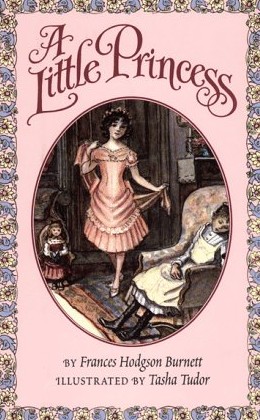
A 1905 novel by Frances Hodgson Burnett, author of Little Lord Fauntleroy and The Secret Garden. Also known as Sara Crewe and The Little Princess.
Sara Crewe, the daughter of a British Army officer, is refreshingly kind, generous and clever, despite her father's wealth buying her every luxury she could desire. She retains this attitude even when she is packed off to a boarding school for formal education. However, a couple of years later, word comes that a bad investment has bankrupted her father, who subsequently died of Brain Fever brought on by the shock.
Unable to pay for her education and having no known relatives, Sara has no choice but to accept a position as a servant at the boarding school. Despite these hardships, she continues to be kind and gracious, keeping her spirits up by believing that there is still magic in the world and things will get better.
It becomes more and more difficult for her to keep that attitude glued on as time passes, especially when she is denied food as a punishment. Sara is about to give into despair when warm clothes, bedding and food begin to appear out of nowhere in her attic room. Her father's associate, Mr. Thomas Carrisford, has been searching for her since Crewe's death. He'd sent the gifts not knowing Sara was "his" girl, just wanting to help someone in need. He gives her back her half of the "bad investment," which in the end turned out to be worth many times more than he and her father had anticipated, and takes her as his ward. Her fortune restored, Sara returns to her former social station, but she does not forget those who were kind to her when she was in need.
See here for derivative works.
Not in any way a Distaff Counterpart to The Little Prince, though there's a paper to be written on that topic. Please do not confuse with Alice Soft's Little Princess, or Tony Ross' Little Princess children books.
Compare the 1858 French novel Malheurs de Sophie with a similar Riches to Rags and Rags to Riches premise affecting a little girl from the aristocracy.
The original novel contains examples of the following tropes:
- #1 Dime: The sixpence Donald Carmichael gives Sara. Even when she's actually starving, Sara refuses to spend it, instead keeping it as a token to remember that someone was once kind to her.
- Adaptation Expansion: The novel originally began life as a novella called "Sara Crewe", that was serialized in St. Nicholas Magazine in 1888. But Burnett felt that the story was incomplete, so it was first expanded into a play, "A Little Un-fairy Princess", and finally into this version.
- An Aesop: The book was meant to be a critique of Britain's "welfare system", with the goal of making sure everyone has gainful employment. Boys get sent to the Navy and girls to domestic service. They are Made a Slave instead of becoming productive members of society.
- Alpha Bitch: Lavinia. She was the best-dressed girl at the seminary and the headmistress’s show pupil until Sara came and won everyone over with her fine dresses, heart of gold, exotic background, and money from her father that paid for special privileges. She slaps Lottie in the face for apparently no reason, and she takes delight in Sara’s downfall, even tattling on her and her friends when they sneak treats.
- Ambiguously Brown: Sara is described as having a "brown" hand and a "small, dark face". This implies that she could be mixed race. Alternately the Victorian standards of brown and dark could be referring to her just being tanned from growing up in India (it would be another few decades before tanned skin would become fashionable). Her mother is specifically described as having been French, so her complexion could also reflect Mediterranean heritage. What is even more possible, and even likely, is that Sara's father is a grandson of white Mughals, English officers with the East India Company who learned and spoke the languages, converted to Islam, married Mughal noblewomen and utterly assimilated into the Mughal culture of 18th-century India. Sara's great-grandmother could have been a Mughal princess.
- Amoral Attorney:
- Mr. Barrow, Captain Crewe's solicitor. He's the one who comes to the school to announce his client's death, and suggests making a servant of Sara to Miss Minchin (as an alternative to throwing her out on the street, which would be bad publicity for the school). Well, he does also suggest that Miss Minchin might do her the "favor" of keeping her on as a student... but his primary reason for having to say that is because he has cleaned out what remained of her father's money to pay off his own bills, leaving nothing for the child but a huge amount of debt.
- Averted with Mr. Carmichael, Carrisford's solicitor. He's introduced as the head of a loving family that Sara envies, and when his profession is revealed, it's in a conversation where he offers to travel to Moscow to follow a vague lead on Sara's whereabouts.
- Anonymous Benefactor: Mr. Carrisford watches over Sara without her realizing that it was the man next door to the school who was secretly delivering presents and gifts up to her room to keep her spirits up.
- Bad Bedroom, Bad Life: After becoming a servant, Sara sleeps in a poorly heated attic, but despite her poor circumstances she dreams of better things there. It's much more comfortable after "the magic" comes in and makes the room more livable, even for Becky.
- Beneath the Mask: After Sara's father dies, Miss Minchin reveals her bitchy, greedy self.
- A Birthday, Not a Break: The news that Captain Crewe died after having lost all his money arrives during Sara's birthday party. The first things Miss Minchin takes away are her birthday presents, as she had paid for them expecting to get the money back as part of her next payment for Sara's upkeep.
- Book Dumb: Ermengarde St. John, who has trouble with her lessons, particularly French.
- Book Smart: Sara impresses her teachers at her boarding school with her intelligence. Despite being seven years old, she spends much time reading books and can speak French fluently.
- Book Worm: Sara is an avid reader, even at age seven.
- Brain Fever: Captain Crewe's fate."He's dead, ma'am," Mr. Barrow answered with jerky brusqueness. "Died of jungle fever and business troubles combined. The jungle fever might not have killed him if he had not been driven mad by the business troubles, and the business troubles might not have put an end to him if the jungle fever had not assisted. Captain Crewe is dead!"
- Break the Cutie: The bulk of the story. Miss Minchin, the servants, and Lavinia deliberately try to break her further after she's ruined. The novel even points out that "her child heart might have been broken" had it not been for Ermengarde, Lottie and Becky.
- Class Princess: Sara is this when she first comes to school, until she’s demoted to a servant.
- Companion Cube: Emily. Although in one moment of despair Sara screams at Emily that she's "just a doll".
- Contrived Coincidence:
- Well, it is by a Victorian novelist: the old gent from India who moves in next door turns out to be looking for a particular young lady who is due to inherit a great deal of money. Since the 'Indian Gentleman' is not even sure which city, if not country the little girl was sent to school in (he sends his solicitor to Paris, then to Moscow, on the basis of vaguely similar names and backgrounds), it's somewhat serendipitous that he happens to move in next door from the right girl.
- Possibly the greatest moment of coincidence is not necessarily important to the plot: a hungry Sara comforts herself with a fantasy of finding a lost sixpence, taking it to a bakery, and eating six buns without stopping. "Then," says the narrator, "if you can believe it--" Sara glances down to see a lost fourpence, then looks up to find she is in front of a bakery, where she is sold six penny buns for fourpence. The only difference is that she doesn't end up eating all six.
- Cope by Pretending: After Sara becomes destitute, she tries to lose herself in fantasies of being a princess locked in the Bastille who will soon be freed, or who is living among the common people to learn about them, to distract herself from her suffering.
- Costume Porn: Some paragraphs in the book are spent describing Sara's beautiful clothes. Indeed, lengthy paragraphs are devoted to describing the wardrobes of Sara's dolls.
- Daddy's Girl: Sara and her father were very close, and her mother died when she was quite young.
- Darkest Hour: When Sara's attic party is caught and Sara is subjugated to another day without food, and Sara glumly tries to sleep to dream of something nice. This is right before the magic comes.
- Dean Bitterman: Miss Minchin.
- Death by Childbirth: Sara and Lottie's mothers died this way
- Denied Food as Punishment: And smacked around a little, too.
- Doting Parent: Sara's father.
- Dream Reality Check: After Sara sees the food, furniture, and fire left for her in the attic, she marvels that for a dream, everything feels real, and then puts her hands by a fire. She draws them away quickly, saying that a dream-fire wouldn't be so hot. In the next chapter she admits to pinching herself repeatedly and "just now I touched a hot coal, on purpose."
- Dying for Symbolism: The death of Sara's father, which results in her losing all her wealth and being reduced to working as a servant, also symbolises the end of her childhood, as she begins to grow up throughout the story.
- Earn Your Happy Ending: It's Sara's kindness in the worst possible circumstances that attracts the attention of her father's partner, lying sick in the house next door, and leads to their discovery of each other's identities.
- Enfant Terrible: Lottie, before she meets Sara.
- Escapism: Sara goes from being wealthy, well-respected, and popular to a scullery maid in a single day. She moves from the largest room in the school to the rat-infested attic. How does she deal? She pretends her doll is sentient and that she is a princess and must act accordingly. She continues to pretend and act as if she is a gentle and beautiful princess even as the antagonists treat her terribly.
- Everyone Has Standards: Lavinia's friend Jessie goes along with giggling at Sara's fallen status and ill-fitting clothes, but even she can't agree with Sara being outright starved.
- Evil Is Petty: Miss Minchin starts resenting Sara after the latter accidentally embarrasses the former in front of the class for a minor misunderstanding. Of course, when Sara loses her fortune, she wastes no time on mistreating the girl.
- Other characters that treat Sara coldly, such as the cook, don't seem to even have a motivation other than they resented Sara for her former wealth.
- Evil Orphanage Lady: Miss Minchin seems decent at first, but as soon as it is revealed that Sara is an orphan, she turns her into a scullery maid with hardly any pay and shuts her up into a tiny attic, separated from all the other girls except one servant.
- Extreme Doormat: Miss Minchin's sister is far kinder but is completely dominated by her until the end of the story when she finally speaks her mind.
- Fallen Princess: Sara. She pretends she really is a princess who's just fallen on hard times like in The French Revolution.
- Fat and Skinny: Sisters Miss Amelia and Miss Maria Minchin, respectively.
- A Foggy Day in London Town: "the yellow fog hung so thick and heavy in the streets of London that the lamps were lighted"
- Formerly Fat: A downplayed example, as Sara is hardly fat, but she is noted to be plump and fresh faced in a healthy manner befitting her Spoiled Sweet background. Once she is rendered destitute, however, Miss Minchin wastes no time in segregating her away from the other children and feeding her scraps. Sara grows frightfully thin, bordering on frail, but is still getting taller and has to dress in the few clothes that were left to her as long as she could get into them. When Ram Dass and Mr. Carrisford take pity on the child living in the attic and send her gifts of food and sweets, it's a good thing they also send her new clothes.
- Funetik Aksent: Becky and other Cockney characters.
- Gave Up Too Soon: Had Miss Minchin not given up on the hopes the late Ralph Crewe's investment would generate profits, she wouldn't have mistreated his daughter to the point the girl would gladly leave her boarding school as soon as she had a place to go.
- Girl Posse: Lavinia's small band of hangers-on.
- Greed: Miss Minchin's defining characteristic.
- Happily Adopted: In the end, when Thomas Carrisford reinstates Sara as an heiress, he effectively becomes her foster father, and the epilogue reveals that the urchin Sara saved from starvation is apprenticed to the baker.
- Have a Gay Old Time: The word "queer" is thrown around like a stuffed animal in the book, if only in the archaic sense. The girls also "ejaculate" a few times.
- The mention that Sara and her dad "were the dearest friends and lovers in the world" really sounds off to a modern reader.
- Heartwarming Orphan: Sara.
- Heroic BSoD: Sara during her most despairing moment is no longer able to pretend that Emily is anything other than a doll and knocks her on the floor. She pulls herself together though and says that Emily can no more help being a doll than Lavinia can help being horrid.
- Honorary Princess: Every girl is a princess, according to Sara. As for herself, she tries to have every day the good attitude of a princess, including during the period she fell on hard times — hence the title.
- Honorary Uncle: After Sara is taken in by Mr. Carrisford, she refers to him as "Uncle Tom", which he encourages.
- I Am Not Pretty: Sara says "I am one of the ugliest children you ever saw" and envies another child with dimples and golden curls (those being the high standards of Victorian beauty). The narrative assures us that she is too hard on her own appearance, and something about her inspires adults to attend to her.
- Impoverished Patrician: In spite of her poverty, Sara hangs on to her upper-class manners and education, as they're all she has left of her privileged former life. Good thing, too, as this makes her stick out in the memories of strangers as a serving girl who probably came from much, much better circumstances than her current one, which eventually, in a roundabout way, leads to her rescue.
- Innocent Beta Bitch: Lavinia is an Alpha Bitch who enjoys bullying Sara even after her father's death. Lavinia's best friend Jessie is less malicious, at one point she actually feels sorry for Sara, and reprimands Lavinia for tattling on her.
- Interclass Friendship: Sara Crewe is the pet student at a boarding school and quite well off. While there, she meets Becky, the scullery maid, and strikes up a friendship with her. Sara tells Becky stories just like the other girls and sneaks her food that she has bought, and Becky makes her a pincushion out of flannel as a present. When Sara loses her wealth, she and Becky become fellow sufferers under Ms. Minchin's rule. Then, when Sara is adopted at the end, she mentions Becky to her new father and takes her away from the boarding school to a much better life as her personal companion.
- Ironic Name: Lavinia the Alpha Bitch shares a name with the virtuous daughter of Titus Andronicus, who is a quintessential nice girl.
- Kids Are Cruel: Lavinia.
- Lampshade Hanging: Done with some of the story's more dramatic coincidences, including the news of Captain Crewe's ruin and death arriving immediately after Sara has a conversation about whether she'd be such a nice and happy person if she weren't so rich and the way Carrisford finally finds Sara.
- Lonely Doll Girl: Sara's doll Emily was bought by her father so she'd feel less lonely when he returned to India. She becomes one of Sara's few companions when Sara loses her fortune.
- Meaningful Name: Sara is Hebrew for "princess". In the book of Genesis, Sarah — wife of Abraham — gives birth to Isaac, and is promised that she will be a princess of many nations. Becky's name is a diminution of Rebecca, Isaac's wife (Sarah's daughter-in-law), and the mother of Jacob/Israel. Maria (Miss Minchin's first name) means "bitter". Amelia means "lovable" — and she is the nicer sister.
- Mistaken for Destitute: Little Donald Carmichael gives Sara a sixpence, thinking she is a beggar, but his sisters convince him she isn't, since she doesn't speak like someone from the streets and since she didn't react as a beggar would have. The Carmichael children end up nicknaming Sara "the-little-girl-who-is-not-a-beggar". Downplayed, since though Sara indeed isn't technically a beggar, she is utterly destitute and constantly hungry. In the ending, Mr. Carmichael outright says she would have been better off in the streets than at Miss Minchin's school.
- Neutral No Longer: Lavinia's empty-headed friend Jessie reprimands Lavinia for tattling on Sara and her friends for planning a midnight feast (after Sara has been deprived of food for a day) and later says Miss Minchin has no right to starve Sara.
- Never Got to Say Goodbye: Technically, Sara and Captain Crewe did say goodbye before she was left at the Seminary, but they made it brief because both would rather go their separate ways with dignity.
- Nice to the Waiter: One of Sara's defining traits. Even when she herself falls on hard times, she's still kind and generous to those even worse off.
- Older Than They Look: Becky is said to be 14 when she comes to the school to work, but is so stunted in growth from malnutrition and overwork, she looks much younger.
- Ojou: Sara before her father dies. Look at the title.
- Omniglot: Sara can speak fluently in English, French, and Hindustani. It's also mentioned in a passing comment she can at least read in German as well. Pretty impressive for a seven year old.
- One-Gender School: Miss Minchin's Select Seminary for Young Ladies.
- Orphan's Ordeal: Sara falls on hard times after the deaths of her parents, but wins friends and finds a new family.
- Parental Abandonment:
- Sara's mother died in childbirth, and her father when she's eleven.
- Lottie's father is said to be very "flighty" and to have left Lottie to others after his wife died, who also died in childbirth.
- Peer-Pressured Bully: Jessie occasionally feels sad for Sarah after the latter becomes Riches to Rags. The narration states that Jessie isn't wicked, just too weak-willed and easily influenced by the opinions of Alpha Bitch Lavinia.
- Pretty in Mink: A few furs are mentioned, like a doll with an ermine-lined cape, and the fur coat Sara wears at the end.
- Princess Classic: Or almost. In fact, Sara looks up to historical queens and princesses (notably Marie-Antoinette in one instance) as role models, which helps her control her temper on occasions.
- Princess in Rags: As a servant, Sara wears an old black velvet frock of hers, that is already too small for her when she puts it on. The book mentions a bonnet with ostrich plumes that also belonged to her, but becomes bedraggled from repeated errands in the rain.
- Princesses Prefer Pink: A significant scene in which Sara meets Becky is marked by Sara's carefully described rose-pink dancing costume, complete with rosy pink cheeks and a wreath of pink roses in her hair. Becky hammers the point home by comparing Sara to her memory of briefly glimpsing a real princess dressed all in pink.
- Promotion to Parent: Sara acts as a stand-in mother to Lottie.
- Rags to Riches: Inverted: The book and adaptations are frequently promoted as a "riches to rags" story. Though of course she becomes rich beyond her wildest imagination again when it turns out the diamond mines were real and her father's partner is still alive.
- "The Reason You Suck" Speech: Miss Minchin's well-meaning but cowed sister Amelia finally snaps at the end of the novel and thoroughly tells her off. Miss Minchin is shocked and intimidated, and Miss Amelia takes a greater role in running the school thereafter."And now you've lost her," she cried wildly; "and some other school will get her and her money; and if she were like any other child she'd tell how she's been treated, and all our pupils would be taken away and we should be ruined. And it serves us right; but it serves you right more than it does me, for you are a hard woman, Maria Minchin, you're a hard, selfish, worldly woman!"
- Rich Bitch: Lavinia Herbert, who was the richest girl in school before Sara turned up, and sees the younger girl as a threat to her social standing. She's unmerciful in her ridicule when Sara loses her fortune.
- Sadist Teacher: Miss Minchin, who has a nasty cruel streak and cares about nothing more than money. Her sister calls her out on it right at the end: "You're a hard, cruel, worldly woman."
- Said Bookism: There are some instances of words being "ejaculated" in the novel.
- Sitting on the Roof: One of the only things Sara likes about her Fallen Princess circumstances is that her attic room has a skylight, and she can stand up through it to people-watch and see the sunset. It's because the roofs are connected that she meets the Indian servant next door one day, which leads to her being discovered and rescued.
- Spoiled Brat: Lottie. Similar to Mary Lennox, she's pretty much been treated like a pet ever since she was born, with people giving her anything she wants to keep her quiet. At the age of four she is, as the narration describes her, "a very appalling little creature."
- Spoiled Sweet: Sara's a bit naive about the state of the world at first, but even before things get horribly awful she realizes that there are people less fortunate than she is and doesn't act like a Rich Bitch.
- Title Drop: Toward the end of the book, Miss Amelia has a bit of a breakdown:"[Sara] saw through us both. She saw that you were a hard-hearted, worldly woman, and that I was a weak fool, and that we were both of us vulgar and mean enough to grovel on our knees for her money, and behave ill to her because it was taken from her—though she behaved herself like a little princess even when she was a beggar. She did—she did—like a little princess!"
- Too Hungry to Be Polite: The street girl Sara gives five of her penny buns to tears ravenously into them, exclaiming only, "Oh my! Oh my!" She is starving, as Sara notes.
- Wealthy Ever After: Sara, after Mr Carrisford finds her and adopts her and the investment that her father had put into was actually worth much, much more than they thought.
- What Have I Become?: A rather mundane example. Sara's grim circumstances don't fully hit home until a child mistakes her for an actual beggar, at which point she realizes that she really is one step above a beggar.
- You Dirty Rat!: Subverted with the rat in Sara's attic room whom she befriends and names "Melchisedec," after an Old Testament king. She comments on how hard it must be to an animal that everyone treats with fear and disgust when it is just trying to feed itself and its family. Melchy also gets a What Happened to the Mouse? since it's not revealed how he fares after Sara and her crumbs move out of the attic.note
- Younger Than They Look: Mr. Carrisford is described as looking quite haggard, as well as most illustrations showing him with gray hair, despite the fact he is roughly around the same age as Sara's father. The narrative all but states he survived the Brain Fever theat his friend did not.
Adaptations with their own trope pages include:
- A Little Lily Princess
- Princess Sarah
- Str.A.In.: Strategic Armored Infantry (although that one is a very loose adaptation with elements from Burnett's other works)
- Shōkōjo Seira
- The Little Princess (1939)
- A Little Princess (1995)
The 1986 WonderWorks mini-series provides examples of:
- Adaptation Expansion: Several incidents only mentioned in passing in the book are given full scenes and the series adds a minor subplot about a statue of Kali that Captain Crewe owned.
- Adapted Out: Several of the Carmichael children, including all the boys besides Donald.
- Beta Bitch: Jessie is more willing to be antagonistic for Alpha Bitch Lavinia, but begins to question it after Lavinia tells Miss Minchin about Ermengarde's hamper of food.
- Big "SHUT UP!": Ermengarde gives one to Lavinia when she tells Sara that skivvies don't belong in school.
- Chekhov's Gunman: Carrisford appears in the first scene of the series.
- Dies Differently in Adaptation: Captain Crewe, instead of dying of now-disproven brain fever, catches pneumonia on his way back to India.
- Even Evil Has Loved Ones: After her sister Amelia leaves after her "The Reason You Suck" Speech, Miss Minchin is briefly seen holding back tears.
- Have a Gay Old Time: Several characters, including the cook and Miss Minchin call Becky a slut at multiple points. During the time period, "slut" was another word for a drudge.
- Kick the Dog:
- The cook wastes no time mistreating Sara, rubbing in her former status frequently and denying her dinner after Sara fails to obtain parsley.
- Lavinia as well, from saying she knew Sara was always just a servant to jerking her arm to make it look like Sara deliberately spilled food on her.
- Pet the Dog: Miss Amelia defends Becky when Miss Minchin accuses her of stealing food and convinces her to drop the accusation. Before that, she also attempted to convince her sister to give Sara something for Christmas, though that fails.
- Miss Minchin gives a very brief one to Sara when Erminegarde gives her a Christmas present, telling her to open it downstairs instead of taking it away from her.
- Screw This, I'm Outta Here: Miss Amelia after she gives "The Reason You Suck" Speech to her sister.
- Servile Snarker: Ram Dass acts this way towards Carrisford.
- Spirited Young Lady: Sara is a bit more assertive in this adaptation, more prone to talking back while still being dignified.
- Truer to the Text: This version leaves almost nothing from the book out and changes very little.
The 1996 animated film contains examples of:
- Death by Adaptation: When Sara's father is revealed to be alive, it's explained that his business partner died and was mistaken for him.
- Easily Forgiven: Miss Minchin no longer owns the seminary but she's still allowed to teach there, in spite of how she treated the new owner's daughter.
- Spared by the Adaptation: Sara's father.
