
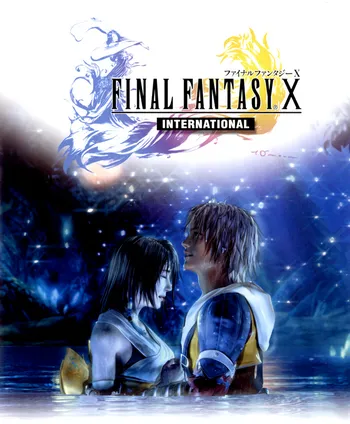
The tenth game in the mind-crunchingly popular Final Fantasy series.Final Fantasy X was the franchise's first foray on the PlayStation 2, with suitably eye-popping graphics and a story which holds its own in a game franchise loaded with great stories. Most notable for being the first fully-voiced Final Fantasy entry (and it shows), and for garnering then-obscure VA James Arnold Taylor some attention.The plot opens with a Fake Out Opening to the futuristic aesthetic of previous Final Fantasy games. Kid Hero, sports star, and raging egotist Tidus prepares for a game of blitzball — a combination of rugby and water polo — which is very popular in the sprawling Mega City of Zanarkand. No sooner has the bell rung than a mysterious Ronin-in-Red appears, and with him, a giant sphere of watery doom which engulfs the city, reducing it to so much neon kindling. With the help of the samurai, Tidus is pulled through a portal just in the nick of time, reawakening in the pre-industrial, flooded world of Spira. According to the locals, his home city of Zanarkand does exist in Spira, but as ruins: it was destroyed one thousand years previously.Tidus soon learns of an aquatic monster called Sin which terrorizes Spira, keeping its population stuck in the dark ages. There is no explanation for Sin's wrath, nor any meaningful mode of defense, leading people to regard it as some form of divine punishment. There exists a ritual which temporarily makes Sin go dormant, but it involves a pilgrimage to the opposite end of the globe, ending at the foot of Zanarkand. Only a Summoner can undertake this journey, but they are traditionally pacifist monks, requiring battle-ready "Guardians" to clear a path for them. With nowhere to go, Tidus volunteers to be Guardian for a prospective Summoner, Yuna, in hopes of finding a way back to his own time. Over the course of the tale, Tidus uncovers strange connections between his own past and Yuna's family; it seems his own father, who supposedly drowned at sea when Tidus was just a child, was also transported to Spira, where he served as Guardian to Yuna's father on his own pilgrimage.Unfortunately for Tidus, he's new to this Guardian game, and ignorant of Spira's history and customs. Luckily, Yuna is accompanied by additional Guardians to bail him out:
Wakka, a blitzball fanatic with a surfer Pidgin accent and a gravity-defying hairstyle which would make Guile from Street Fighter jealous. He befriends Tidus when he washes ashore, and pulls strings to get him recruited as Guardian.
Lulu, a goth-dressing Lady of Black Magic with a penchant for stuffed animals and a copious amount of cle— uh,belts. She has little patience for tourists on this journey, and acts as overprotective mom to Yuna.
Kimahri Ronso, Cat FolkProud Warrior Race Guy who communicates primarily in glowers. He is the oldest of Yuna's guardians, having bonded with her when she was little.
Auron, the wry samurai responsible for Tidus' predicament. Although Tidus knew him as a crazy old man on the streets of Zanarkand, he claims to also be a resident of Spira. As it happens, he's also a legendary guardian, the equivalent of Michael Jordan playing for the Cavaliers. He serves as the game's Obi-Wan.
Rikku, a member of the anti-puritan Al Bhed race who have embraced machinery. This violates the tenets of Spira's religion, which holds that Sin was punishment for man's abuse of technology.
Seymour Guado, a half-human member of the mysterious Guado race, famed for their long robes and their Picasso-esque hairstyles. He is also the son of their deceased leader, and would like to assure everyone that he is a kind public servant who wishes nothing but good upon the peoples of Spira. And that he will not, repeat, NOT be attempting todestroy the world later in an orgy of megalomaniacal nihilism like in every previous game. Really. Also, the fact that his unique summon looks like the Devil in a gimp suit is purely coincidental.
Cid, Rikku's father, and leader of the Al Bhed. The game's obligatory curmudgeonly airship lieutenant.
The enemies faced by Tidus and our heroes include a Corrupt Church, a Nietzsche Wannabe, and a not-so-Sealed Evil in a Can with an insidious way of perpetuating itself. Along with Final Fantasy VI and VIII, it's thought to have one of the best plots in the entire game series, if somewhat more linear gameplay than its predecessors and having some questionable voice acting. (And is a worthy introduction of the franchise onto the PS2 console.) It also departed from the ATB battle systems for a simple turn-based system that showed the queue of upcoming character and enemy turns, giving players as much time as they want to ponder their next action mid-battle. It was successful enough to go against form and inspire a true sequel, Final Fantasy X 2, which takes place two years after FFX and stars two of the three main female characters from that game.Notable for having roughly the same plot as an earlier Squaresoft title, Bahamut Lagoon, which was lampshaded with FFX-2's airship, named Celsius — the airship in Bahamut Lagoon is called Fahrenheit.note The airship of FFX is named Fahrenheit, though this is never explicitly stated in either game.Music was composed by Masashi Hamauzu, Nobuo Uematsu, and Junya Nakano, with arrangements from Shiro Hamaguchi and Hirosato Noda.On September 13th, 2011, Square Enix announced an HD Port of the game for the Playstation 3 and Vita. The game will be using character models made from scratch instead of simply upscaling the old ones. It was later announced that the PS3 version would include the sequel, (The vita versions must be purchased separately) and that both games will be based on their "International" versions. It is stated by Square to be released in 2013, both in Japan and outside of Japan aswell.
This game contains examples of:
Abusive Parents: Jecht, of the emotional abuse type. Tidus spends most of the game hating him, which is probably why Jecht — as Sin — chooses Tidus to be the one to ultimately kill him.
Action Commands: Lulu's "Fury" Overdrive requires the player to rotate the right analog stick as fast as possible. Auron's "Bushido" techniques are activated via button combos, similar to the skills used by Sabin (FFVI) and Zell (FFVIII). Tidus' (timed button press) and Wakka's (slot machine reels) Overdrives also use action commands.
Action Girl: Lulu and Rikku, as well as Yuna in X-2.
Adrenaline Makeover: Yuna toughens up considerably after discovering the truth about Yevon. Meeting Tidus helps, too.
Affably Evil: Seymour and, to some extent, the other Maesters (except Kelk, who seems to be genuinely good).
A Friend in Need: The whole party of guardians fight to rescue Yuna from her wedding to Seymour, despite effectively declaring war on the Yevon church.
Alas, Poor Villain: Kinoc. He's not an especially likable character, but he was backstabbed by his own partner. In fairness, he really should have seen it coming. On the other hand, someone will miss him.
Arc Words: "This is my story," and variations thereof.
Arranged Marriage: Auron turned one down sometime before Braska's pilgrimage. In a way, Seymour and Yuna's too, although it was arranged by the former party.
Assimilation Plot: Seymour wants to kill everyone in Spira to give them the peace of death. Note that he wanted to do this both before and after himself dying.
Awful Truth: In order to defeat Sin, summoners and one of their guardians must sacrifice their lives. The Final Aeon is made from someone with a bond with the summoner, and calling it up kills the summoner as well. Their sacrifices are ultimately futile, because Yu Yevon will possess the summoner's Final Aeon and then go into hibernation for a few years.
Auron also presents one to Tidus when he tells him that Sin is Jecht.
Badass Creed: Tidus is obliged to change the Auroch's motto, the appalling TO DO OUR BEST!, to a call for unequivocal victory.
Bad Bad Acting: In-universe in the infamous laughing scene, done by Tidus and Yuna. That scene was a game made by Tidus as a way to relieve stress for the road ahead, and at first both force themselves to laugh, before really laughing about how ridiculous it sounded. However, this was beforeTidus realized that Yuna had to sacrifice herself in order to defeat Yu Yevon, so this makes the scene Harsher in Hindsight. Many people take this as Bad Bad Acting out of universe.
Bag of Spilling: In X-2 in the traditional sense for Yuna and Rikku. In the first game, before "Tidus' Story" starts, Auron had completed the pilgrimage once, and Lulu has made it to the Calm Lands, and none of them have the gear or abilities to show for it.
You could argue that since Auron is dead, his unsent spirit would be significantly less badass than his full self at the point he died, and without any items. Who knows what Yunalesca did to him, anyway? Lulu doesn't Hand Wave away so easily, though. Although the fact she failed in her quest and Ginnem died might mean she didn't learn much on that pilgrimage.
Auron also mentions in the beginning of a battle that there wasn't as many fiends in his time. Could be that he just didn't get as much battle time in his first pilgrimage with Braska and Jecht.
Barred From The Afterlife: Souls must receive a sending ritual from a summoner in order to reach the Farplane. Souls that don't get this ritual become Unsent (sentient undead) if they're lucky, otherwise, their jealousy towards living beings warps them into Fiends. This leads to some Fridge Horror: At the end of the game, there's no more summoners, since the Big Bad was powering them. The sequel reveals Fiends are still appearing, but no one is sure why. Someone's going to connect the dots and have a Heroic BSOD at some point...
Unsents are allowed to voluntarily go to the Farplane at any time (Mika does this after you tell him you defeated Yunalesca), but most don't choose to do so, and once the transformation to fiend is complete, there is little sentient being left to make that choice.
Begone Bribe: A learnable skill, which becomes rather useful due to the rare items some enemies leave behind them after using it. This even applies to some bosses.
BFS: Both Tidus and Auron wield these. So does Jecht, especially as the penultimate boss, "the Final Aeon". That same sword is later used as the platform where the party stands in the Amazing Technicolor Battlefield against Yu Yevon.
BGM Override: The trek down to Zanarkand is the most notable (and serves as the page quote for the trope), but the game does this for some other sequences as well, with a new spin on it due to the smooth transition from overworld to battles used in some places.
Arguably Cid, since he is the leader of the Al Bhed and the captain of the airship. You don't meet him and ally with him until about halfway through the game, though.
Auron may qualify as well, as he is the one constantly demanding Yuna continue her pilgrimage, even when other members of the cast are willing to let her give up or actively encouraging it. Auron won't let that happen, because he wants Yuna to be the summoner to break the cycle. He's also Braska's legendary guardian and one of the most famous people in Spira.
Bilingual Bonus: The apparently-gibberish Hymn of the Fayth, if written down and then read in a certain manner, becomes a Japanese prayer to Yevon.
Bittersweet Ending: Yu Yevon is defeated and Spira is finally freed from the eternal terror of Sin. However, doing so costs Tidus his life, leaving Yuna to go on through life without him. Her last words to him: "I love you." However, it is hinted that there's a chance for Tidus to return. In the sequel, he does if the player makes the right choices.
Black and White Morality: Slightly lost in the translation, but the Japanese kana for "Yevon" and "Al Bhed" can be read as "Ebon" and "Albedo"... "black" and "white". Now think about what those groups represent in-game, and...yeah.
Blatant Lies: The heads of the Church of Yevon know everything about the origins and purpose of Sin, yet they choose to maintain the population in ignorance with a false creed. They also use forbidden machina in their temples while excommunicating everyone else who makes use of them.
Bold Inflation: Yuna is guilty of this, though this is at least partially a problem with actress Hedy Burress's performance. This trait was not present in the sequel, where many people noted said actress' performance had gotten significantly better. Word Of God is that Hedy Burress tried to lip-sync with the digital representation of the character. As the former was speaking English, and the latter was lip-syncing Japanese, it made for some odd inflections. The sequel, X-2, had more effort put into the localization, syncing the character with the voice actor, rather than the voice actor syncing with the character.
62 of them, by the loosest definition: Lord Ochu, Belgemine's Ifrit on Mi'ihen Highroad, her Ixion on the Moonflow, her Shiva in the Calm Lands, her 8 Aeons at Remiem Temple, Ginnem's Yojimbo, Geosgaeno, Ultima and Omega Weapons, the 35!! monster arena creations, the 10 Dark Aeons (you can fight the Dark Magus Sisters separately, thus making them truly three separate bosses), and Penance—the last 11 are absent in the original version, though.
The beginning of the game has Tidus washing up in Besaid. The Golden Ending of X-2has Tidus, revived, washing up in Besaid.
In addition, Tidus begins his narration of the story in the ruins of Zanarkand, and in the perfect ending of X-2, Tidus and Yuna return to the ruins for the end of their story.
Thirdly, after being sucked out of Zanarkand, Tidus awakens in a zero-gravity void above a ruined stadium. This is the heart of Sin, where Jecht resides. It will take Tidus the entire game to get back here.
Booze Flamethrower: Auron does a variant for Tornado, one of his Overdrives. He creates a huge whirlwind, then throws his bottle of sake into it, and the whole thing bursts into flame. Through friction, maybe?
Breakout Character: Auron is badass. You may notice it reading this page. Jecht gets much love too.
Calling the Old Man Out: This ends up being the central plot point of the whole game. In fact, it's implied that the whole reason Tidus was even brought to Spira was so he could save the world by doing this. It's also subverted; by the time you can do it, Tidus forgives him and Jecht is apologizing for being such a crappy father.
Cat Folk: The Ronso are a race of muscular, anthropomorphic blue feline humanoids from the world of Spira. The Ronso tribe lives at the base of Mt. Gagazet and guards the sacred mountain fiercely. They are formidable warriors, well known for their strong sense of honor and loyalty, as well as their pride and quickness to anger.
Cathartic Scream: Early in the game, Tidus states that he just wants to scream. And he does so, right in the middle of the Killika Temple.
Later, in Luca, Yuna asks him if he wants to scream again. Tidus states that it's really not going to help this time.
Charles Atlas Superpower: Every single blitzball player can participate in strenuous underwater activity for long stretches of time without coming up for breath. The masters of this can even sleep underwater. Rikku and the other Al Bhed working on the salvage ship can do this too.
Chekhov's Gun: The airship Tidus finds together with Al Bhed very early in the game is much later used to escape from besieged Home.
Chekhov's Skill: Tidus, Wakka, and Rikku all demonstrate the ability to swim at the outset. This becomes essential once the pace of the game picks up.
Climax Boss: Yunalesca. The fight is fairly challenging and is preceded by a long, epic cutscene complete with a major plot twist.
Convenient Terminal Illness: Seymour's mother is hinted to have had one, part of her reason for so readily agreeing to forsake her humanity and become her son's Aeon.
Crystal Spires and Togas: Spira is a tropical themed version of this, with most of the "crystal spires" being the remnants of a lost civilization, though.
Cutscene Incompetence (also an example of Stupid Surrender): The party is unable to actually stop Yuna's wedding, since some guards are pointing guns at them. However, in regular battle, guards of the very same type with the very same guns aren't any more threatening than regular fiends.
Possibly Fridge Brilliance, the real problem was not the guards but what they represented.
Dead All Along: Since the nature of pyreflies and passing over allows any soul with a strong enough will to stay "alive" past their death so long as they are not sent to the Farplane by a summoner, there's quite a few of these that turn up over time in the game's plot. The most prominent secret Unsent is Auron, who died after the previous pilgrimage he undertook with Braska and Jecht, but his spirit is so unsatisfied he's sticking around to make sure things get done right this time. A rather important scene reveals that Grand Maester Mika is also unsent, though the leaders of the Church of Yevon kept this a secret. Furthermore, there's the minor character of Belgemine, who trains Yuna randomly throughout the game by offering to fight her in summon combat. Eventually, she reveals herself to be an Unsent.Final Fantasy X 2 reveals that Maechen is also an example of this.
Death By Pragmatism: The Al Bhed at Operation Mi'ihen. Full-on frontal assaults against Sin don't work unless you're the designated heroes. This is revealed to be a plot by the Yevon clergy in order to solidify their (and Sin's) dominion over Spira. They let the Al Bhed and the Crusaders believe they stood a chance so that, when Sin destroyed them, they could point to them as heretics who got what was coming to them. Of course, Cid's assault on Sin using the airship proves that machina could have damaged Sin, at least up to a point, and this is what the Church was trying to hide.
In the ending, played straight with Tidus disappearing and going to the Farplane.
Averted in the sequel.
Did You Just Punch Out Cthulhu?: Yunalesca, and to a more evident extent, Sin, who is shot down out of the sky by an airship after having both its arms disintegrated in plain view of the whole damn world.
Difficulty Spike: The game takes a sudden jump up when you hit Macalania Woods and doesn't let up until you get the airship.
The game too, considering that most of the games before weren't as difficult.
Distressed Damsel: Subverted. Yuna is kidnapped by the Al Bhed, and when the party arrives to rescue her, she's already kicked some ass and is about to leave.
The Dragon: Jecht as Sin is this to the true Big Bad, Yu Yevon. But defeating Jecht is the emotional climax of the story, not to mention that whole Anti-Climax Boss thing...
Another example occurs when Wakka, trying to cheer Rikku up, makes a rather tasteless joke as the Al Bhed prepare to destroy Home. Rikku quite rightly chews him out for it, and if you speak to Wakka afterward, he admits that he really ought to have "kept his big mouth shut."
Eldritch Abomination: Sin is a giant aquatic beast that cannot be harmed by anything except OTHER Eldritch Abominations. Even then, its core (Yu Yevon) will just possess the Aeon that killed Sin and grow into a new Sin within years. Some of the regular Aeons qualify as well. Anima might be terrifying when you see her face, but it's nothing compared to her full body. The fact that her power is based on pain itself doesn't help.
Elemental Tiers: The various elemental type enemies are encountered one by one as you advance through the game. The one you meet in a recent area will be stronger than the one you previously meet. Ditto for the various elemental Flans. The trend continues with Final Fantasy X 2, although the order of strength have been juggled around.
Eleventh Hour Superpower: Almost. During the last battles, the Fayth give the team one last present — permanent Auto-Life, replete with a special animation.
Empathic Environment: Once you cross over the northern slopes of Mt. Gagazet, sunset begins, which becomes fully night once the party enters the Zanarkand Ruins, where Yuna is expected to trade her life away to defeat Sin. Once you defeat Yunalesca and save not only Yuna's life, but the lives of all summoners after her, dawn finally breaks.
Evil Plan: Three, and all they wrap around each other:
The Church of Yevon strive to keep everyone in the dark about the world's past in order to stay in charge and prevent another war.
Seymour, a maester of Yevon, manipulates this system in hopes of destroying it. To this end, he forces Yuna to marry him and tries to kill her guardians. He wants to become Sin so he can mercy-kill all of Spira.
Yu Yevon, the guy behind everything, gave up his humanity to give his doomed people a chance to live on in dreams and to protect that dream. By the time the game takes place, he's lost sentience and acts on little more than programmed instinct. It's likely he'd be horrified by what he's become.
Eviler than Thou: You might think you're on a quest to defeat the ancient force of destruction known as Sin, but by the end of the game, you'd almost think the real Big Bad was Seymour.
Exposed to the Elements: Everyone, except maybe Auron in his Badass Longcoat, has this to a certain extent. Kimahri in particular wears little more than a loincloth, but he at least has fur. Auron is a bit of an inversion: His full clothing and longcoat is well suited to Mt. Gagazet and Macalania, but is less suitable for the tropical islands that make up most of the world. Not to mention Lulu's dress, which with the long sleeves and fur collar, looks way too warm for someone who lives on a tropical island.
Exposition Fairy: If you ask him, the scholarly Maechen will fill you in on whatever region of Spira you happen to reach on the pilgrimage.
Eye Scream: Poor Auron. To be specific, he was casually blasted in the face/eye when he confronted Yunalesca as he was trying to avenge Braska's and Jecht's deaths.
Fan Disservice: Yunalesca starts off in her oh-so-revealing metal bikini, then you have her subsequent forms, which are anything but fanservice material.
Fanservice: All over the place. If we listed examples, it'd be half the page. The other half would just be the words "Auron" and "Badass".
At least one reviewer has commented on there being no shortage of alcohol in Japan, as they don't share the west's taboos surrounding it. Couple that with Jecht's parenting style, and Tidus' lousy home life is reflective of rigid Japanese dads.
Blitzball and bikinis notwithstanding, Spira is essentially Dark Age Europe. The people are preoccupied with death, setting the stage for a theocracy which controls everyone's lives. In turn, Yevon suppresses learning and enforces its dogmas to maintain the status quo. (Although the suppression of learning is more Hollywood History.)
The desert-based Al Bhed are analogous to the Saracens, who opposed Christian Europe.
Fantastic Racism: The treatment of the Al Bhed. The Guado also used to suffer it before embracing Yevon and returned the favor, too, which is why Seymour had a pretty unhappy childhood. And they earn it in the future from the Al Bhed and Ronso after their atrocities against them in the game.
Fear of Thunder: Rikku is terrified of thunder and lightning ever since a misaimed lightning spell hit her as a child. This is Played for Laughs. It's interesting to note that this is an example of averted Gameplay and Story Segregation, seeing as after this revelation, Rikku will scream in panic every time she's hit by a Thunder spell.
At the same time, Gameplay and Story Segregation is also played straight with this trope example. With the way the Sphere Grid works, it allows players to learn abilities from other characters, so there is nothing stopping Rikku, who is deathly afraid of thunder, from learning Thunder spells.
Actually, as part of the above-mentioned dialogue, Lulu suggests that Rikku learn some magic to help her control her fear. The easiest path out of Rikku's sphere grid is straight into Lulu's. In this case, gameplay and story are in sync.
Feather Motif: Yuna's wedding dress contains a double dose of feather symbolism—first of her role as The Messiah (and thus divine/angelic), and second as a symbol of freedom and flight. Immediately after the ceremony, she quite literally flies away on Valefor.
Fighting From The Inside: While fighting Braska's Final Aeon, Jecht does this if you attempt to talk to him using Tidus. After a couple of times, it stops working.
Five-Man Band: Yuna and her original four guardians.
The Leader: Yuna. It's her pilgrimage. Everyone else follows her.
The Lancer: Tidus contrasts Yuna. See The Hero for more details. Wakka filled this role before Tidus showed up, complete with boisterous and fiery personality but more of a Big Brother Instinct.
The Smart Girl: Lulu. An expert in magic and with the experience of her past pilgrimage.
The Sixth Ranger: Both Auron and Rikku, who joined after the quest is well underway.
Five Races: Humans as the Mundane, Ronso as the Stout, Guado as the Fairy, Al Bhed as the High Men (they represent what Humans really are, when the roots of the Yevon religion are revealed), and the Hypello fill the role of the Cute. All except the Hypello have some significance to the plot.
Fixed Camera: Sometimes, the game's camera can create issues when it changes perspective as you round corners. The developers were smart enough to keep your axis of motion unchanged, though, if you keep holding down the joystick in the same direction, so that suddenly turning a corner doesn't steer you into a wall.
Foot Focus: Yuna walking barefoot on the water to perform the Sending.
In the prologue, Sin's gravity magic has an odd effect on Zanarkand, causing the towers to bend into weird shapes. We later learn that this Zanarkand is an illusory bubble, and that Sin was pressing in on the outside.
When Seymour notes that Auron "has the scent of the Farplane" about him. There's a good reason for that...
Tidus' narration drops hints several times about The Reveal surrounding everyone's odd emotional reactions to the things he says.
Four is Death: There are four Maesters; the fourth one, Seymour, is one of the game's primary antagonists, and you have to kill him four times before he stays dead.
Five Temperament Ensemble: The initial Guardians. Auron and Rikku mix different temperaments together.
Tidus: Sanguine
Lulu: Phlegmatic
Wakka: Choleric
Yuna: Melanchoic
Kimahri: Leukine
"Funny Aneurysm" Moment: invoked After Tidus learns that Yuna's pilgrimage will end with her sacrifice, he reacts accordingly when he recalls certain events from earlier in their travels. Especially remembering how Yuna acted when leaving Besaid.
Possibly the most glaring example would be Blitzball. In cutscenes, Blitzball promises a fast-paced, impossibly cool game of 3D soccer. In actual play, it's a plodding, 2D, hybrid action/tactical RPG. Also, you can somehow play the game at any save sphere, and there's no explanation of just how or where you are actually doing this. There is a bit of an aversion with this, though, in that in certain instances where the party is isolated or chased, the blitzball option becomes unavailable.
On that note, the Blitzball teams in general. The Luca Goers are shown in-universe as being a star team of elites, but in reality they are only a little better statwise than you in their story match (with Tidus equaling them). The Al Bhed Psyches on the other hand you beat in the first round in a cutscenes, and most players know that the Psyches are easily the best team in the game, with each member having ridiculously high stats in specific fields.
There's also a fascinating subversion involving the save spheres in that non-player characters can actually be seen using them, something that is never seen in any other installment of the franchise. If the player buys items from O'aka at Macalania Temple just before being chased by the Guado, then he will give a wave good-bye and then use the area save sphere to teleport away. Later, Braska can be seen in a flashback making use of a save sphere just before he, Auron, and Jecht enter the Zanarkand Cloister of Trials, apparently to restore HP and MP. Finally, if the player takes part in the ten cactuars sidequest in the Bikanel Desert, one of the cactuars will use a save sphere to teleport to the Fahrenheit.
Generation Xerox: Deliberately invoked. Auron leads Tidus and Yuna down the same journey he took with their fathers in the hopes of seeing it turn out differently.
Global Airship: Because of the game's lack of a world map, this is the only way to backtrack unless you want to do it all on foot.
Goggles Do Nothing: Most Al Bhed wear goggles or sunglasses at all times, presumably to hide their spiral green eyes.
Gratuitous German: Maester is the about closest you get to get the right pronunciation of Meister, which is German for "master". It's actually pronounced correctly in the Japanese version.
Gratuitous Spanish: In the Cactuar minigame, when you manage to beat a Cactuar, you get a sphere with the name of the Cactuar. Fail three times, however, and you get an item called "Sphere del Perdedor", which is Spanish for "Sphere of the Loser".
Guide Dang It: The only hint as to the location of Anima's Fayth is NPC chatter in Al Bhed and a hint from a few Guado in Guadosalam. And you still have to figure out how to get to Baaj Temple even once you've worked out that there's a Fayth there.
Hell, the whole Bevelle Cloister of Trials in general. It's nearly impossible to do without looking it up in a guide.
Same thing goes for one third of Tidus's Infinity+1 Sword. If you failed to pick it up straight after you defeat Yunalesca, then you'll find Bonus BossDark Bahumut there to kick your ass when you retrace your steps in the International/PAL version. Same with Dark Valefor if you missed getting Valefor's second overdrive in Besaid at the beginning.
Many of the Celestial weapons require you to find treasure chests in totally obscure/not visible places, while others require you to beat various mini-games and hidden bosses. Most of the mini-games are plainly obvious to find, but Kimahri's Spirit Lance requires you to pray to three random Qactuar stones in the Thunder Plains with the square button*
a book on the counter of Rin's Travel Agency hints at this
—which is only used on the overhead map to recruit blitzball players—and then follow an almost invisible ghost around. Oh, and the ghost doesn't appear on the north side of the plains where the majority of the stones are.
Hello, Insert Name Here: Subverted. Because the game is almost entirely voiced, Tidus is addressed directly with variations of 'you' and 'newbie' or 'new guy'. When being spoken about, Tidus is replaced with pronouns and sometimes in the sequel as 'You-know-who'.
The Heretic: Upon learning the truth about Sin's origin, Yuna rejects the teachings of Yevon to pursue the monster to destruction, upturning 1000 years of tradition. Earlier, she was branded one for resisting Seymour. Careful what you wish for, Church of Yevon.
The Hero: An odd example based on perspective. In-universe, Yuna is the one expected to save the day, and the plot hinges on her journey and decisions, but Tidus is The Protagonist and performs his own heroics. At the end of the game, it's revealed that the Fayth intended Tidus, not Yuna, to be the one to defeat Sin, so he ultimately ends up as The Hero.
Tidus' reaction to the fact that he was encouraging Yuna to die was (understandably) angsty, to say the least.
Gatta can suffer one post-Operation Mi'ihen, depending on what you say to him beforehand, when you meet him off to the side of Djose Temple after discovering his mentor's body torn in half by Sin's attack.
An especially noble case, where Tidus destroys Yu Yevon to give the Fayth and Spira peace at last, despite being told—and having a long time to consider—that doing so will end his life.
All the summoners know that their pilgrimage will end in their death if they succeed. However, this is more an example of a Senseless Sacrifice, given the truth about Sin and the Final Summoning.
The same goes with Auron, although for him it's also a bit of a relief. In his case, it's an inversion: the sacrifice was not dying, but instead choosing to force himself to tread on to get revenge for his friends, watch after their kids, and bring peace to Spira. It was only after all of this that he allowed himself his final repose.
There is also the You Shall Not Pass incident described in detail in that article. The fact that they subverted it doesn't make it any less heroic. It just makes it less of a sacrifice.
Hey You: Tidus is never referred to by name, and in at least one instance is actually addressed "Hey, you." This is due to the fact that his name is chosen by the player.
How We Got Here: The game opening has all of the main heroes assembled around a campfire, preparing to enter Zanarkand. A short narrative voiceover later, and the player is zipped back to the past to see how the whole thing got started. In fact, pretty much the first two-thirds of the game is one massive flashback.
Hufflepuff House: The Crusaders. They stick around in X-2, rechristening themselves as the Youth League.
"I Know You're in There Somewhere" Fight: While fighting against Braska's Final Aeon, Tidus gains a "Talk" command that attempts to reach Jecht and resets the monster's Overdrive gauge. It stops working the third time you use it.
Impossibly Cool Clothes: One look at all the failed cosplays inspired by this game will tell you how hard this clothing is to reproduce. It's worth noting that Lulu is absent from many of the game's CGI movies, unless it's from the waist up. Her skirt is simply too abstract to hold up under dynamic camera angles or movements.
Improvised Zipline: The ship fires massive anchor cables into the building the characters need to get to, but since it's under fire, it can't stay long, so the party surfs down the cables onto the building.
Infinity–1 Sword: When visiting the Farplane for the first time, Tidus' sword Brotherhood gains buffs that make it the strongest weapon he'll be able to acquire until a good while later in the game.
It's also a hint from the game that you should use it, since the next area is almost all thunder-type enemies, and the Brotherhood just gained Waterstrike.
Infinity+1 Sword: The Celestial weapons, once upgraded, are extremely powerful. However, the player may resort to creating even better customized weapons for some of the toughest bonus bosses.
Instant Runes: And how. Runes are placed throughout the game, many times for no reason other than to accent beautiful backgrounds. The prime example of this are the summoning circles that appear for each aeon. They play no role in the game other than for accents, leading a lot of fans to wonder what they mean and leaving them with the desire for full, detailed versions of the circles to be released.
Just Whistle: Tidus teaches Yuna to whistle in Luca, promising that if she ever does so, he will come running. One of the last scenes of the game is Yuna standing on a pier, whistling for him.
Kid with the Leash: Although a bit older than most, the summoning animations put a lot of emphasis on Yuna's role as this, often with her stroking or petting the monstrous Aeon before sending it into battle. The animation for Ixion has her literally using a bolt of lightning as a leash to pull Ixion out of a portal, and she hugs Valefor lovingly around the neck and pets her beak before sending her into battle. Some of the Aeons subvert this — Bahamut is so badass that he doesn't need to be petted (instead only forcing Yuna to stumble as he lands on the ground), and Anima's emergence cuts to Yuna with a "Did I really want to to do this?" look on her face. In Yojimbo's case, she's more the "Kid with the Wallet."
Knight Templar: Maester Mika seems to carry out this trope. At a couple of different points, Auron mentions that Mika and Seymour are "not of one mind", and Mika would not approve of Seymour wanting to destroy the whole world. In his conversation with the party right before he sends himself, Mika states that he doesn't want to see Spira destroyed by Sin, and genuinely thinks that there's no other way to stop it than sending summoners on their pilgrimages to bring about the Calm. The problem, though, is the means he and the rest of the church use to enforce the status quo, such as lies, forced marriages, and murder.
Last Girl Wins: Yuna is the last of the three female leads that Tidus meets, and he ends up kissing her in Macalania and starting a quasi-relationship with her that ends tragically when he disappears at the end, only to be started back up again at the conclusion of X-2.
Late Arrival Spoiler: Some versions of the manual that comes with the game feature advertisements for Final Fantasy X-2, including Yuna. Kinda makes the revelation she's expected to sacrifice herself to destroy Sin a bit hollow.
Letter Motif: The original Besaid Aurochs (and Chappu) all have a double consonant in their names.
Limit Break: Overdrives. Even your summons have them, and so do a few bosses.
Lip Lock: Because this game happened to be the first Final Fantasy with spoken dialogue, the English voice acting in particular had several teething problems, such as having certain lines sped up noticeably to fit the Mouth Flaps. Some lines also become noticeably disjointed, creating awkward conversations which feel like multiple sound clips randomly placed together.
Literally Shattered Lives: A character who's petified can be shattered if they're hit while turned to stone. You won't be able to rotate in another character to replace them, and will have to continue the battle shorthanded. In underwater battles, anyone who's petrified immediately sinks like a stone and shatters without any chance to cure them... which can be highly enjoyable to watch if Rikku uses a Petrify Grenade on underwater fiends.
Lost Forever: Many of the items in Bevelle and Home, for example. Watch for those Al Bhed Primers!
The Lonely Piano: The opening piece, "To Zanarkand", though it's a bit more uplifting than most pieces of this trope.
Luke, I Am Your Father: A very strange case, whereby the hero discovers that his estranged father has actually been transformed into the recurring monster which threatens to destroy Spira. This is also handled very matter-of-factly; Auron outright tells Tidus only three/four hours into the game, and he just refuses to believe it until he gets way too close to Sin.
Magikarp Power: Not by the main cast; their individual talents generally remain useful throughout the game. Rather, it applies to a few of the recruitable Blitzball players.
Keepa starts on the Besaid Aurochs and, beyond his Catch stat (mediocre even among other low-level goalies), he's pretty lousy in all areas. But from level ~70 on, his shooting ability explodes—until he's easily the strongest forward available. Kind of satisfying. So if you plan on playing Blitzball a lot, it might be worth it to keep him signed. A level 99 Keepa is no one you want playing against you...
Wedge is the opposite—a good front-line player who trails off and then suddenly becomes arguably the best goalie in the game.
Magitek: The machinery wielded by the Al Bhed. Some of Spira's mainstream culture shows signs of it too, like the Blitzball stadium and the various puzzles in the temples. Not surprising, considering Bevelle's true history.
Made of Explodium: After Sin fires his Wave Motion Gun, the party watch as the valleys formed across the ocean and land begin to refill. As the ocean reforms, an understandable tsunami begins to form. However, as it draws closer to the cast, instead of meeting a giant wave, the earth begins to explode with enough force to knock the leading couple off their feet.
Mama Bear: Seymour's mother must have been a very powerful woman, considering that she was his only known guardian during his pilgrimage. And then she sacrificed herself to become the fayth of one of the game's most powerful Aeons.
One of the translations of Yuna's name could be "moon", referring to her quiet, calm personality. Not to mention that Tidus is derived from the Okinawan word "tida", which means sun, hence his bright and optimistic character. The game is well aware of this—the items you gather to make both character's Final Weapons are called "The Sun Crest" and "The Moon Crest", respectively.
The spelling of Tidus is also similar to 'tides'. What is it that affects the tides, and what is Yuna named after?
Or Sin; besides being an obvious name to give something that you believe is the embodiment of the population's... sins, Sin is also the name of the Babylonian moon god. Makes sense when you consider Sin's affinity for the ocean and its powers over gravity.
A more subtle one: The Japanese way of saying Sin's name is "Shin", which can be translated as "Truth", as in the truth that's being concealed about it.
After a series of events that force Yuna on the run, she ends up stating that after what has happened, "nobody will build a statue of me". The Ronso present reply "Then if nobody else will, the Ronso will! With a grand horn on [the] head,", which refers both to the importance of Ronso horns, and to the fact that the summoner job classes in earliergamesin theseries had horns on their forehead in the same place the Ronsos do.
Not many realize it, thanks to its No Export for You status, but Valefor first appeared in the early Squaresoft title Bahamut Lagoon. That makes all the summons except Ixion Mythology Gags from one Square game or another.
Nintendo Hard: Many of the minigames required to fully-power the Celestial Weapons.
Most notoriously, the Catcher Chocobo minigame which nets you the Sun Sigil required for Tidus' Celestial Weapon. Many a controller has been smashed in a fit of rage due to this minigame. This is one of the most memorable examples of Fake Difficulty on the PS2. The controls are difficult to manage, and more than that, it's mostly a Luck-Based Mission. There are some people who can inexplicably win four-out-of-five times, but for many others, it often requires three or more hours of hair-tearing frustration to finally succeed.
And for those that can win four-out-of-five times, the really frustrating part is the Dodger Chocobo section right before, which to them is infinitely harder because the Chocobo is hard to control.
Lightning Dodging is a close second to Catcher Chocobo, though it thankfully relies more on skill and patience than luck.
The butterfly game is this without a guide. Same for Chocobo Racing at Remiem Temple, though the 5-chest prize is this even with a map.
No Export for You: The US didn't get the International version, only the PAL regions and Japan.
Averted with the HD release, which is stated to have the Int version's content.
No Hero Discount: Rin is still charging you for weapons and items despite the fact that the airship they are on is being attacked by a giant monster and again later when attacking Sin. This is actually lampshaded:
Wakka: "We gotta pay?! If we lose, you'll die too, buddy!"
Rin: "I have faith in your victory."
Non Standard Skill Learning: The Overdrives have this feel, due to the diverse nature of the party. Tidus and Lulu gain new Overdrives by using previous ones repeatedly and levelling up, respectively. Yuna only has one skill that she starts with, but gets new Aeons to summon with it during the plot. Rikku's overdrives are based on the party's inventory. Auron levels up by collecting movie spheres, Kimahri learns Overdrives from enemies, and Wakka plays Blitzball. One of the most Egregious example of Guide Dang It would be Valefor's Energy Blast attack. How do you obtain it? By talking to a friggin' dog in the very first village
North Is Cold South Is Hot: Besaid Island lies at the south pole; Mt. Gagazet at the north. Enough said.
Not Completely Useless: Kimahri's much more useful than many people give him credit for because of how adaptable he can be. Depending on the abilities you give him, he can function as a valuable backup mage, inflict additional status effects, and so on. On top of that, he's the only other party member besides Auron whose weapons usually have the Piercing trait, which can be pretty useful at the start of the game before Auron actually joins you.
Nothing Is Scarier: The second half of the final dungeon. The tense music cranks the paranoia all the way up, and those damn pieces of the floor that suddenly bar your path with a loud noise certainly don't help. It's even creepier when you have the No Encounters ability equipped, preventing random encounters from breaking the tension.
Obfuscating Stupidity: Tidus is generally not guilty of this, because he really is new to Spira. But when Wakka shows him the "Yevon prayer", which Tidus knows as the blitzball "victory" sign, he seems to be deliberately doing it much more shakily than he'd know how to do.
Oblivious Guilt Slinging: Tidus unintentionally does this often. After The Reveal, he has a few minutes of Heroic BSOD when he thinks about how bad saying these things must have hurt Yuna. (Although, it turns out that she was okay with it.) If you go and replay the game, it's quite startling to see the situations knowing the truth of what they're all thinking. Particularly the scenes in Djose Temple, the Moonflow, and when Yuna gets out of Luzzu's way right before Operation Mi'ihen.
Obvious Beta: The infamous Chocobo Catcher minigame. Invisible boundaries, bizarre control scheme, the largely luck-based gameplay, the infamous "positive/negative zero" glitch... There is no way a developer looked at that and went "Perfect!"
Obviously Evil: Seymour, you're not fooling anyone. And even if he was, his Leitmotif isn't. The Guado in general are pretty sinister looking, with elongated arms, wickedly clawed hands, gnarled faces and hair, and a hunched stance.
One-Hit KO: Using Steal on the Al Bhed robots instantly kills them (but does not count towards gaining the Slayer Overdrive mode). Weapons with Stonestrike and Deathstrike do this to anything vulnerable to those conditions. If it happens to one of your own characters, he/she is lost for the remainder of the battle.
Zanmato is expensive and hard to pull off because of the Random Number God, but it kills every single enemy, including bosses, in one hit. The only exceptions are Yunalesca and Braska's Final Aeon, who enter their next form instead (Unless they already are in their final forms, in which case they do die).
One-Winged Angel: The monstrous boss forms of Seymour, Yunalesca, and Jecht.
Opposing Sports Team: The Goers are painted this way in the beginning, and in the mandatory minigame segment. After that it fades away, because more important issues are taking center stage.
Opposites Theme Naming: Tidus is a romanization of "Tidaa", which is Okinawan for "sun"; Yuna, on the other hand, is Okinawan for "night".
Outrun the Fireball: When Home is destroyed. The explosion actually hits the airship, though.
Party Scattering: Sin splits up the characters and sends them across Spira. Luckily, most of them are pretty close together, and it doesn't take too long for them to meet up again. Unluckily, Yuna was captured and taken away to a completely different city, and the player must do without her until the party can find her again.
Patch Work Map: Spira. The lands bordering the Thunder Plains are probably the most glaring transition.
Path of Inspiration: The Church of Yevon, an arguably greyer example of the trope. Ignoring Seymour, the leaders all mix some level of corruption with good intentions, believing that You Can't Fight Fate when it comes to Sin and that even a little drab of hope is better than futility.
Posthumous Character: This is how we get the surprisingly complex Character Development for Jecht. Even if it turns out he's not actually dead yet. We also learn a lot about Braska this way.
Post Mortem Conversion: In life, Braska was a thorn in the side of the Church who reached out to the Al-Bhed. After his death, they try to turn him into a hero of the Church and make sure that everyone forgets about his true feelings and actions.
Auron:(after seeing a statue of Braska in a temple) "So you're a champion of Yevon now, Braska?"
Powered by a Forsaken Child: Each summoned aeon is powered by a person willingly encased in crystal specific for that purpose. If you look carefully at temple wall decorations, you could see the body of the sacrificed Summoner. It's hard to notice the protuding parts of the entombed human body unless you look carefully. Somebody put real◊ care◊ and◊ artistic◊ vision◊ into◊ those◊, which is morbid beyond belief when looked at in this context.
Practical Taunt: Tidus's Provoke skill, if successful, makes an enemy attack him only, with its most basic attacks, or even drive down the enemy's accuracy. It sounds like a spell, but it's performed through a rude gesture and sometimes a verbal taunt. "Hey, hey, hey!"
Pre Ass Kicking One Liner: The cast try, but only Auron gets it right, and boy does he get it right. For example, when coming into battle with wounded allies and facing two giant metal humanoids with three-story swords, what does he say? "I foresee no difficulty."
Quality Over Quantity: Invoked in-universe by Donna. She berates Yuna for choosing a large number of Guardians (AKA the rest of the cast) over one quality one. She even says "Quantity over Quality, what were you thinking?" (She herself only has her lover, Barthello). And in the end, it's averted, because Yuna ends not only beating Donna to Zanarkand, she ends up saving the world for good.
Having said that, even the main cast can't prevent Yuna from being kidnapped in the first place, and need the Al Bhed's hyper-competent skill to get her back, which is something Barthello lacks. Also, Donna does make it to Zanarkand, just not before the heroes get there.
Rage Against the Mentor: Averted with Auron, who tells Tidus a little bit more than he is willing to hear each time he asks, never really holding back except for a couple of things.
Ragtag Bunch of Misfits: Braska and his guardians. Braska was in trouble with Bevelle for marrying an Al Bhed. His companions were equally disgraced or discredited before their success made them the kind of heroes Bevelle had to paper over its differences with:
Braska: "A fallen Summoner, a man from Zanarkand, and a warrior monk, doomed to obscurity for refusing the hand of the priest's daughter. What a delightful irony it would be if we defeated Sin!"
Although the blitzball tutorial specifically notes that there is some deviation when it calculates the chance of successful passes/shots/etc., you seem to get the low end of the stick unusually often...
Placement of the balloons in the Catcher Chocobo minigame determines whether success is even possible. If you don't get 4 out of the initial 5, you have a lot to make up, and if the game put most of the balloons right in the path of where birds spawn, you might as well put down the controller and wait until next time.
Using the Magus Sisters and Yojimbo. There are ways to massage the results in your favor, but it's never certain.
Recurring Traveller: A couple of people, including the merchant O'aka, the wandering scholar Maechen, the priestess Shelinda, and other summoners going on their own pilgrimages.
Ronin: The Samurai Auron, who has all of the traditional ronin festoonery, down to the sake bottle hanging on his belt.
Rousing Speech: Auron has one at a critical moment: "Now! This is it! Now is the time to choose! Die and be free of pain, or live and fight your sorrow! Now is the time to shape your stories! Your fate is in your hands!"
Sad Battle Music: "Someday the Dream Will End", which plays both as the field and battle music in Zanarkand.
Same Story, Different Names: Of writer Kazushige Nojima's first game Bahamut Lagoon: With Yuna standing in for Yoyo, Seymour for Sauzer, The Fayth for the Dragonites, and Yu Yevon for Alexander. FFX Bahamut, meanwhile, stands in for... Lagoon Bahamut.
Scenery Porn: It's almost impossible not to be awe-struck with some of the backgrounds. The Farplane and pyreflies are especially noticeable. While the scenes in the Farplane take place on a barren stoney platform, it was shortly shown as actually being covered with flowers in a large landscape with a sunset, rainbows, and beautiful waterfalls. X-2 has a character wondering if the Farplane is creepingly pretty... or pretty creepy.
Schizo Tech: Probably the most thoroughly explained example in the entire series. Advanced technology/machina like that used by the Al Bhed are outlawed by Yevon's teachings, as the technology is more or less the same of that of the allegedly-corrupt and decadent civilization of Zanarkand. The restrictions on robots and More Dakkado not apply to the religious authorities, however.
The name of Cid's airship, Fahrenheit, is a reference to an airship in Bahamut Lagoon, an older Squaresoft title. This is continued in Final Fantasy X 2 with another airship named the Celsius.
The puzzle room in Zanarkand Ruins uses Tetris pieces in a really bizarre way.
One of the optional Aeons is Yojimbo, whose summoning animation is quite similar to a scene from Sanjuro, complete with falling sakura petals.
"He said he went to Macarena Temple." "Macalania Temple." "Aye!"
The BGM "Hopeless Desire" bears more than a passing resemblance to "Greensleeves".
One of the earlier bosses is an octopus-like creature named Tros.
Anima bears a resemblance to Eva-01. Both in both form and origin.
The Evas and the Summon Spirits also resemble each other: a human sacrifices themselves to place their soul into a powerful biological weapon. Except in FFX, men can do it too.
When you think about it, you can't help but notice some similarities between FFX's ending and FFVI's ending — In both games, the source of power of the protagonists disappear at the end of the game: In FFVI, magic and Espers disappear from the world; in FFX, Fayth and Aeons disappear. In both games, these phenomenons happen when the party is on an airship. Terra is directely linked to Espers, being a demi-Esper herself; as for Tidus, he's a creation of the Fayth, and is only able to exist because of them. Both are affected by the post-game events. Terra managed to survive the change, losing her Esper half. Tidus, on the other hand, completely fades out of existence...
Speaking of similarities, the plan to enter Sin from the airship and stop it from inside brings to mind the plan to the stop the Giant of Babil from Final Fantasy IV. In both games, Cid personally braves through the giants' assaults to get the party inside with their airships. Tidus' group aims to blow a new hole instead of going through the mouth, though.
Kimahri first mistakes Tidus for an enemy and attacks him—but since Kimahri is listed as a party member in the manual, the player knows in advance that the hostility won't last for long.
Likewise, Auron and Rikku are listed as party members in the manual.
The manual lists four of the first aeons by name and description.
Stepford Smiler: Played with in Yuna. She is a bit of a Broken Bird, but she isn't smiling to hide a flaw of her own. She's smiling to give Spira hope.
The Stoic: Auron incarnates this trope. Fridge Brilliance kicks in when you realize he died because of a burst of anger.
Stripperiffic: The breast-baring regency gown worn by Lulu, Rikku with her short shorts, and Shiva overall.
Yunalesca and her metal bikini, which consists of a thong and cleavage-exposing bra.
Dona, who looks more like a hooker than a summoner.
Lucille of the Chocobo Knights trio.
Hell, about a third of the women (and many men) in Spira wear very "servicey" outfits.
Stylistic Suck: The laughing scene. In-story, it's supposed to be horribly forced and hollow.
Suicide By Cop: Jecht sends his son to Spira so that Tidus can ultimately kill him.
Supporting Protagonist: Tidus seems to be this for most of the game; many players are a little startled when he suddenly declares, "No, wait: this is MY story."
Taken for Granite: The Fayth are statues that house the souls of people who provide the power for the summoned creature. Many fiends can also petrify you... but you can also petrify them as well, with the right spells and items.
Taking Up The Mantle: Yunalesca in the backstory. Yu Yevon (her father) meant to protect Dream Zanarkand and destroy all machina using Sin, but he quickly lost his mind and was unable to do so. When Bevelle said that they would do anything to appease Yevon and get rid of Sin, Yunalesca told them to make a religion that did exactly what Yu Yevon wanted to, namely banning all machina and stopping anyone from looking for Dream Zanarkand.
Tech Points: FFX takes the unusual step of basically replacing Experience Points with these, renaming them "Sphere Levels" and providing a "Sphere Grid" for a Point Build System... except for how progression through it is essentially linear. (X-2 went back to standard levels.)
The Reveal: There are plenty of reveals in this world of stagnant tradition and ancient dogma, but three stand out as plot-pivotal. Each of them are personal to Tidus, and each is handled differently.
Guardians become Final Aeons, who become Sin after destroying it. Early in the game, Auron flat-out tells Tidus that Jecht became Sin. Tidus keeps this to himself though, and Auron never mentions the first part, so the pieces don't get put together until the end.
High summoners die when they summon their Final Aeon against Sin. Everybody knows this except Tidus the outworlder, and nobody has the nerve to tell him.
Tidus is part of a summoning from within Sin, and will disappear if Sin is truly destroyed. Tidus alone learns this, and keeps it a secret so the party will finish their quest.
There are also three dealing with the backstory:
Yu Yevon is Sin, the great hero and former King of Zanarkand, but he is unable to stop Sin acting on instinct.
The Fayth are the Aeons, and also the people of Zanarkand who are perpetually summoning Sin and Dream Zanarkand.
The Yevon religion was formed by Bevelle, who wanted to stop Sin, and its teachings are a combination of Sin's primary objectives and Yunalesca's temporary solution to destroying Sin.
Technicolor Death: This is integrated into the plot: When monsters are killed, the pyreflies they're made of emanate from their remains.
Those Two Guys: Luzzu and Gatta. Possibly a subversion, as no matter what you do, one of them will wind up dead. Also, stadium guards Biggs and Wedge and Lucile and Elma.
Too Many Belts: Lulu wears a dress made of belts. It was meant to try to challenge the graphics designers. It worked too well, leading to her being underrepresented in FMVs.
Took a Level in Badass: Yuna starts out as a peaceful, quietly devout girl, but as the game continues, she gets increasingly powerful Aeons, busts out of a kidnapping attempt, breaks out of an attempted forced marriage, was the first person to Screw Destiny when she learns that what she had been taught her entire life was a hideous lie, and then proceeded to beat that lie into pieces.
She gains several more levels in X-2. "I don't like your plan. It sucks."
The game does this for the entire summoner class. The bread and butter of the summoner's ability is summoning powerful monsters to attack enemies, but they don't really have much power on their own. Summoners in past games augmented their abilities by being proficient with other magic (Rydia and Dagger, for example). But in Final Fantasy X, a summoner created Sin and terrorized the world for a thousand years solely through the art of summoning. The summoner's identity? Yu Yevon.
In a sense, Yu Yevon too. He started out as Well-Intentioned Extremist who created the dream Zanarkand as a way to save his homeland and then created Sin so that he could be safe while he summoned the dream world. But as the years passed, the act of maintaining the dream world and re-summoning Sin destroyed his mind. Now, after a thousand years, he's essentially just the living equivalent of a looping computer program, able to do nothing but maintain the false Zanarkand and recreate Sin when it gets destroyed by the Final Aeon. Let's face it, getting killed by the party was probably the best thing that could have happened to him.
Translation Convention: A rare exception, in that the game doesn't translate the language spoken by the Al Bhed. It does, however, allow the player to collect primers which will interpret their spoken and written language.
Trapped in Another World: Tidus, although his relationship to this new world may not be what he thinks it is.
Trouble from the Past: The game works on this principle. The inhabitants of Spira all consider Sin to be their punishment for not following Yevon's teachings. A summoner must give their life in order to vanquish Sin temporarily. Then, it comes back again. The player attempts to find a way around this clause.
Tsundere: Lulu is a Type A towards Wakka. She snarks constantly and derides him, often comparing him to his brother, her past lover. But they show a few moments of tenderness, and by the sequel, where they are properly together, she has become almost fully deredere.
Undeath Always Ends: Yuna ends up sending Auron at the end of the game after he insists that he's "been here long enough... This is your world now."
Subverted. The game seems to set up this trope for the plot-mandatory blitzball game, with Tidus standing in the face of a booing crowd and proclaiming that his team will take the cup. However, the Aurochs really are as bad as their reputation, and you're likely to suffer a humiliating defeat. It is possible to play this straight and win the match, but it requires very careful gaming of the system, and even then be prepared to reload many times.
However, once you shake up their roster and get a bunch of levels on them, the Aurochs can be the best team in Spira. Similarly, the Kilika Beasts start out one of the weakest teams to face at low levels, but display frightening Magikarp Power later, while the fan-favorite Goers are the opposite.
Underground Monkey: Many, and if you capture all of a family of them, you'll unlock a powerful Arena monster King Mook.
Underwater City: The sunken ruins where the airship is found as well as the ruins under the Moonflow.
Underwater Kiss: Between Yuna and Tidus. An iconic moment for the game.
Useless Useful Spell: The instant death spell; by the time you get it, anything worth using it on is immune to it.
Vicious Cycle: Sin's death and rebirth. Every time Sin died before, it just came back. And as far as the higher-ups of the Corrupt Church are concerned, that's fine. They trick people into thinking there's a way to stop it to give people some hope, until the main characters find a way to actually stop it.
Video Wills: Yuna's sphere. Eventually, once he realizes he's never going back to his own Zanarkand, Jecht's Spheres become this too.
Villain Ball: In a minor example, Seymour gets to hold it in one scene. It's pretty funny to see a Luddite preacher so easily pwned by technology he doesn't have a clue about.
The church, too. They genuinely believe that Sin cannot be destroyed. Would you rather create a ritual that brings peace temporarily, or just tell the population that they will be plagued by a giant monster forever and there's nothing they can do?
Yu Yevon and Yunalesca are mild versions of this. Yu Yevon wanted to make sure Zanarkand was safe (even if that meant forcing his people to dream forever and killing anyone who used machina) and Yunalesca wanted to give hope to the people of Spira and preserve her father's objectives (even if that meant forming a church that encourages summoners to throw away her lives and everyone else to be complacent).
With a Friend and a Stranger: With the protagonist as stranger variation, and a trio of friends instead of a duo.
Braska, with Auron as the friend and Jecht as the stranger. How well Braska and Auron might have known each other before their pilgrimage is never elaborated upon, but they are both from Spira, which gives them a stronger connection to each other than either one has to Jecht initially.
Woobie, Destroyer of Worlds: Seymour is at least intended to come across as this: he was born to a human mother and Guado father, he and his mother were banished by his father to maintain the peace in Guadosalam, his mother her life to become a Fayth right before his very eyes (to his horror), and he grew up lonely. As a result, he develops an ideology that life is suffering, and intends to become Sin so that he may kill everyone on Spira and end the cycle of death and pain. Unfortunately, he's targeted by the Misaimed Fandom because the creators played down the potential Woobie traits and played up his condescending attitude and Smug Snake grin (as opposed to, say, the other way around. However, his mother contradicts this, saying that he wants to become Sin because he has a lust for power after obtaining Anima.
You Bastard: To get the sigil for Rikku's Ultimate Weapon, you have to hunt down and fight some Cactuars. Each one is introduced individually, with a name and personality. First, the cactuar stone tells you their names and where you can find them, e.g. Tomay — Gone to fetch the water, be back soon. When you've killed them all, the stone reads it all again, but instead of "be back soon" after each one, it says "gone for good", and it's actually quite chilling. This is retconned in X-2 in order to make Yuna hunt down the Cactuars all over again. It turns out they don't die; in fact, the Cactuar Mothers encourage a senseless beating now and again.
Zero-Effort Boss: Yu Yevon. After spending years upon years recreating Sin and summoning Dream Zanarkand, he's been reduced to a black tick thing with a symbol on it. Granted, it was because there's practically nothing human left of him. The party easily kicks his ass, due to having infinite Auto-Life cast on everyone. The only way to lose the fight is to petrify your frontline allies.