
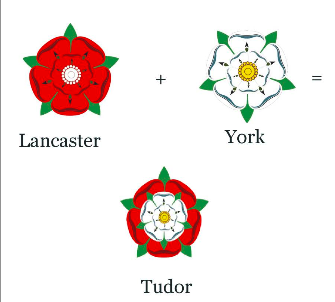
The Wars of the Roses were a series of dynastic civil wars set in England between 1455 and 1485. They originated in a struggle between descendants of two of King Edward III Plantagenet's eight sons. Henry "Bolingbroke" of the House of Lancaster stole the throne from his cousin, Edward's first grandson Richard II. Although his house had a couple of strong monarchs (see Shakespeare's Henry V), Henry VI (son of Henry V, and grandson of IV) turned out to be a strange boy with mental issues. note He was challenged for the throne by The Rival House of York (a cousin line descended from Edward III). After thirty years of conflict, in which almost all of the Lancastrians died, Henry Tudor took the final victory and was crowned Henry VII. He was a cousin of the Lancastrian side (half-nephew of Henry VI), and married Elizabeth of York, a daughter of the Yorkist faction (Edward IV, specifically), uniting the two sides into The House of Tudor. However some historians claim this wasn't the end of the Wars, as there were still threats to Henry from Yorkist Pretenders, which a lot of the nobility didn't seem ready to help him against.
On a side note, the "Wars of the Roses" were never called that by contemporaries. While the name does come from the White and Red Rose badges of the Yorkists and Lancastrians, respectively, it wasn't until Shakespeare and Walter Scott that the conflict became known by its now common name. Earlier commentators might have called it the Cousins' War, the English Civil War (a name later taken by a rather more ideological conflict) or perhaps as the War of the English Succession (which later became a now-disused name for the Nine Years' War). Until World War I, the Battle of Towton was the bloodiest single day for British soldiery; around 28,000 men perished on those snowy fields, a record that would not be surpassed until the opening day of the Battle of the Somme 450 years later. To this day, it remains the bloodiest battle ever fought on British soil.
For the novel/film, see The War of the Roses. The eastern equivalent of these historical events would be the Three Kingdoms – Shu, Wei, Wu.
Tropes as portrayed in fiction:
- The Fate of the Princes in the Tower: The young sons of Edward IV mysteriously disappeared in 1483 and historians and fiction writers have been debating what happened since.
- Femme Fatale: How Queen Margaret of Anjou is often portrayed, thanks to the influence of her victorious enemies. To give you a good idea: she (or how she's depicted) is the most likely inspiration for Cersei Lannister in A Song of Ice and Fire.
- Flower Motifs: A white rose for the House of York, and a red rose for the House of Lancaster. In reality, those symbols were sporadically used (if they were used at all) before Henry Tudor chose the red and white rose as his family's sigil. Monarchs of both houses used feathers for their personal badges as often as they used flowers, and their armies generally marched under animal symbols.
- Heart Is Where the Home Is: Following the historical record, Yorkist Anne Nevill is betrothed first to Richard III from York until her father switches sides in the Wars of the Roses, which prompts him to marry her off to Edward IV, the French-born Lancastrian prince. When the latter dies, Anne marries Richard. Factually speaking, Anne's feelings over these events are lost to time, but fiction insists on portraying them in this trope's light.
- Historical Hero Upgrade: Henry VII. Considering the first and by far the most famous dramatic portrayals of the Wars were patronised by his granddaughter, this one's a no-brainer.
- Historical Villain Upgrade: Richard III, though not so much anymore. Modern portrayals of the House of York tend to cast him as the mildest of the York brothers, an interpretation certainly more accurate than Shakespeare's.
- Kingmaker: The trope-namer was Richard Neville, the Earl of Warwick, whose mentorship of Edward IV allowed the young man to gain the throne.
- Mama's Baby, Papa's Maybe: The Lancastrian prince Edward of Lancaster was constantly speculated to be someone else's son, given how long it took for his alleged father, the pious and seemingly asexual Henry VI, to create him. Edward IV, who did not much resemble the York side of the family, was also dogged by rumors of illegitimacy. Historians differ as to the veracity of these claims.
- Puppet King: Henry VI was one. He is not thought by historians to have been unintelligent, but he was temperamentally unsuited to wear the crown. He let the nearest, strongest counselor tell him what to do, and this rotated around as these counselors plotted and schemed against each other. On the other hand, The Earl of Warwick thought he had a puppet in the young, Boisterous Bruiser Edward IV, but Edward was his own man.
- Royal Brat: More than a few. Richard II, Prince Edward of Westminster and George Duke of Clarence all qualify based on the historical records. Some fiction writers cast Edward V as this, though that is speculative.
- Sibling Rivalry: The Yorkist period under Edward IV is often portrayed with a great deal of this, given that Edward's younger brother George, Duke of Clarence, tried to depose him more than once and spread rumors that Edward was illegitimate. His younger brother Richard, contrary to popular legend, was in fact very loyal to Edward during his lifetime.
- Stock Unsolved Mysteries: The fate of the Princes in the Tower is one of the great historical mysteries. Many historians still think Richard III was the most likely culprit, but the Ricardians point out that it made little sense to have them disappear without proof of their deaths.
- Succession Crisis: The root of the whole mess was the premature death of Edward, the Black Prince, and the ascension of his young son, who turned out to have mental problems. This leads to several usurpations and competing claims.
- Tangled Family Tree: They didn't call it the cousins war for nothing, and nearly every book, fiction or nonfiction, about the conflict includes more than one chart illustrating how they are all related to one another.
- Tyrant Takes the Helm: Richard III's ascension to the throne is often portrayed this way, since he technically seized the throne from the lawful heir Prince Edward V (who was just 12 years old at the time). Whether he could justifiably be called a "tyrant", however, is a matter of much debate.
- Warrior King: More than a few, by necessity, including Henry IV, Henry V, Edward IV and Richard III.
Wars of the Roses in works of fiction and historical fiction:
- Stormbird, a 2013 novel by Conn Iggulden begins a Historical Fiction series Wars of the Roses, continued by Trinity, Bloodline, and Ravenspur. It takes place during the last years of The Hundred Years War and the reign of Henry VI, starting with his marriage to Marguerite d'Anjou, covering Jack Cade's rebellion and ending with Richard of York's appointment as the Protector.
- Shakespeare's Henry VI and Richard III. To an extent Richard II and Henry IV also deal with them despite taking place a generation earlier: modern scholars tend to disagree, but Shakespeare portrays Henry Bolingbroke's usurpation of the throne from Richard II and crowning of himself as Henry IV as the first move of the wars.
- Aya Kanno's manga series Requiem of the Rose King takes place during the War of Roses. The series is loosely based off of Henry VI and Richard III.
- The Daughter of Time: Josephine Tey's detective novel, in which the protagonist combs through the evidence for and against Richard III murdering his nephews, is credited with heavily rehabilitating Richard's reputation in modern times.
- The Hellequin Chronicles short story Infamous Reign is set during the final months of Richard III's reign, ending shortly after Henry VII's victory at Bosworth, and deals heavily with the Princes in the Tower. As it turns out, Richard wasn't such a bad bloke, and was actually a friend of the protagonist, Nathan Garrett a.k.a. Hellequin, but made a bad misjudgement in regards to the Princes—following one of the modern theories, he was having them shipped abroad so they'd no longer be a focus of support for his enemies, but unfortunately, they were descended from Arthur Pendragon, and Mordred (at this point, completely Ax-Crazy) was dead set on keeping any descendant of Arthur's off the throne. In the end, the Princes are spared and end up far away from the throne, but Richard dies at Bosworth and has his reputation tarnished—something that Henry VII (who is entirely unfazed by the enraged Person of Mass Destruction and Living Weapon standing in front of him) actually apologises to Nathan about, noting that Richard didn't deserve his monstrous reputation, but Realpolitik dictates that he needed a convenient scapegoat to smear and bolster his own claim, so he let it happen.
- The I, Richard Plantagenet Series is a Doorstopper series of five first person novels which chronicle the final events of the wars from Richard III's point of view. They begin with him as a small child observing his father's attempt to take the throne and end with his own death at Bosworth Field.
- The Black Adder's premise is that Richard III actually won the battle of Bosworth Field, but was accidentally beheaded by his incompetent nephew Edmund while trying to take his horse. Subsequently, Edmund's father Richard, one of the Princes In the Tower who were never imprisoned or killed, is crowned king and becomes Richard IV. After a 13-year reign, the entire family line, including Edmund, is wiped out in a botched attempt by Edmund (now calling himself the Black Adder) to seize the throne for himself, with Edmund technically being king for about 30 seconds before succumbing to poisoning. The entire period is erased from history by the House of Tudor, with Henry Tudor claiming the throne and changing the historical records to show that he won the battle, as well as portraying Richard III as a tyrant and kin-slayer.
- Philippa Gregory's The Cousins' War Series novels cover this period from the perspective of women who were prominent figures at the time, but have been largely forgotten by history.
- The White Queen TV adaptation follows the life of Elizabeth Woodville, a commoner from a traditionally Lancastrian family who marries Edward IV and is the mother of Edward V and his brother Richard ("the Princes in the Tower") as well as Elizabeth of York. Richard III and his queen consort Anne Neville take center stage in the last few episodes.
- In Terry Pratchett's Nation, it's mentioned that one of Daphne's ancestors fought in the War of the Roses... wearing a pink rose and thus ended up fighting both sides at once. Because everyone thought it was bad luck to kill a madman, he lived through it. Fanshaws may be pigheaded and stupid, but they fight.
- The second duology of Arcia Chronicles is a fantasy retelling of the Wars of the Roses, dubbed "War of the Daffodils".
- Another fantasy retelling is the "War of the Lions" that drives the plot of the original Final Fantasy Tactics game.
- ... and yet another in A Song of Ice and Fire, with Stark and Lannister Feuding Families being less than subtle clues.
- And, even more directly, brief mentions are made of the Red and Green "Apple" Fossoways, who appear to have their own squabbles over titles and are two branches of a house.
- The symbol of House Tyrell, one of the major power players in the series, is depicted in the TV adaptation Game of Thrones as a dead ringer for the Tudor double rose.
- Still another reference comes in the Blackfyre Rebellions, where the Blackfyre claimants used a house sigil with Targaryen colors inverted.
- The backstory even further reinforces this as per "the Dance of the Dragons," which saw House Targaryen in a family feud akin to the historical English dynasty of The House of Plantagenet, which will give rise to the Stark vs. Lannister (York vs. Lancaster) conflict later on.
- The sigil of the Targaryens is a red dragon, rather like Henry Tudor's.
- Gemfire is best described as "Romance of the Three Kingdoms in a Standard Fantasy Setting version of the Wars of the Roses," down to the king being from House Lankshire. And Ishmeria being shaped like England and Wales (including the Isle of Man) and the king's bastard heading up House Tudoria.
- Avalon Hill had a game based on the war called Kingmaker.
- Sharon Penman's The Sunne in Splendour, centered on King Richard III and Anne Neville.
- Not to be confused with Jean Plaidy's The Sun in Splendour, also about the Wars of the Roses, but about King Edward IV and Elizabeth Woodville.
- The Black Arrow by Robert Louis Stevenson.
- Subtly referred to in Tim Burton's Alice in Wonderland (2010).
- The Battle of Epping Forest: "You ain't seen nothin' like it... not since the Civil War"
- Dark Albion: The Rose War is a fantasy take on the period, meant for OSR role-playing games.
- Yu-Gi-Oh! The Duelists of the Roses has a plot loosely based on this war (changing characters to those from the franchise and turning battles into card games, but following the locations and general conflict.)
- The video game War of the Roses by the Swedish indie studio Fatshark.
- FreezeFlame22's Wars of Frozen Flames are heavily based off War of the Roses. The series serves as a way to expand upon the franchise's lore, with every character being a Koopa version of the existing characters.
- Europa Universalis, with it's starting date of 1444, naturally features the Wars of the Roses as one of England's first disasters, triggered if Henry VI goes too long without siring an heir.
- The 2022 film The Lost King chronicles the remarkable and successful search for Richard III's remains by amateur historian and Ricardian, Phillippa Langley. Richard's ghost appears as a character and there is a brief scene of him preparing to ride into battle at Bosworth Field.
- The 2010 novel The Virgin Widow focuses on the romance between Richard III and his wife, Anne Neville. A Lighter and Softer take on their story, it portrays them as the actual ages they were when they married 18 and 16, respectively and gives them a Happily Ever Before ending, long before Edward IV dies and Richard seizes the throne.
- Amy License's House of York Series has Edward IV as the main point of view character and chronicles his father's rebellion and his rise to power and reign.
- Margaret Frazer's Dame Frevisse
