
Maelyn Dean: Well, let's see... You'll play video games, drink as much soda as you want, comment on whatever you feel like, go wherever you want, and do as you please.
Liz Mosely: Holy cow! There's absolutely no downside to this job!
Maelyn Dean: Well, there is the limited hand mobility, but you'll get used to that.
Strictly speaking, any active avoidance by an artist, especially a beginner or amateur, of drawing a particular thing. This is usually self-admitted and, if it carries an apologetic tone, the implication is that trying to draw a difficult scene element would hamper rather than help the work rather than it just being a Lazy Artist. Can get extremely glaring with something the audience is expecting to see; hands, in particular, are often considered very difficult to draw.
A hand is a mess of overlapping and foreshortened digits, odd wrinkles, and tendons poking out in the strangest of places — plus, while there are only so many different positions that, say, arms or ears or eyes can assume, hands can be found in an almost infinite variety of poses holding an infinite number of things. And considering people tend to naturally focus on hands, one minor mistake can ruin an entire picture. There are entire sections in art libraries and entire university courses devoted only to hands. Bare human feet have a similar problem, though it's not quite as bad because of how less flexible a foot is from a hand, and so there are less poses they can assume.
Compare Cheated Angle.
Examples
- Bleach: Tite Kubo's apparent aversion to backgrounds, especially when you compare later chapters to the first ones, has become somewhat memetic.
Tite Kubo: Backgrounds can tell you where a character is, but I don't think it's that important. I don't want to draw a background if the focus is on the character.
- A much more minor example: Ken Akamatsu has stated that the reason that Chachamaru is in her loli form for a good chunk of the magic world arc in Negima! Magister Negi Magi is because it's easier to draw than her adult form.

- Similarly, in Wish angels and demons shrunk to chibi forms during the night or day respectively, or when sprinkled with a certain potion was at least in part a work-saving measure for the chief artist.
- An odd example in Pokémon: The Series. The anime has no qualms about drawing characters' hands filling the screen, but except for a handful of early episodes (and inconsistently in later ones◊), fingernails are never seen (running contrary to the art style of the games, which has no such qualms). Averted starting with Pokémon the Series: XY; since then, fingernails are properly drawn.
- In-universe, Nozaki of Monthly Girls' Nozaki-kun is a manga artist who has little skill at drawing backgrounds and perspective. He mentions that a lot of his early work (one-shots and contest entries and so on) used as few backgrounds as possible and covered this with close-ups and manga effects.

- The founder of the Museum of Bad Art has noted this as one of the common features of paintings in its collection. One example is Sunday on the Pot with George in the Poor-traits section (scroll right), where, although the artist painted George's hands, he extended George's legs in order to avoid having to paint his feet. In fact, there's an entire section dedicated to paintings that awkwardly avoid drawing hands.
- The reason why so many images of Napoléon Bonaparte or George Washington depict them tucking their hands inside their coats. Most painters, even the best ones, had difficulty drawing hands of a realistic size and asked their subjects to take poses which concealed the hands. This tucked-hand pose eventually became popular on it's own as a sign of dignity and erudition. which meant that people continued to pose like this even after the advent of photography (which completely obviated the problem of drawing hands) until the early twentieth-century. As Napoléon died of complications of a stomach ulcer, this ubiquitous pose resulted in France to a Common Knowledge stating this was a real life posture as he was often clenching his belly due to abdominal pains.
- It is known that Francisco de Goya found painting hands so annoying that he charged extra for every single hand he had to paint. This seems to have even extended to the Spanish royal family: his famous portrait of Charles IV and his family has 14 subjects (13 royals plus Goya himself) but only six whole or partial hands—and one of those hands belonged to a baby.note
- The infamous Rob Liefeld, among other anatomical habits, keeps characters' feet obscured or off panel. And when they are on the panel, they're always standing on their tip toes,
sometimesalways for no apparent reason. He either refuses to or can't draw feet in a normal standing position. There was at least one occasion where the characters didn't have any feet, their legs just ended in flared stumps. Which would have been just fine if the rest wasn't in Rob's normal "I actually think this is what real people look like" style. Hence, the ever infamous 40 Worst Rob Liefield Drawings And its sequel.
- Deadpool's Original Sin tie-in, set mostly during The '90s, boasts a Liefeld-esque drawing style, complete with everyone's feet remaining hidden from view. When the comic shifts to The New '10s, it undergoes both a change in art style, and an immediate abandoning of this trope - As SHIELD agent Scott Adsit ties his shoes, the panel closes up on them.
- Gotlib is making fun of this trope in one of his comics about cartoonists: a (fictional) comic book panel drawn by a "cheating" artist is supposed to show the exciting and terrible battle of Waterloo... but most of the panel is occupied by a big cannon and a pile of cannonballs.
- Scott Adams has admitted that he likes putting hats on Dogbert (from Dilbert) because he finds the top of Dogbert's head hard to draw. He also saves time by "drawing only the feet of dead people". He also only draws the lens-end of TV cameras because he doesn't know what they look like from behind.
- Referenced in one Peanuts strip where Charlie Brown commented on a picture of a man drawn by Linus:
Charlie Brown: I note that you drew him with his hands behind his back. This is because you, yourself, have feelings of insecurity.
Linus: No. I did that because I, myself, can't draw hands! - Gary Larson (The Far Side) has admitted that the reason most of his characters have either Eye Glasses or Eyes Always Shut is because he has trouble drawing eyes.
- On Wings, Casey reveals that she can only draw people as caricatures, and always draws skis on them because she can't draw feet. Video
- One sketch on Saturday Night Live pokes fun of the infamous Unabomber police sketch◊ by having the actor playing the sketch artist claim that he's not good at drawing eyes or hair. He then pulls out various sketches of the Unabomber with the same sunglasses and wearing a variety of silly hats.

- ZUN, the creator of Touhou Project, is known for drawing characters in poses where their hands are obscured, as well as never drawing ears (typically with plenty of hats). Since he is the single programmer, artist, and composer for the entire project (and his music is generally praised), the fans giggle, but they generally forgive him for it. The reason for the ears (almost) never being drawn has since become fairly clear: He draws them looking Pointy. And in an inversion, he gave Rin Kaenbyou human ears, then cat ears (since she's a Cat Girl) and forgot to erase her human ears; in other words, she uniquely has 2 pairs. Fortunately, Art Evolution took place and newer artworks from feature decently-drawn hands. Junko's artwork from Touhou Kanjuden ~ Legacy of Lunatic Kingdom actually showcases her open hands, with proper shading.
- Sonic the Hedgehog characters lack toes, as seen on Big the Cat and Tikal and official artwork of Tails◊ and Amy.◊
- Fire Emblem: Awakening character models have no feet. According to the developers, this was because they were uncertain how many joints the 3DS could render and animate.


- Parodied in the Damsel route of Slay the Princess. As the Princess's Animesque appearance starts deteriorating, her final form has her hands perpetually behind her back to really sell the "preteen who just got their first 'how to draw manga' book" style. The Shifting Mound doesn't even bother moving her arms like she does with the Princess' other forms.
- Real Life Comics (of which a fair amount is a so-called Cut and Paste Comic) avoids hands, and the author does a few Lampshade Hangings about the characters' habit of keeping hands in their pockets.
- Questionable Content rarely shows its characters' feet (mostly just because of the composition of the shots). One poster featuring full-length views of several main characters was captioned "proof that I can, in fact, draw feet".
- Subverted in a strip of Sam & Fuzzy. The character's hands are continually hidden, looking like this trope at first, until it is revealed he actually doesn't have hands.
- Done only by Naomi, for the sake of a joke in The Last Days of FOXHOUND, she gets called out by Grey Fox/Cyborg Ninja for doing this. She cites the cold for this habit.
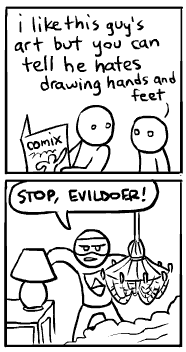
- Chainsawsuit: "I like this guy's art, but you can tell he hates drawing hands and feet." The superhero in the comic has his hands obscured by a lamp, a chandelier, a pelican, newspaper, and a roof. And even the pelican's feet are obscured. Probably a Take That! at Rob Liefeld, above.
- Kaja and Phil Foglio, of Girl Genius fame, seem to avoid drawing Von Pinn's legs and feet. When you see a full picture of her, you understand that these are hard and time-consuming to draw.
- Strewth! shows you how it's done.
- Done literally with Emmit the shuttle pilot in Station V3.
- Most of the characters have limited hairstyles in The Walkyverse, due to the artist having a hard time drawing hair. Lampshaded in the comics and in his commentaries. One early plot of Shortpacked! had Amber getting a makeover, including a fancy new hairstyle, which only lasted the arc (the excuse being "curling is expensive" (it's not); real reason, "curls are hard to draw"). Amber did at least get a newer hairstyle from her inception, though everyone else is pretty much stuck with their character model hair.
- Word of God is that's why most characters with glasses are rarely seen with them off; he generally starts drawing their heads with the glasses as the reference point and has to adjust majorly to draw them without them.
- Strange Planet mostly keeps the characters' feet out of frame, and when context allows they'll be, say, wearing socks or bundling themselves in blankets. There are exceptions though, and since the characters are effectively cute Greys, the artist can get away with depicting simplistic, toe-less feet without it being jarring.
- Katie Tiedrich admits in the description of this Awkward Zombie page that she hates drawing the top of Midna's helmet, and thus always puts her at the top of panels in this page and subsequent comics including her.
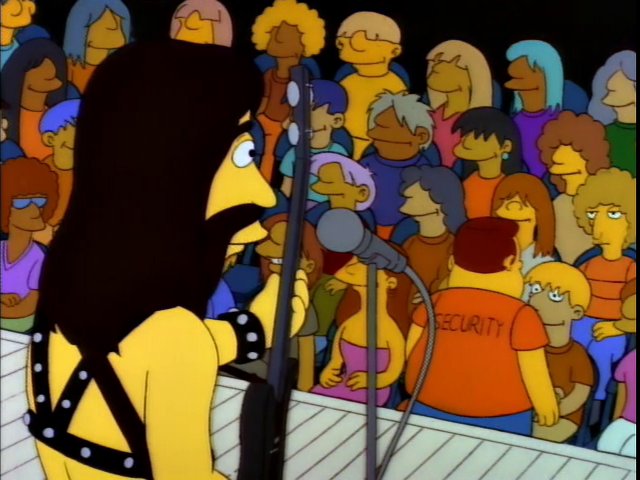
- The Simpsons: In the commentary track for "The Otto Show", it is gleefully pointed out how in the concert scene, nearly everybody was drawn with long bangs◊ so the artists didn't need to draw eyes.
- Hilariously, this even applies to art-generating artificial intelligences. As one of the developers of TADNE, an AI for generating anime-style pictures, has noted: "[our model] seems to try to hide hands (...) it features an unusual amount of ‘off-screen’ hands, Yakumo Yukari-style ‘portals’ (...) cutting off hands, sweaters & long sleeves, crossed arms, arms behind back etc." Technical explanation
- This is common for young, inexperienced artists, who are decent at drawing faces, but struggle with hands. Often, they also struggle with symmetry, so one eye is drawn first, then the other is hidden with bangs or an eyepatch.
