
The in-universe usage of a show's theme music (or another item on the soundtrack) within an episode. Generally only used if the theme is itself a freestanding song rather than a Title Theme Tune. This might occur if a character sings the theme song or hums the melody, or if a character is shown playing the theme song melody on an instrument.
If a character complains about the music (e.g. "Turn that off! I hate that song"), it's also Self-Deprecation or Biting-the-Hand Humor.
The musical version of an Opening Shout-Out. Flirts with Left the Background Music On. See also Leitmotif.
Not the same thing as Title Theme Drop, which is when the show's title theme is reused in some way by other parts of the soundtrack, such as a remix of the title theme playing when fighting the final boss of a video game. Diegetic Soundtrack Usage is when the use of the song is diegetic: that is, someone or something within the work is doing the reference, such as a character humming the theme tune, or band playing the song, etc. There may be some overlap at times, if both are used within the same work. If the lyrics of the theme tune (or any other song) are used in dialogue, it's Waxing Lyrical. See also Theme Music Power-Up. A common variation of Leaning on the Fourth Wall.
This trope is not to be confused with Source Music, where music appears diegetically for the first time.
Example subpages:
Other examples:
- Many products back in the day had songs about their products, such as the songs for KitKat, Almond Joy/Mounds. Nowadays, since singing a song about your product seems old-fashioned, some of these products that had songs will now just play a short instrumental version of these old songs somewhere in the commercial. One problem: if you're not old enough to remember these songs when they had words, you'll have no idea that these songs are this trope and aren't just random songs.
- In Balala the Fairies, the theme song is their transformation music. Even the toys made for the show play it.
- BoBoiBoy: BoBoiBoy can use his power watch to contact his friends who have their own power watches as well. When he receives a call, his watch briefly plays the melody of the theme song as the ringtone.
- Happy Heroes:
- In Season 2 episode 44, Big M. presses a button on his voice toner which causes it to play the show's theme song.
- In episode 8 of Happy Heroes and the Magical Lab, Doctor H.'s car radio plays the original theme song, "Happily Flying Forward" (which had been replaced with a few other songs starting from Season 9).
- In episode 15 of Happy Heroes and the Magical Lab, a singer holds a concert where she sings the theme song ("Happily Flying Forward" again).
- Lamput: In "Origins", after Mr. Moustache gets the docs into his car to be arrested, Lamput walks away and whistles what little the show has of a theme song as if nothing happened.
- Motu Patlu: In "Bhoot Bangla", one of the skeletons John the Don controls to scare Motu and Patlu sings a short snippet of the show's theme song.
- The Noonbory and the Super 7 episode "Adventures in Kidborysitting", Cozybory is heard humming the theme song. This is even kept in the Korean version, which has an Alternative Foreign Theme Song.
- The Firesign Theatre skit "The Further Adventures of Nick Danger", from the album How Can You Be in Two Places at Once When You're Not Anywhere at All, has the title character whistling his theme tune as he walks the streets by night.
- In a comic featuring Venom as the main character, he's seen swinging building to building singing a song, with lyrics featuring himself, obviously meant to line up with the classic Spider-Man theme song.
- In one of the Amalgam Universe comics following the Marvel Versus DC, Spider-Boy also sings his own version of the song about how Toyetic he is.
"Spider-Boy! Spider-Boy! Has the very best action toys! Top-ten show, game and vid! Gotta love the Arach-Kid!"
- Deadpool:One of the first times Deadpool breaks the Fourth Wall is when on his way to fight the Hulk he starts singing the theme song from The Incredible Hulk (1977).
- Sonic the Hedgehog (Archie Comics):
- In at least one issue, Sonic sings the themesong for the Sonic the Hedgehog (SatAM). He does the actual lyrics but hums over the part where his own name would be mentioned. "Catchy tune," he notes, "wonder where I've heard it before."
- Eggman sings his leitmotif from Sonic Adventure 2 in a later issue.
- In one of the Knuckles the Echidna comics, Knuckles has Vector crank his headphones up to Gale-Force Sound levels to blow out a wildfire. Vector does so with the comment "Here comes that Top Ten fav - Sonic Boom!", with a note from the editor confirming that the music is indeed the song with that name from Sonic CD.
- An issue of the licensed Bubblegum Crisis comic from Dark Horse had Mackie singing "Kon'ya wa Hurricane," the first OVA's theme song.
- In an early installment of the Mickey Mouse comic strip, "Minnie's Yoo-Hoo" (the character's theme song from the cartoons) is shown playing on a phonograph.
- In Marvel Double Shot #2, Tony Stark is shown singing the theme song from the 60's Iron Man cartoon while in the shower.
- An issue of Daredevil has a child singing the theme song to The Avengers: Earth's Mightiest Heroes.
- A later issue of Avengers Assemble reveals that Spider-Woman has it as her ringtone. In the final issue, Captain America has it downloaded to Anya/Spider-Girl's phone. The last panel is of her dancing to it.
- In Deadpool #8, the merc sings Spider-Man's theme song with his own lyrics:
"Deadpool-Man! Deadpool-Man! Does whatever Deadpool can! Makes a plan, any size, catches thieves and makes them die. Look out! There goes the Deadpool-Man!"
- An issue of the 2019 volume of Iron Man features a Lotus-Eater Machine sequence that has the lyrics of the 60s Iron Man cartoon theme shown on-panel.
- The final issue of Saladin Ahmed's Exiles run has a scene where Wolvie is briefly trapped in a timeline based on the '90s X-Men: The Animated Series cartoon, complete with the theme song:
Wolvie: Ahhh! Everyone's so loud and so mean! I do like whatever that song is, though.
- In The Smurfs comic book story "Bathing Smurfs", Handy is heard singing The Smurfs (1981) theme tune as he returns to the village from his hiking trip, with the words superimposed on a music scale. Some Papercutz English translations of their stories such as "The Clockwork Smurf" and "The Finance Smurf" also have this as the substitute for whatever songs the Smurfs originally sang in their original French versions.
- DC Comics Bombshells #19 has a variation:
Harper Row: "Na na na na na na na na Batgirls!"
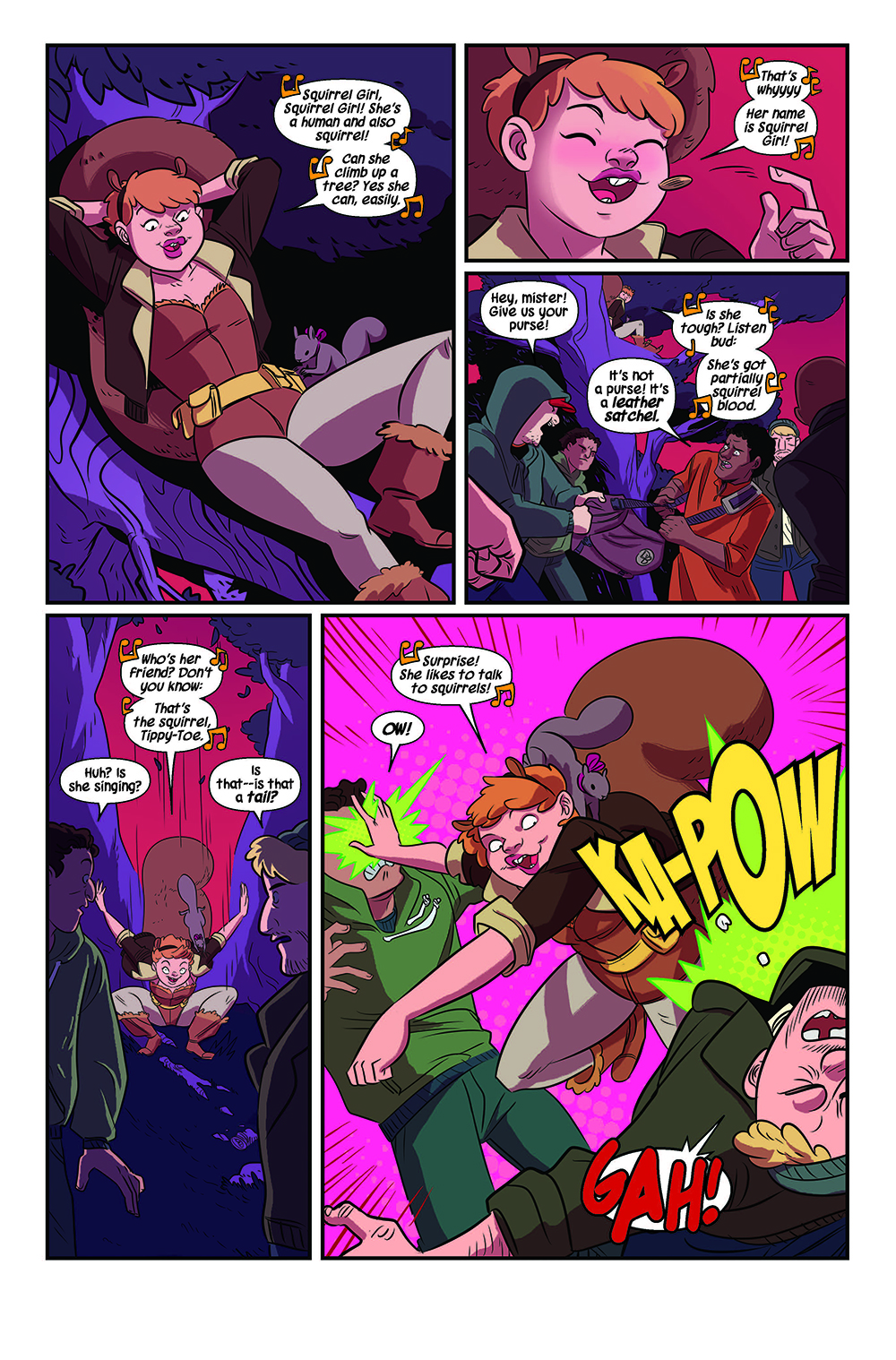
- In the first issue of The Unbeatable Squirrel Girl, the Spider-Man theme tradition is
 ◊ continued◊:
"Squirrel Girl, Squirrel Girl! She's a human and also a squirrel! Can she climb up a tree? Yes she can, easily. That's whyyyy Her name is Squirrel Girl!"
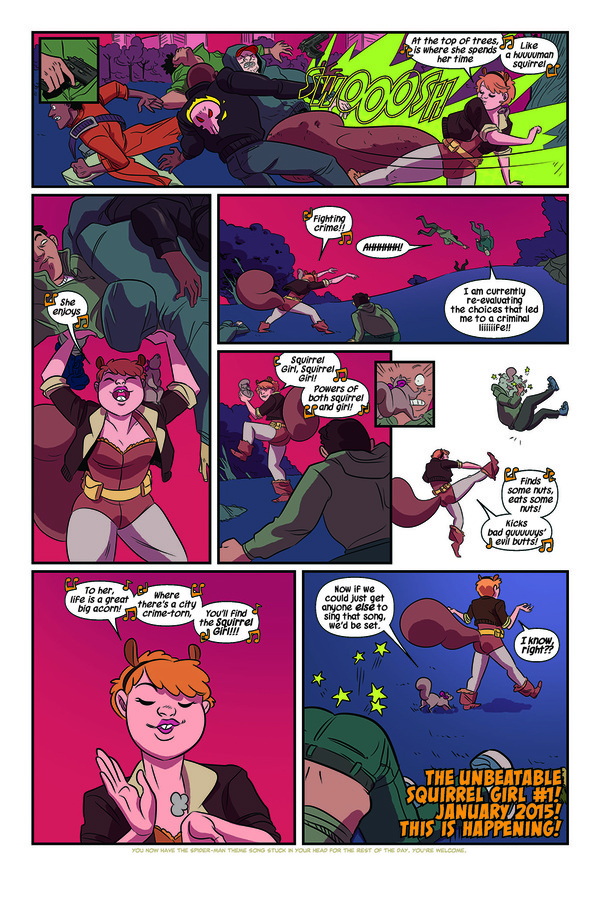
◊ continued◊:
"Squirrel Girl, Squirrel Girl! She's a human and also a squirrel! Can she climb up a tree? Yes she can, easily. That's whyyyy Her name is Squirrel Girl!" - Issue #3 of the Ryan North Fantastic Four run reveals that the Human Torch's ringtone is his infamously terrible rap from the 90s Fantastic Four TV show.
- Giraffes On Horseback Salad: In keeping with its origins as a Marx Brothers movie, the graphic novel features several songs incorporated into the story. These include "Doing the Chez La Vie" (Groucho's opening act for the Woman Surreal), "The Pull of the Heartstrings" (Jimmy's harp solo), and "La Femme Surreal" (Groucho's report to Linda).
- Turnabout Storm: Pinkie, in one of her 4th wall breaking antics, starts humming the iconic Pursuit ~ Cornered theme from Ace Attorney in the middle of the investigation.
- A Growing Affection: GO!!! (a.k.a. Fighting Dreamers) is used as Hinata's ring tone.
- In Empath: The Luckiest Smurf, the Smurfs theme song from the cartoon show is consistently referred to as "the Smurf song", even by its characters. In "The Grouchiest Friendship", Empath learns the lyrics of the song during his first visit to the Smurf Village. In "Smurphony Of The Night", Empath uses the tune to disrupt the effect of the Mind-Control Music that Lord Vladimir Smurfula uses on Smurfette.
- In "For The Smurf Of Money" (an adaptation of "The Finance Smurf"), the Smurfs near the end of the story sing an altered version of the Smurf song when they decide to ultimately reject the money system.
"La, la, la la la la, sing the smurfy song.La, la, la la la la, smurf it all day long.La, la, la la la la, a life with no money.La, la, la la la la, smurfy as can be.Caring for every Smurf is smurf more than all the gold.Everyone is smurfier to smurf the ways of old.La, la, la la la la, now you know the tune,La, la, la la la la, you'll be smurfing soon." - In Pokémon Reset Bloodlines, Ash has the English Dub theme songs in his iTunes Library that the Pokédex can play. Several of the sidestories also feature a few of these:
- In the Erika Interlude, Erika's Gloom hums "What Kind of Pokémon Are You?"
- In "Happy Birthday, Ash!", Delia sings "You & Me & Pokémon" during Ash's 15th birthday party.
- In the Frax & Velvet Interlude, Jasmine Lono has "Under the Alolan Sun" set as her ringtone.
- Lorelei has "Pokémon Dance Mix" as her ringtone in the Pokémon G-Men Interlude.
- In the My Little Pony: Friendship Is Magic fan comic Twilight's First Day, the opening notes of the show's theme tune is used, in musical notation, as the school bell at Princess Celestia's School for Gifted Unicorns.
- In one online MSTing, the protagonist of the story being MSTed is revealed to have been knocked out and marooned in a space capsule. Tom and Crow promptly start singing "So they conked him on the noggin and they shot him into space"; Mike doesn't find this quite as funny.
- In the Enterprise Parody Fic "Farce Contact", the MACHOS shout "Let's rock!" as per Aliens. At the end of the story, the Future Guy uses a parody of the theme to get Enterprise cancelled.
'Faith of the Heart' blared from the comm system.
"That's not rock, that's some 70's pop tune by Diane Warren!"
"But it's working, sir. The Suliban are fleeing in terror." - Lincoln's Memories: Played with. In "A Rockin' Good Time", Lincoln and Luna write the Ending Theme.
- In the movie Final Fantasy VII: Advent Children, Loz's cell phone ring tone is the victory music from the game. Amusingly, he gets a phone call right after Tifa is done beating him up.
- In the movie An American Tail, the violin cue from James Horner's movie theme (A, high D, A, B flat, A, G, B flat, A) is played by Papa Mousekewitz on his own tiny mouse violin at the end of the movie when he's trying to attract Fievel. (Justified - After a whole movie of Fievel following violin music that turned out not to lead to his papa, the use of the theme itself is the audience's cue "it's real this time.")
- In the animated movie The Flight of Dragons, the tune that Giles plays upon the Flute of Olympus is the first couple lines of the opening song.
- While The Incredibles doesn't have a proper theme song, the most-repeated motif from the score is called "Mr. Incredible's Theme". Bob Parr can be heard humming this melody when he returns home after a night of clandestine superheroing. In addition, one of the DVD Easter Eggs shows Mr. Incredible dancing to a swing version of the theme. The sequel potentially justifies this; the melody is a part of his In-Universe theme song.
- In The Hunchback of Notre Dame the melody of "The Bells of Notre-Dame" is played many times throughout the soundtrack, including in other songs.
- Near the beginning of Cloudy with a Chance of Meatballs, Flint hums his own theme music; the exact same music that was the BGM of the previous scene.
- In the 2012 movie adaption of The Lorax, you can hear "Thneedville", the opening song, to the film play during the seed chase scene.
- The Nightmare Before Christmas: The Mayor finds "This is Halloween" so catchy, we find him humming it later as he brings Jack the plans for next year's Halloween.
- In the 1953 Peter Pan, Peter's three note flute motif (E-A-F#) is played by Peter himself, idly, on his panpipes. His main leitmotif is even optimized (breaks between melodic jumps, stepwise pentatonic scale) for being played on the instrument.
- In The Simpsons Movie, Green Day make a cameo playing the Simpsons theme.
- Three instances in The Sponge Bob Movie Sponge Out Of Water:
- When the camera reveals the island which marks Bikini Bottom, we hear the last eight notes of the theme.
- The seagulls begin singing the song, but Burger-Beard stops them.
- The full audio from the TV version of the theme is heard at the end.
- In Winnie the Pooh and Tigger Too, Rabbit is humming "Winnie the Pooh" while harvesting his garden.
- Spider-Man: Into the Spider-Verse features the theme from the 1967 Spider-Man cartoon quite a few times. It first pops up during Peter's opening narration, where he boasts about having an excellent theme song. The Kingpin later ominously hums the song to himself when he finds Spider-Man trying to shut down his Super-Collider. The song appears one last time to close out The Stinger where Spider-Man 2099 meets his 60's counterpart.
- The opening scene of Cosgrove Hall's The Wind in the Willows (the feature-length adaptation of the book, rather than the later series) has Mole humming the theme tune as he does his spring-cleaning.
- In James and the Giant Peach, the Old-Green-Grasshopper plays the film's opening title music on a violin, late at night.
- The Foo Fighters have done this three times, amazingly enough, with cameos of prior hits in their music videos:
- The video for "Monkey Wrench" starts off with a scene of Dave Grohl standing in an elevator, in which a Muzak version of "Big Me" is playing. Naturally, Grohl starts bobbing his head to the tune.
- The video for "Learn to Fly" shows the airplane that provides the video's setting being cleaned up, to a Muzak version of "Everlong".
- The song that's playing on the car radio in the beginning of the video for "Breakout" is "Generator", from the same album.
- The party-crashing bikers from Quiet Riot's "Party All Night" video are first seen hanging around outside a pizza place, with "Bang Your Head (Mental Health)" playing on a boombox.
- The video to 50 Cent's "I'll Still Kill" has an earlier single, "I Get Money" playing on a TV in the intro.
- In their Rube-Goldberg-esque music video for "This Too Shall Pass", OK Go includes a shot of a television showing part of the music video for "Here It Goes Again", another of their songs.
- Molly Hatchet's "Stone In Your Heart" video begins with the band driving down the road and picking up a hitchhiker while "Flirtin' With Disaster" (their first and biggest hit) plays on the radio.
- At the beginning of *NSYNC's "It's Gonna Be Me" video— which is partially set in a toy store— "Bye Bye Bye" can be heard on the speakers.
- The Backstreet Boys' video for "Larger Than Life" features an audio medley of the group's earlier singles, presented to sound like someone flipping through several radio stations.
- At the beginning of George Michael's "Faith" video, "I Want Your Sex" is playing on a jukebox (the very first image of the video). Interestingly enough, upon release "Sex" was used less to advertise the Faith album (released in October, as opposed to this song's June) than the recently new film Beverly Hills Cop II.
- Limp Bizkit's "Rollin'" video began with Ben Stiller and Stephen Dorff pulling up to Fred Durst— while their car's radio plays the band's previous single "My Generation".
- "Whatcha Say" can be heard at the start of the "In My Head" video, either coming from a car radio or the speakers of the convenience store whose parking lot is the video's location.
- The opening shot of Alicia Keys' video for "Fallin'" is her bedside radio playing "Girlfriend", another of her songs.
- The opening to the "Voices" video by Disturbed features a man listening to music on his Walkman; the music being "Stupify", an earlier single from the same album.
- "Bad Reputation" by Joan Jett and the Blackhearts can be heard playing on a jukebox in the music video for their later song "I Love Rock'n'roll."
- Hi Nay: in one episode, Mari sings the lullaby "Ili-ili tulog anay" - which, played on kalimba, serves as the podcast’s Theme Tune - to calm down the ghost of a singer after Donner accidentally angers her by humming the song the primary antagonist tends to whistle sinisterly.
- Thunderbirds:
- In Thunderbirds Are Go, Alan is heard humming the theme as he travels on the couch-elevator.
- Although it's not quite the same principle (being more a case of Recycled Soundtrack), in one episode the tune "March of the Oysters" from Stingray (1964) can be heard emanating from a man's house.
- Virgil plays a version of the theme tune on the piano in some episodes.
- And in the live-action movie Jeff Tracy and Lady Penelope have the theme as ringtones.
- In a Captain Scarlet and the Mysterons episode, the tune "Dangerous Game" from Thunderbirds is on the radio. Not all the radio music was recycled, though.
- In one episode of Fireball XL5, Steve Zodiac and company perform the show's end title song at a concert.
- In Stingray's "Raptures Of The Deep," Troy Tempest sings the show's end credits song to Marina. Unlike the example above, however, it's a hallucination he's having.
- Sesame Street:
- During one episode, when discussing the weather, Elmo sings a few bars of the opening theme "Sunny days sweeping the clouds away"
- In a News Flash sketch, Don Music is shown in the process of writing the Sesame Street theme, but he can't come up with a line to rhyme with "where the air is sweet". With Kermit the Frog's help, he ends up changing the lyrics to depict a stormy night, with the last line asking "Can you tell me how to get to Yellowstone Park?". Then, after the rewritten song is performed, Kermit asks Don how to get to Sesame Street.
- The Crossover with Mister Rogers' Neighborhood begins with an instrumental of the theme song to that show, "Won't You Be My Neighbor?", playing as Big Bird hums along to it.
- Bear in the Big Blue House: Around the beginning of "A Beary Bear Christmas", Bear sings a line from the theme song in order to get the kids to notice him when they're arguing over how to help out to get ready for the holidays.
- In one episode of Fraggle Rock, Mokey goes back in time to write the show's theme song, which encourages the ancient Fraggles to laugh.
- Donkey Hodie:
- In the episode "Big Nest Bird Party", Donkey sings the "A hee and a haw and a haw and a hee" part of the show's theme song while walking.
- "Mousy Hodie" has Mousy sing the first part of the theme song when coming out of her version of Donkey's windmill.
- In the first episode of the early-1980s Public Radio serialization of Star Wars, the famous Main Title fades down and is filtered to become — the background music of a commercial for the Imperial Merchant Marine Corps to which Luke is listening.
- In Stan Freberg's Dragnet spoof "Little Blue Riding Hood," Granny's doorbell plays the Dragnet theme. (For this and its A-side "St. George And The Dragonet," the orchestra used was the actual Dragnet orchestra, as Jack Webb loved the idea!)
- In every Dragnet spoof that Freberg made, virtually anything that can make music plays the Dragnet theme — and nothing else.
- One episode of The Navy Lark has Sub-Lieutenant Phillips whistling the show's theme music as a "Ditty" he'd picked up somewhere. He's promptly told to stop it by the rest of the cast as it sounds silly and annoying.
- In the Sailor Moon stage musicals, better known as the Sera Myu, the characters sometimes perform stageshows within the musical itself. For example, one musical has the Senshi, in civilian form, perform La Soldier as part of Rehersal, considered the Sera Myu's theme by the fans (it appears in nearly every musical either as part of it or an encore number), only to have a character complain they'll be recognized by the baddies for singing it. Moments later the baddies show up in Paper Thin Disguises and perform their version of La Soldier (sung by the children in the group).
- In the Bernstein/Sondheim musical West Side Story, when Doc goes downstairs to meet Tony, the boy is whistling "Maria" to himself.
- In A Funny Thing Happened on the Way to the Forum, the characters of Senex and Hysterium sing or hum the songs "Everybody Ought to Have a Maid" and "I'm Calm" at a various points. The first one's a plot point, as Senex mistakes Philia for a new maid (read: concubine), prompting the song. He sings it later while taking a bath, unintentionally leading Erronius to erroneously believe that his house is haunted.
- In Assassins, John Wilkes Booth is heard humming a bit of "The Ballad of Booth" before starting his conversation to try and convince Lee Harvey Oswald to shoot JFK.
- In Pokémon Live!, the show opens with the Orange Islands version of the Pokemon theme before being interrupted by Giovanni's commercial, and Ash listens to the original Pokemon theme on the radio.
- In Bluey's Big Play, a stage play based on the popular Australian cartoon Bluey, the theme tune is played on Bandit's phone as the Heelers play musical statues. During a few points in the game, they can be heard singing or humming along with the tune.
- Aquarium: Aqua sings her own theme, "Aqua Iro Palette", at the chapel.
- In Doki Doki Literature Club!, Monika composes, plays and sings a song called "Your Reality", which has the same tune as the opening theme. In the side stories in DDLC Plus!, she composes and plays a piano version of "My Song, Your Note", which has already been used in another form in the soundtrack.
- The DC Super Hero Girls episode "Techless Tuesday" has Mrs. Clayface try to activate the windshield wipers on the Batjet to force Batgirl off. She instead activates the radio, which briefly plays the series' theme song "Get Your Cape On".
- RWBY: In Volume 1, Episode 1, Ruby is introduced listening to the show's first opening theme, "This Will Be the Day", on her headphones.
- TailsTube: At the start of Episode 4, Tails briefly hums part of "Believe In Myself" from Sonic Adventure 2 before he realizes that he's live.
- In Act II of Dr. Horrible's Sing-Along Blog, the Doctor's cellphone ringtone is the first two bars of the Bad Horse theme.
- Mr. Deity's cellphone plays the Mr. Deity theme song.
- Used as a Mythology Gag in episode eight of the The Joker Blogs: Joker hums his theme tune from the animated series while escaping from Arkham Asylum.
