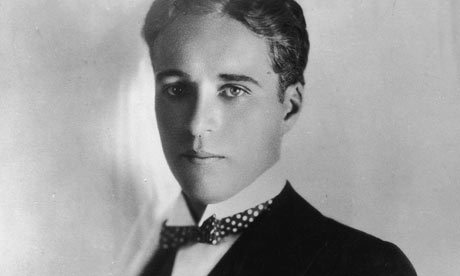
Sir Charles Spencer "Charlie" Chaplin, KBE (16 April 1889 – 25 December 1977) was an English comedian, actor, film director, screenwriter, editor, producer and composer. He can be considered to be the first world-famous movie star, and he remains one of the most recognizable and acclaimed icons of the silver screen up to this day.
Growing up in poverty in London, with a mother who was a failed music hall entertainer of diminishing mental health, Chaplin and his older brother Sydney worked themselves up until Charlie became a leading stage comedian himself. While on an American tour, he was hired by Mack Sennett's Keystone Studios and began appearing in low budget one-reeler comedies in 1914. By the end of that year, Chaplin had starred in 35 films — many of which he'd also directed — and was recognized around the world. By 1916, he was working for the more prestigious Mutual Studios, where he produced, directed, wrote, edited, and starred in his own comedy films. Two years later, he signed a million-dollar deal with First National Pictures and opened up his own studio on Sunset Boulevard (which today houses the Jim Henson Company). In 1919, he co-founded United Artists, one of the major film studios which still operates today. He made the groundbreaking feature-length comedy The Kid in 1921, and over the ensuing decades continued to create a series of highly entertaining and influential films, often incorporating more dramatic stories amid the hilarity.
Chaplin is best known for his character of Charlot, or The Tramp — a poor, downtrodden man who nevertheless takes on life with vim and alacrity, defeating the bully/policeman/figure of authority and getting the girl before walking into the sunset.
Outside of cinema, Chaplin was quite politically active, although this never directly showed itself in his films until The Great Dictator. A scathing satire of Nazi Germany, that film closes off with a narrative-breaking Author Tract delivered directly to the camera, in which Chaplin touches on many of his Real Life personal beliefs (and which is incidentally widely regarded as one of the greatest speeches ever delivered). Accused of being a Communist sympathizernote by the United States government during the Red Scare after the end of World War II — the infamous FBI director, J. Edgar Hoover, had in particular been carrying a grudge, having seen Chaplin as a "subversive" for decades at this point, and was downright gleeful to get him into as much legal trouble as possible — his visa was revoked in 1952 (he was a British citizen) and he lived the remainder of his life in Switzerland. As a result of his political beliefs, his last American film, Limelight, wasn't allowed to be released in the US until 1972, twenty years after it was actually filmed; the fact that it hadn't been screened in Los Angeles prior to then allowed it to be nominated for (and win) that year's Academy Award for best original music score, the only competitive Oscar of Chaplin's career. At the previous year's ceremonies, the Academy had brought the Hollywood legend back to America to present him with an Honorary Award, earning him a 12-minute-long standing ovation in a supreme moment of "burying the hatchet".note
Chaplin's film career lasted from 1914 to 1967. Some of his films include:
- Mabel's Strange Predicament — his second film appearance and the debut of The Tramp
- Kid Auto Races at Venice
- Tillie's Punctured Romance — feature film for Keystone Studios, directed by Mack Sennett
- The Knockout — actually a Fatty Arbuckle vehicle in which Chaplin has a small part
- The Tramp
- The Floorwalker
- The Fireman
- The Vagabond
- The Rink
- Easy Street
- The Cure
- The Immigrant
- The Adventurer
- A Dog's Life
- Shoulder Arms
- Sunnyside
- The Idle Class
- The Kid
- Pay Day
- The Pilgrim
- A Woman of Paris — a drama which he directed but did not star in
- The Gold Rush
- The Circus
- City Lights
- Modern Times
- The Great Dictator
- Monsieur Verdoux
- Limelight
- A King in New York
- A Countess from Hong Kong (his last film)
According to a memoir, My Life in Pictures, published a year before his death, Chaplin was still planning movie projects right to the end.note He died of a stroke at his home on Christmas Day in 1977, at the age of 88.
Being arguably the first major film comedian, Chaplin is responsible for establishing countless comedy tropes. Many of his descendants followed him into the acting world, including his daughter Geraldine Chaplin and his granddaughter Oona Chaplin. Geraldine actually played her own grandmother in Sir Richard Attenborough's 1992 Biopic Chaplin, in which the man himself is played by Robert Downey Jr. in one of his best-regarded performances, though the film ends with a montage of footage of the unparalled original. Chaplin was also the uncle of Spencer Dryden, drummer of Jefferson Airplane.
A particularly good documentary series is Unknown Chaplin (1983), which managed to unearth lots of rare footage of outtakes from Chaplin's Mutual two-reelers, giving a unique insight into his working methods.
He ended at #66 in One Hundred Greatest Britons.
Trope Namer for Eating Shoes and Charlie Chaplin Shout-Out.
Tropes invoked by his films and the man himself:
- Adolf Hitlarious: Poked fun at Hitler in The Great Dictator, which was a bold stance to take at the time, since most countries, including the U.S.A., considered him to a politician like any other and were reluctant to offend him. Chaplin wanted to warn these people about Hitler's plans and the film was finally released when the man had already invaded Europe. Still, this didn't convince many Americans until Pearl Harbour forced them to enter war with the Axis. From that moment on The Great Dictator was seen as a visionary picture. The similarities between Hitler and Chaplin's physical appearance (tooth brush moustache) were already noticed during the 1930s. Chaplin was even born on April 16, 1889 and Hitler on April 20 of that same year! Hitler himself didn't particularly like Chaplin as he thought that the actor was Jewish (he wasn't). The Great Dictator was banned in Nazi occupied Europe, of course, but he did watch a private copy of it, twice. Chaplin also wondered what he might have thought of it.
- Of note: while other filmmakers were horrified of the propaganda power of Triumph of the Will, Chaplin laughed at it. He used the film copiously to perfect his satire.
- After the horrors of the Nazi death camps came to light in 1945, Chaplin was absolutely shocked, as many other people were, and said that
 if he had known about it he would have never made a comedy about Hitler.
 - Richard Brody, the film critic for The New Yorker, nonetheless argues argues
 that Chaplin's lampoon was a dead-on parody:''What’s most important about Hitler is the fact that he is, in fact, ridiculous—and that people nonetheless adulated him as a political leader. In Chaplin’s film, Hynkel is a joke, but there’s nothing funny about the anti-Jewish pogroms he instigates.
- Amusing Injuries: Chaplin falls down a lot and kicks his opponents around.
- Auteur License: Chaplin got this very early in his film career. In his earliest Keystone films, Chaplin was constantly arguing with his directors like Henry Lehrmann and Mabel Normand about his gags he developed to the point where he feared he was going to be fired. However, studio head Mack Sennett, upon learning how popular Chaplin's films were and impressed at how hard the British actor worked on them, eventually decided to allow him to direct his own films instead.
- Butt-Monkey: Well, his works ran on Slapstick, so of course the Tramp would be subject to non-stop abuse to end up in funny situations.
- Charlie Chaplin Shout-Out: Trope Namer.
- The Chew Toy: The Tramp's role in every single movie.
- Chummy Commies: He's one of the greatest and most famous comedians of all time, brought laughs to millions, and was generally known as kind-hearted, friendly, charismatic, and an all-around decent guy. He was also completely open and completely unapologetic about being very far over on the left side of the political spectrum (to be specific, an anarcho-syndicalist).
- Couldn't Find a Lighter: In Shoulder Arms, Chaplin in the trenches of WWI holds the cigarette over the trench to get a light from a helpful enemy sniper.
- Dashingly Dapper Derby: The Tramp can always be found wearing one.
- Dirty Communists: Was accused of being one, and eventually had to leave the country and live in Europe. He was actually an anarcho-syndicalist, which was just as bad during the Red Scare. The irony of it, was not a single sentence from Chaplin's File was going to bar his re-entry when they were made available for viewing.
- Dumb Muscle: Allowing wily Charlie to defeat him.
- Dumbwaiter Ride: In the 1916's The Count, Mr. Chaplin hides in an unusually large dumbwaiter just as the butler upstairs is summoning it. He gives one of the party guests quite a fright when he arrives on the upper floor.
- Early-Installment Weirdness: In his film debut, the short film "Making a Living," Charlie appears as a con artist wearing a top hat with a drooping mustache. His iconic Tramp character debuted in Chaplin's second film, "Kid Auto Races at Venice." Perhaps more surprisingly, in his first feature film, Tillie's Punctured Romance, made in late 1914 after the Tramp had become a huge breakout character, Charlie again plays a cynical con-artist type instead of the Tramp. Also if you think Chaplin could only do Comedy with Heart, watch A Woman of Paris. You have to remind yourself that Chaplin made it.
- Eating Shoes: Trope Namer in The Gold Rush.
- Eponym: The word "Chaplinesque" is used to describe a melodramatic tragicomedy or "tearjerker".
- Everyone Calls Him "Barkeep": "The Little Tramp/Charlot"
- Evil Elevator: Possibly the first filmmaker to use malfunctioning mechanics such as elevators as gags.
- Excuse Plot: Chaplin made whole movies by trial and error, only using some pre-planning on his features, saying that he didn't worry about the story, knowing it would naturally grow out of the characters;"I don't care much about story—plot, as they call it. If you have the neatest tailored plot in the world and yet haven't personalities, living characters, you've nothing."
- Five-Finger Discount: In The Floorwalker a group of shoppers strip a display in a department store bare while the salesman is trying to run The Tramp out of the store.
- Good Hair, Evil Hair: The toothbrush mustache done with make-up helped the Tramp's silly look. To the point where only Chaplin and Oliver Hardy get a pass on using it, given the mustache wound up being ruined by Adolf Hitler — but not before Chaplin mocked how there was a guy resembling him in The Great Dictator.
- Hall of Mirrors: in The Circus. Maybe the earliest use of this trope?
- The Heavy: 11 of the 12 Mutual films feature Eric Campbell as an intimidatingly large Big Bad and a comic foil to the tramp's antics
- Hot Pursuit: The Tramp often crossing paths with the police, resulting in hilarious chase scenes (a holdover trope from Mack Sennett). Police chase scenes of note include ones from The Kid (1921), The Circus, and A Dog's Life.
- Iconic Item: His bowler hat, big shoes, toothbrush moustache and bamboo cane. Just try imagining the tramp without his trademark bowler hat.
- Insult Backfire: After repeatedly being "accused" of being Jewish, he finally retorted, "I'm afraid I don't have that honor."
- Instant Seduction: In his autobiography, he mentions that a girl staying next to him flirted with him by knocking on the wall a few times. He went to meet her and within three lines, they "engaged nocturnally." Awesome.
- Intergenerational Friendship: He became very close to his The Kid co-star Jackie Coogan, to the point that when Coogan, now grown up (and shortly before being cast as Uncle Fester), saw Chaplin in LAX and went up to speak to him, Chaplin burst into tears and shouted, "My God! My dear sweet boy!" The two remained close for the rest of Chaplin's life.
- Kick the Dog: Often the 'dog' is Charlie himself, other times a dog is literally kicked, such as in the short Sunnyside.
- Laughing Gas: Laughing Gas, a 1914 short, has Chaplin playing a dentist who uses nitrous oxide (or laughing gas) as an anesthetic on his patients, only to end in hilarious results.
- Literal Ass-Kicking: Lots of it. The Tramp in particular seems unable to let a good rump go by unkicked.
- Lost in Character: Some behind-the-scenes footage from The Great Dictator sees Chaplin verbally abusing a crew member, while in costume as Hynkel. Chaplin would later dicuss the incident in an interview, admitting that wearing a fascist uniform for portions the film had somewhat of an adverse effect on his personality.
- Meat-O-Vision: In The Gold Rush. An anecdote says that the extra performing in the chicken suit couldn't get The Tramp's distinctive walk just right, and eventually Chaplin had to do it himself.
- Mickey Mousing: Even though his movies were silent, Chaplin would always have someone playing an instrument like the violin on the set so a tempo and rhythm for the scenes could be established, and then a separate score could be played to the film later on. Jerry Lewis said in an interview that he learned this method from Chaplin and applied it to his own movies.
- Mistaken Ethnicity: He was famously "accused" of being a Jew, and graciously responded, "I do not have that honour."
- Mistaken for Gay: In Behind the Screen, a country girl is trying to get hired as an actress at the silent film studio the movie takes place in, and failing that, she dresses up as a stagehand and gets hired as one instead. David, Chaplin's character, finds out that she's actually female when the cap covering her long hair falls off, and after she puts it back on, the two kiss passionately, which his boss, Goliath, happens to witness and thinking the other stagehand is also male, proceeds to mock David by walking back and forth with dainty steps with his arms at his sides, essentially calling him "a fairy".
- A Nazi by Any Other Name: The Great Dictator made a not-so-thinly veiled attack on Nazis in 1940 when not only were the Nazis still in power, but America was officially at peace with them.
- No Ending: If it wasn't a Bittersweet Ending it was probably this.
- No Name Given: For almost every character in his movies.
- Nonspecifically Foreign: The Tramp is seldom refered to by name, but when he is given a name in the inter-titles it's either "Charlie" or "Charlot", implying perhaps that he is intended to be French. The singing scene in Modern Times, the only time the character actually "speaks" on film, sees him singing a nonsense language that sounds somewhere between Italian and French.
- Outliving One's Offspring: When you have eleven children, this is bound to happen. (He outlived two.)
- Perpetual Poverty: The Tramp, although he occasionally comes into money during the course of a movie. See The Gold Rush.
- Pint-Sized Powerhouse: The character was known as The Little Tramp for a reason, as Chaplin was 5' 4" (1,63 m), and while he is mostly a clumsy piece of slapstick, at times he can take out very large and burly men.
- Pop-Cultural Osmosis: Chaplin is universally recognizable to many people, even those who never saw or enjoyed one of his films. He has been a mainstay of pop culture since 1914, inspiring countless songs, comic strips, cartoons, parodies, circus clown acts, etc.
- The Pratfall: Featured in many of his works.
- Pretty Boy: Just look◊ at young Chaplin!
- Prima Donna Director:
- See this anecdote, from Marlon Brando of all people.
- Allegedly, the scene in The Circus in which the Tramp walks a tightrope took 600 takes before Chaplin was satisfied with it.
- See this anecdote
- Propaganda Machine:
- Chaplin directed Shoulder Arms in 1918: a film in which he is a soldier in the trenches during World War I, poking fun at the German soldiers. He made this picture to duck rumors that he didn't enlist in the British Army during World War I because he was scared. By making and appearing in this film he did show some sort of engagement.
- The Great Dictator was used as a propaganda film too.
- Furthermore, Chaplin made The Bond at his own expense purely as a war bond promotion after the US entered World War I.
- Public Domain Character: The Tramp.
- Rags to Riches/Self-Made Man: He was born to an estranged, alcoholic father and a mentally-ill mother and spent time in workhouses, but eventually became so wealthy and famous that he could make any film he wished, independent of the Hollywood studios.
- Red Oni, Blue Oni: Red to Buster Keaton. At least when it came to their characters.
- Riding into the Sunset: An ending used in many of his films as the Tramp, when at the end he would be seen walking down a street into the sunset, alone or along with the female lead. Fittingly, the last of his Tramp movies, Modern Times, ends this way.
- The Rival:
- Buster Keaton and Harold Lloyd during the silent era. Chaplin did work together with Keaton in Limelight.
- Laurel and Hardy during the talkies era. Chaplin had a specific rivalry with Stan Laurel, being that both men were part of the same music hall comedy troupe. While Chaplin was the star, Laurel could imitate him so perfectly that almost nobody could tell the difference. Chaplin was quite jealous about this and after he made it big in Hollywood in 1914, he never helped Laurel out to become a star himself. After Laurel teamed up with Hardy in 1927 to form the screen's most iconic comedy duo, Chaplin still couldn't understand why they were considered to be so funny. Laurel, for his part, later opined (in a 1957 letter to a friend) that Chaplin was not only "mean and cheap" but even exhibited "signs of insanity".
- However, when they were sailing from one engagement to another, Chaplin would practice the violin so Stan could cook bacon on the gas ring and nobody would notice.
- Silence Is Golden: Several silent film greats faded into obscurity with the arrival of the talkies, but not Chaplin; he continued to make more-or-less silent films like City Lights (which has no audible dialogue at all) and Modern Times (which has very little dialogue, and none from the Tramp save for a gibberish song), and had success with them. It would take until 1940's The Great Dictator, made more than a decade into the sound era, before Chaplin would speak intelligibly onscreen.
- Sliding Scale of Idealism vs. Cynicism: Even though most of his films didn't have clear cut happy endings, there was still a sense of heartfelt optimism and human emotion in many of his movies. This shines the strongest in The Kid and City Lights.
- Speaking Simlish: Chaplin's Tramp character never spoke a word until 1936's Modern Times, in which he takes a job as a singing waiter but forgets the lyrics to his song, so he sings complete gibberish instead. Chaplin liked the fact that silent comedy crossed all language barriers and so didn't want to limit the Tramp to one language for his only speaking scene.
- Strictly Formula: This was Chaplin's main misgiving about his period with Mutual: he felt his films there were drifting to this trope, as he noted "Does every film have to end with a chase?"
- The Tramp: His basic character archetype.
- Walking the Earth: The Tramp is a real globetrotter.
- Your Costume Needs Work: At the height of his fame, Chaplin entered a Tramp lookalike contest in San Francisco and lost. He was not wearing a costume, however, and the judges probably recognized him.