
Conflict is the driving force of nearly any story. It provides suspense, action, adventure, conversation, contemplation, development and football hooligans.
With that in mind, it's inevitable that the combinations of conflict will be well charted and mapped. A fight may be between a too-good-to-stand hero more wholesome than Mom and apple pie and a serial bank robber who uses a gun that turns things into gold. It may be a pair of teenaged brothers who like the same girl. But there is a certain tenor to the conflict that goes hand in hand with whether or not one of the participants is, in fact, a horrible person. Maybe there are actions that can be taken against Those Wacky Nazis that would be extreme against the Well-Intentioned Extremist. Maybe the Knight Templar goes about his war in a different way from the Dark Messiah. The stakes are certainly higher when The Hero is up against an Omnicidal Maniac rather than an Ineffectual Sympathetic Villain, and so the tension is heightened.
In any case, morality is a big part of conflict and with morality, the shades of black, white and grey that a story carries with it. Remember, though, just as Light Is Not Good and Dark Is Not Evil, it is the actions of the people involved rather than their image that determines whether they are Good People, Bad People or Guess It Doesn't Matter People.
Compare Good and Evil for Your Convenience.
Not to be confused with Cool Shades or Sinister Shades, though those may be involved somewhere.
Sub-tropes include:
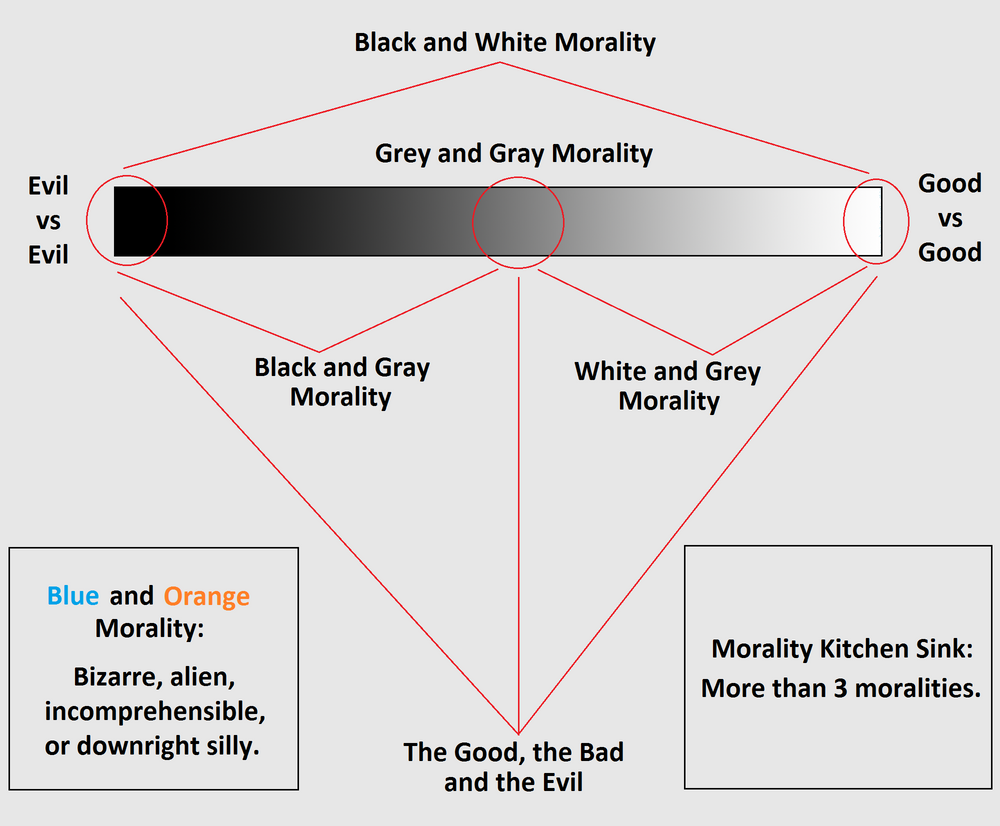
- Black vs. White: Doesn't need too much explanation. Harry against Voldemort, Belmont Family versus Dracula, Gondor against Mordor, Autobots against Decepticons, etcetera. When there are a lot of other conflicts on the side, this tends to be the one most emblematic of the series. The Worthy Opponent may deign to work for the Card-Carrying Villain to get the chance to fight the Messianic Archetype, but the story isn't so much about the first as it is about the last two.
- Graying Morality is a gradual subversion of the Black and White narratives, as the moral conflict becomes more nuanced with more shades of gray evolving. Ideal Heroes becomes Anti Heroes, while the Bad Guys become Anti Villains. May turn into full Grey-and-Gray Morality given enough time, or in more idealistic settings, White-and-Grey Morality.
- White vs. White: Both sides are heroic, but neither side can agree on an issue, causing a conflict in which Both Sides Have a Point.
- White vs. Grey: A lot of conflicts between the Ideal Hero and the Anti-Hero or Anti-Villain tend to lean on this side.
- White, Grey and Black Conflict: There are three factions, one the clear cut good guys, one the clear cut bad guys and one that doesn't fit either.
- White and Grey vs. Black: The core good guys don't do bad things, but there's other groups in the world who hate the villains just as much and are willing to do nasty things to them that the heroes don't have to.
- White/Grey and Black vs. Black: Basically, where the heroes are forced to team up with bad and not-so-good people to take down other bad people.
- White and Grey vs. Grey and Black: When you want one side to be good guys yet still have moral ambiguity in both parts of the conflict.
- White vs. Grey (and sometimes White) and Black: The villains are mixed in with people who aren't puppy-killing evil. Often leads to the dilemma that one must hurt the non-villains.
- White vs. Grey vs. Black: Where the conflict is a Mêlée à Trois between a good faction, a morally complex faction, and an evil faction who don't ever (or at least rarely ever) team up with each other.
- Grey vs. Gray: More cynical works tend to fall here, although still more idealistic than Evil vs Evil or Black and Gray. Revenge stories, such as Cycle of Revenge and Feuding Families often present such a conflict. Don't have to go Grey to get a well-developed character or anything, but it does make it easier. See also Unsympathetic Comedy Protagonist for a frequently grey conflict that doesn't have to be realistic. (Handled poorly, risks becoming A Lighter Shade of Grey.)
- A Lighter Shade of Grey happens when both sides are still morally ambiguous/neutral overall, but one is more good than the other. Handled poorly, this can become Black-and-White Morality.
- Moral Disambiguation is a subversion of Grey vs. Gray that moves towards Black-and-White Morality.
- Grey vs. Grey and Black: A subgroup of Grey-and-Gray Morality. Basically, both sides are handled with great moral ambiguity, but the enemy side is made clear by there being also some Black individuals in place along with the Anti-Villain, Woobie, Destroyer of Worlds, Well-Intentioned Extremist, Knight Templar, etc. Only recently put up and worth serious contemplation, especially in regards to the Sliding Scale of Idealism Versus Cynicism.
- Grey vs. Black: The protagonists aren't the nicest guys in the world, and may even be out and out assholes, but we root for them because the people they fight are even worse. Often present in Darker and Edgier works. Handled poorly, this can become A Lighter Shade of Black.
- Black vs. Black: Enemy Civil War, Warhammer 40,000. The most cynical and dark works often fall here. If handled poorly, tends to lead to Too Bleak, Stopped Caring due to it being impossible to root for anyone in the story.
- A Lighter Shade of Black is an attempt to avert this by making one villain the clearly more sympathetic one.
- Grey vs White and Black: Sometimes due to their ambiguity, both White and Black picks on Grey separately.
- Blue vs. Orange: A story where one or more of the sides is not so much good/evil/neutral as alien or just bizarre. May use Otherness Tropes.
- Black vs. White vs. Grey: For works trying to be "realistic" while still having distinct "good guys" and "bad guys".
Also not to be confused with Red vs. Blue (which technically falls under Grey vs. Grey);. The names of the kinds of conflicts listed above probably comes from the convention that Light Is Good and Dark Is Evil (or vice versa). Contrast No Antagonist. See also Alike and Antithetical Adversaries.
