
Must be Monday. New podcast! Just click on the fancy logo below.
SubpagesMain
|
Hello, kids! HERBIE the robot here. A lot of you are probably wondering why I'm on this show instead of the Human Torch. Well, keep wondering, because I'm not telling!
Let's say, just for kicks, that you are writing the latest Crisis Crossover for The DCU. And boy do you have ideas... Oh yeah, it'll be awesome. It'll have a worldwide cult trying to bring forth a monster like the world has never seen, we're talking some serious incomprehensibly powerful crap. And to make things worse, this cult has unleashed The Legions of Hell. Seriously, Earth is screwed up so much that the Justice League ends up having to find the one person who knows enough about this stuff to be of any help: John Constantine, Hellblazer.
Sounds like fun, right? I mean, at the very least it would make for some entertaining fare. Only one problem: You aren't allowed to use John Constantine. Nobody is. The only person allowed to feature John Constantine is the one writing his book - to everybody else, he's off-limits ( exiled, if you will), even though he very definitely exists in the same world that the rest of DC is writing about. *
Most commonly in comics but also in other media, there are parts of The Verse that, while in Canon, aren't available to be placed in current stories for a variety of reasons.
Part of Executive Meddling, with a dose of Viewers Are Morons and maybe even a bit of Canon Discontinuity.
Such circumstances inspire many a writer to create a Captain Ersatz or an Expy.
Examples
open/close all folders
Content Reasons
- Vertigo Comics, while a part of DC, has/had such comics as the above mentioned Hellblazer, as well as Swamp Thing, The Sandman, and others. While they are technically in DCU continuity, and have made token appearances every now and then, they are not allowed to make any big significant guest appearances because their series/stories are too dark and mature to risk some unknowing kid picking up an issue of Hellblazer after a Hellblazer/Superman crossover. Arguably, this is completely pointless; many Modern Age comics in The DCU are just as violent and disturbing as anything you'd find in Vertigo. Perhaps out of this realization and Vertigo's shift to publishing only creator-owned comics set outside the DCU (as well as because, outside of John Constantine, most of those characters are without an ongoing title - and with the exception of Tim Hunter, most of the characters predate the Vertigo line itself), the embargo was loosened up during Brightest Day and officially broken by the New 52 reboot*
the in-universe explanation being that Vertigo was one of three split timelines that Barry Allen merged as he rebooted the universe at the end of Flashpoint , with Swamp Thing and Constantine being active members of the new DCU.
- This led to the creation of several Constantine expies, such as Willoughby Kipling (who has since met and compared notes with Constantine), Rasputin, and Ambrose Bierce (a Historical Domain Character who lampshaded this practice by claiming "They give you a trenchcoat and steal your razor. Like an assembly line, really.")
- Also, Daniel, aka Dream of The Sandman made a notable appearance in Infinite Crisis to pick up his recently deceased mortal parents, though the character is never specifically identified. He's also made cameo appearances in JSA, since he had a few connections to the team, and a Halloween Issue of JLA. (Grant Morrison said this was intended as the 1990s equivalent of The Phantom Stranger showing up on the JLA Satellite at Halloween.)
- The second version of Challengers Of The Unknown, which existed in a sort of halfway-house between Vertigo and the DCU, alongside Fate and Night Force, managed to feature a quick cameo by Constantine during a Superman crossover. The two characters never actually met, though.
- Kevin Smith also liked throwing in Vertigo references: Morpheus cameos in a late issue of his run on Green Arrow, his Batman makes references to Swamp Thing's once Ret-Conned attack on Gotham, and Fun Land, a Sandman serial-killer with a thing for kids and amusement parks, shows up for a Batman Cold Open. Presumably, he can do what he wants because, hey... Kevin Smith.
- Death of the Endless had a major role in an Action Comics storyline, with a prominent ad campaign. Gaiman has said that he's a little less leery about giving permission. He however was consulted prior to the issue, and even contributed some of Death's dialogue in the issue.
- Lucifer made an appearance during issues of The Spectre, fresh out of Hell and enjoying Australia.
- Subverted with Alias; though originally conceived as a stand-alone book with no overt ties to the Marvel Universe (complete with Bendis being made to create a Suspiciously Similar Substitute for the original Spider-Woman, due to these mandates) but the book quickly became tied into the Marvel Universe due to Bendis incorporating Jessica Jones into the cast of Daredevil, as well as retconning Jones as being a previously unmentioned classmate of Peter Parker. She has since married Luke Cage and has a daughter with him.
- Though the entire reason the book was cancelled and relaunched as The Pulse in the first place was because Marvel was growing increasingly wary of having their A-list heroes showing up in a book full of F-bombs and sex jokes. Bendis himself acknowledges this in the letter page of the final issue.
- The MAX War Machine miniseries is similarly out of continuity.
- Warren Ellis originally wanted to use Nick Fury, SHIELD, and Hydra in Nextwave. Marvel vetoed it (apparently having Nick Fury inject pureed chicks subcutaneously was beyond the pale), so he invented a host of Captain Ersatzes. Nick was replaced by Dirk Anger, SHIELD by HATE, and Hydra by the Beyond Corporation. Arguably, this worked out for the best.
- Interestingly, Marvel failed to do the same with the heroes of the piece, with the result that even though the series was never meant by the editors to be in canon, Marvel eventually incorporated the Nextwave version of Machine Man into canon with his post-series guest spots, as well as "handwaving" the Nextwave version of the second Captain Marvel as being from an alternate earth.
- Even more interesting, Marvel actually adopted Nextwave into canon, taking the completely derailed, but hilarious, personalities into their mainstream appearances. This was handwaved with something about mind alteration through drugs. However, everything created for the series was abandoned, including The Captain.
- The DCU's Ambush Bug took a lighthearted look at the DC universe... which happened to be a big no-no at the time, causing his series to be sequestered to its own continuity. The character himself exists within the DCU, and gleefully hops between canon and non-canon at will.
- Other comedic series may or may not be in continuity. For instance, the Giffen and DeMatteis Justice League America/Europe/International was in-continuity, but the later miniseries Formerly Known As The Justice League and the JLA Classified arc "I Can't Believe It's Not The Justice League" don't seem to be — despite the editor-in-chief saying that they are.
- In the Marvel Universe, there's a whole sub-set of superheroes that live their lives sliding in and out of continuity in varying degrees. Many break the fourth wall regularly and parody other characters whenever they appear in their own series, but are welcomed into continuity with open arms.
- Deadpool mocks the costuming choices and real world merchandise of the rest of the Marvel Universe but still gets to make guest appearances in X-Men and X-Men Origins: Wolverine.
- Squirrel Girl and the rest of the Great Lakes Aveng-- uhm, X-Me-- uh, Champi-- ahem... Initiative have had their own mini-series and one-shots, but apart from their own series they have only been featured in a Deadpool tie-in for Civil War and in ONE panel of the latest Crisis Crossover. Justified because the rest of the team are too weak, and Squirrel Girl is all too powerful to be allowed to affect the Status Quo.
- Similarly, Slapstick's debut limited series has been completely ignored by Marvel canon — most notably the events of issue #4, where an irradiated bum destroys major portions of New York, attracting the attention of The Avengers, the Fantastic Four, the New Warriors, Ghost Rider, Daredevil, and other heroes. However, Slapstick himself was recruited into the New Warriors and appeared as a semi-regular character in Avengers The Initiative.
- The early comic stories of Doctor Who had such high strange "Who meets Silver Age" moments such as "Dr. Who" teaming up with Santa Claus to save evil goblins from stealing Christmas. (That example just scratches the surface.) He also had two grandchildren named John and Gillian. Needless to say, we haven't heard much from John and Gillian lately, apart from infrequent appearances which make it clear they don't belong in the "real" Doctor Who Expanded Universe.
- Marvel's first The Punisher series under the MAX banner takes place in its own continuity, through Castle still has his own ongoing set deeply in main continuity. He still can guest star in other characters' books and encounter superheroes and supervillains on his own, but such appearances in the MAX title were forbidden, with the exception of Nick Fury. The post Civil War Handbook lampshades it a lot:
"Although recently Castle has escalated his war on crime even further, with record-breaking body counts, he is paradoxically now rarely encountered in the field by any super hero save Daredevil.(...)It’s almost like he inhabits two worlds, one where heroes can capture him and one where they can’t, and he can slip from one to the other with ease."
Licensing Reasons
- Marvel has had a bunch of series over the years that were integrated into the Marvel Universe, only to be discarded when the licensing stopped. Typically Marvel keeps the rights to the characters who were created specifically for the comic books; these characters sometimes appear in cameos after the main characters can no longer be used.
- There was ROM Space Knight, who was created to sell toys. The thing is, while the comics series was a rousing success, the toy flopped. Inexplicably, Marvel has never been able to get the rights back. This has the side effect of preventing other comics in which he appeared from being collected in trades - most notably an issue of Heroes for Hire. (ROM has been able to make a few cameos, unnamed, in his humanoid form.)
- Godzilla had a 24-issue series in which he fought SHIELD, the Fantastic Four, The Avengers, and countless other Marvel heroes. He then disappeared. Marvel has been able to "cheat" a bit here, though, by having the villain from the series later capture the big G (offscreen) and send him in a mutated mind-controlled form (practically a Captain Ersatz) against Iron Man. Red Ronin, a Humongous Mecha from the series, has made semi-periodic appearances since the series.
- The SHIELD Helicarrier that was used to hunt Godzilla later appeared in The Incredible Hercules. Like all Helicarriers, it fell from the sky. No, seriously, one issue later, Hercules' buddy knocked ALL the Helicarriers from the sky.
- In later comics, Godzilla does make a brief cameo appearance in his regular form, though he's never mentioned by name. This is called attention to in the Marvel Monsters Handbook, where Elsa Bloodstone is baffled that they don't have a monster profile on Godzilla.
- After the end of the Millennium series of Godzilla films in Japan, Toho was willing to license out Godzilla, and Marvel took the opportunity to license Godzilla just long enough to reprint the 24 issue series as a single Essentials paperback.
- The Transformers and the G.I. Joe series were specifically set in Alternate Continuities which were similar but not quite the same as the regular Marvel Earth.
- The Transformers was initially set on the regular Marvel Earth, with Spider Man guest-starring in the third issue, although it was quickly shifted to an alternate continuity as the series went from a four-issue limited series to an ongoing title. Likely in reference to how unlikely this was to stick, Nick Fury appeared in one panel and demanded not to have to fight the giant radioactive lizard again. Until recently, this has meant that IDW's reprint TPB series couldn't reprint said issue (a text synopsis was used instead) nor could they reprint any Marvel UK stories involving Deaths Head (another Marvel character that appeared in Transformers UK).
- While Deaths Head is unequivocally a Marvel character, replacing the character with newer versions (Death's Head II and Death's Head 3.0) does neatly avoid the original's back story involving him being taken from the Transformers universe to the Marvel Universe via the TARDIS. This causes problems in reprints of the original stories, though the gaps are usually lampshaded as the result of "incomplete" archives. Death's Head may have had a reprieve, however — IDW was able to reprint the Doctor Who Magazine comic strip in which he crossed over.
- G.I. Joe also crossed over with the main Marvel universe on a couple of occasions, but these were tiny cameo appearances. In one issue of GI Joe J. Jonah Jameson happened to ask from a newspaper seller if they carried the Daily Bugle, though the actual character was not referred to by name. One issue of Spider-Man featured soldiers in a couple of panels who bore a striking resemblance to the Joes, though again, names were not mentioned.
- Of course, since Circuit Breaker's motivation is that she hates Transformers, Marvel has no use whatsoever for her, unlike Bounty Hunter (uh, I mean freelance peacekeeping agent, yes?) Deaths Head. It seems pretty unlikely that we'll ever see her again anywhere at this point.
- NFL Superpro, the only character whose entire existence can be considered a Dork Age, was only stopped because the NFL pulled its license. He is still in continuity, and was mentioned in an issue of Marvel Team-up (as just Superpro) a year or three back. Robert Kirkman, writer of Marvel Team-Up, wanted to actually use Superpro in a story, but wasn't allowed to.
- Micronauts was yet another toy-based comic. In this case, one concept from it, Captain Universe, managed to escape into the greater Marvel Universe. The non-toy based characters have made a few appearances in Marvel under the name "Microns", and one of these, Bug, played a decent-sized role in the recent Annihilation: Conquest, and later joined the Guardians of the Galaxy.
- Likewise, in reprints of old issues of things like Marvel Team-Up or Marvel Two-In-One, they've had to skip issues that include team-ups with Doc Savage, King Kull, Conan The Barbarian, Solomon Kane...
- Shang Chi: Master of Kung Fu is a modern day continuation of the Fu Manchu stories with the title character being the rebellious son of the villain. While Marvel can still use Shang Chi, the expired license means the original series cannot be reprinted.
- Before Panini bought up Marvel UK, the Doctor Who Magazine comic strip was more-or-less part of the Marvel Universe. While both DWM and Marvel still make occasional nods to the shared mythology invented by Alan Moore and others, they can't refer directly to each other any more. Notably, the Special Executive never mention their Gallifreyan origins.
- During Marvel's run of Star Trek comics in the late-nineties, they put out two issues of a Star Trek/X-Men crossover (one issue with TOS crew, one with the TNG crew), which also spawned a novel. Odds of Storm or Wolverine mentioning that they actually met Captain Kirk or Captain Picard in a recent issue? Yeah right.
- Shogun Warriors, a comic that featured Combattler V, Brave Raideen, and Dangard Ace. Not a chance of them showing up ever again...
- Though in this case it's because all three machines were explicitly destroyed after the license ran out.
- As with the Micronauts example above, the non-toy characters (such the human pilots of the aforementioned robots) survived, and have made sporadic appearances in the Marvel Universe.
- The tabletop wargame Star Fleet Battles (and its RPG spin-off Prime Directive) is an interesting case; they're only licenced to use elements of Star Trek: The Original Series and Star Trek The Animated Series, but not the actual characters. So in addition to the Enterprise crew never being directly mentioned, the game is set in an Alternate Continuity that lacks Cardassians, Borg, Ferengi, and many of the now-established races of The Federation. On the other hand, it's also the only Star Trek spin-off that still uses the Kzinti.
- The Star Trek CCG was only able to use characters from Star Trek: The Next Generation onward, since a CCG based around the original series had been licensed to a different company. Subverted in that, when the Star Trek: Deep Space Nine episode "Trials and Tribble-ations" aired, almost all of the original series characters were now DS9 characters too, and promptly got cards.
- The Milestone heroes were barred from appearing in DC's Blackest Night crossover so the company could avoid possible issues with future reprints. The 2011 DC relaunch had Static moving to New York, presumably as a way for DC to avoid using the rest of the Dakota-based Milestone heroes. Despite this, Static appeared in Justice League Unlimited without much issue, and Rocket and Icon both appear in Young Justice.
- While Rocket, Icon, and Static can appear in the television episodes of Young Justice, Rocket and Icon have since been pulled from the tie-in comic. Rocket appeared with Zatanna for a brief scene in issue #20, but when Zatanna reappeared in following issues, Rocket had disappeared. Icon was notably shown on the solicited covers for two different issues, but by publication time, he'd been photoshopped out.
- DC briefly published a series of titles centered around the Red Circle heroes, who were owned by Archie Comics. Archie has now regained publishing rights to the characters and will be launching them in their own titles, meaning that DC can no longer use or mention any of the Red Circle characters, even those who interacted with other DC heroes.
- Buffy The Vampire Slayer and Angel had this problem after the 'Angel' license was dropped by Dark Horse and picked up by IDW. Eventually, an agreement of sorts allowed the use of a couple of characters, and in 2010, at Joss Whedon's request to have everything Buffy comics under one publisher and thus avoid this trope, IDW voluntarily surrendered the Angel license to Dark Horse.
- In the Stargate Verse, the only Stargate SG-1 characters to appear in the pilot episode of Stargate Atlantis were Jack O'Neill and Daniel Jackson, even though other characters like Col. Samantha Carter would have made sense given that the new series was very tech-heavy. Producer Brad Wright noted that MGM only allowed them to use pre-existing characters from the original movie for the pilot, although they were permitted to bring the other cast members in for later episodes. Things seem to have gotten straightened out later on because the pilot of Stargate Universe had both Samantha Carter and Walter Harriman from SG-1 making an appearance.
- The Daleks never made an on-page appearance in the Doctor Who New Adventures because the publishers couldn't afford to pay Terry Nation his royalties.
Legal Reasons
- The SPECTRE fracas in James Bond movies is a good non-comics example. The villainous terrorist organization debuted in Thunderball, a book written by Ian Fleming based on a screenplay he worked on with several other people. One of said people brought him to court in a complicated brouhaha; eventually, it was settled out of court, but the terms prevented SPECTRE from appearing in The Spy Who Loved Me.
- The estates of Siegel & Shuster, original creators of Superman, won a court ruling that the concept of Superboy belonged to them. This is believed to have led to the death of one character, the Modern Age clone Superboy, and the renaming of another. Any writer at DC who suggests making another Superboy character will probably be denied, even if their idea is awesome. Even the Legion Of Super Heroes cartoon, which was based on the concept of Superboy, instead has a teenage "young Superman" as its star. And the DVD of the '60s Filmation Superman cartoons had the Superboy shorts deleted.
- It's since been ruled that Kon-El (the '90s clone Superboy) is different enough from the original Superboy ("our" Superman as a teenager) to be used with impunity.
- Big Finish could not use Grace in Big Finish Doctor Who audios because the character is partly owned by Fox. (They could get her actress to voice different characters.)
- In The Transformers, the Jetfire toy was a licensed reissue of the Bandai VF-1S Valkyrie toy, and the character was to resemble the toy for obvious reasons. However, difficulties with one of the entities involved with Macross/Robotech (It's not clear whether it was Big West, Tatsunoko Production or Harmony Gold who put their foot down) made it obvious to Hasbro, Sunbow and Toei Animation that the character could not be used without a major hassle. Instead, the cartoon featured "Skyfire"... and the comic books used Skyfire but called him Jetfire. Thanks to the multiversal nature of Transformers fiction, none of this is a problem—Skyfire and Jetfire are considered Alternate Universe counterparts who happen to be unusually divergent, and modern depictions tend to feature a "Jetfire" who combines elements of both—but it's still weird.
- Similarly, issues over the ownership of Deaths Head and Circuit Breaker; Marvel ramrodded both into non-Transformers appearances (Circuit Breaker appeared in cameo in Secret Wars II and Death's Head in an editorial cartoon) before they "officially debuted" in their respective Transformers comics to ensure that they own the two characters and not Hasbro, meaning that their issues can't be reprinted by IDW Comics. Which in the case of Death's Head, means that none of his UK stories ("Galvatron: Wanted Dead or Alive" and "The Legacy of Unicron") can be published in the United States (though both stories did see release via comic shops via importing of the UK published trade paperbacks). Circuit Breaker's situation is more complicated, as the first three TPBs had to replace her early appearances with text summaries, though apparently IDW was FINALLY able to strike some sort of deal with Marvel to reprint #72-80 in full come the release of volumes #5 of their reprint series.
- There has been a pullback of Wonder Woman-related characters due to an obscure clause in the licensing agreements that forbids their use in any project wherein they are not featured in a "starring" role. This has meant that the second Wonder Girl, Cassie Sandsmark, was initially not able to appear in DC's Young Justice. Prior to this, Donna Troy had been barred from appearing in Teen Titans and Wonder Woman was the only Justice League cast member not to appear on Static Shock.
- Lauren Faust ran into this problem during the creation of My Little Pony: Friendship Is Magic. Turns out Hasbro lost the rights to nearly all of the 1980's character names (save for Applejack and Spike), so most of the main cast of the current cartoon ended up being expies of the originals with the G3 ponies' names.
- Don't expect to see Tarzan ever again in any Kingdom Hearts game past the first, even in the form of flashbacks or recaps, as Disney is unable to secure the Tarzan rights from the Edgar Rice Burroughs estate.
- Temporary averted for the HD remasters; otherwise the game would've had a massive retcon.
- Avoiding this is part of the reason that the Daleks have at least one obligatory appearance in Doctor Who in any given season of the new series, even if just a cameo appearance as was the case with "The Waters of Mars" in the 2009 specials and "The Wedding of River Song" in Series 6. In the license agreement with the estate of Terry Nation, the Daleks have to make regular appearances of some sort on the show (and Nation's estate has to be given final approval on any Dalek story) or the estate can exercise a clause allowing them to revoke all rights to the Daleks and shop the creatures around independent of Doctor Who.
- Speaking of which, scuttlebutt has it that the Daleks' cameo in Looney Tunes: Back in Action (2003) nearly exiled the creatures from the new series (which began in 2005), for Warner Bros. used them without the approval of the estate, which made them very angry to the point of burning bridges with The BBC; it wasn't until Steve Martin (who would only do the movie if there were Daleks cameos) wrote an apology to the estate that the BBC was allowed usage of the Daleks. In retrospect, this helps explain the near-genocide of the Daleks in the Time War as a legal safety net.
- The embargo on Buffy the Vampire Slayer and Angel crossovers is a good example of this. When Buffy moved to UPN, Angel remained on The WB, and until the networks came to agreement a season later, no crossovers could be done. This made things extremely difficult when Buffy wanted to meet and talk to Angel after her resurrection. Neither series could use the other network's character, so the meeting had to take place between Sunnydale and L.A..
- Additionally, by the time the Buffy tie-in novels set in season 3 were being released, Wesley had already left for 'Angel' and that series had the rights to him. So, none of the season 3 set novels feature Wesley at all, only the episode novelizations do.
- Way back when, FASA had obtained a license to use a number of mecha from three anime shows — Crusher Joe, Fang of the Sun Dougram and — yep, you guessed it — Super Dimension Fortress Macross for use in their BattleDroids wargame. Never heard of Battledroids? That's because George Lucas threatened a lawsuit over the word "Droid". So, the game became BattleTech. Then, in 1994, Harmony Gold complained and threatened a lawsuit over use of the Macross mecha in the game. The problem was that FASA had rights to the miniatures that originally came with the game, which were based on the aforementioned designs. But because of the way they were licensed, FASA did not necessarily have rights to the artwork, which Harmony Gold took them to task over. The battlemechs based on those designs continued to be used (The Warhammer and Marauder are some of the most famous 3025-era battlemechs), but not depicted in images, being dubbed the "Unseen".
- A year or so ago, Catalyst Game Labs (the game's current publisher) gained the rights to use the artwork for much of the Unseen... except for Macross based designs, which Harmony Gold still retains control over.
- Another attempt to bypass problems with the Unseen was the Technical Readout: Project Phoenix, which published updated, original artwork for the designs, using the art style for current-era Battlemechs. The different look is explained in-universe as a simple retooling of production lines to match current Inner Sphere tech standards, letting the new Reseen mechs exist alongside the original Unseen designs in the background and still allowing Reseen designs to be used in the art.
- The prequel film Oz The Great And Powerful pays homage to many aspects of the 1939 film The Wizard of Oz due to its widespread popularity. However, the film is owned by MGM while the original novel is in the public domain, so the filmmakers could not use elements that originated in the movie like the Ruby Slippers (they were silver in the book), the swirl of the Yellow Brick Road, and even the Wicked Witch of the West's green skin tone could not be used (they got around the last one by making it a slightly different shade of green).
- In Deadlands, the town of Gomorra was extensively featured in the spinoff game Deadlands: Doomtown. Unfortunately, all IP for the spinoff game wound up being transferred to AEG and because Gomorra was so heavily tied to the game, any reference to the town became a copyright gray area. Realizing they couldn't write about the town any more, future Deadlands RPG supplements from Pinnacle explained that there was "the Gomorra Incident" resulting in the town getting blown sky high with nothing left to tell a story about and nobody left to explain what happened.
- Knights Of The Old Republic was originally going to include Vima Sunrider from the Tales Of The Jedi comic series as a companion character, but legal issues with other companies had since developed over the name "Sunrider" and so Bastila Shan, a new character, was created to replace her. Oddly enough, her mother Nomi Sunrider is still mentioned once in the first game, but the creators said it was an oversight.
Creator Reasons
- James Robinson's Starman hasn't appeared regularly since his series ended because Robinson retains control of the character until his death. Jack Knight can still appear, if Robinson gives his okay. (He did write an extra issue of the series as part of Blackest Night, but Jack was conspicuously absent.) Jack's only actual appearances since have been merely background cameos in large gatherings, such as Sue Dibny's funeral.
- The Endless from Neil Gaiman's The Sandman series are blocked by a similar agreement. While Gaiman didn't have anything specific in his contract, he has enough leverage to basically have the Endless be de facto off-limits to the rest of the DCU unless he says otherwise. There is one major exception to this: Destiny, who was created before The Sandman and therefore not created by Gaiman. The fact that these characters (again, with the exception of Destiny) fall so squarely into Vertigo Comics territory also kept them from entering into the DCU much.
- However, the second Dream did appear in JLA for a story arc (with Gaiman's blessing), and also for a few one-or-two-panels guest shots in JSA between its relaunch and Infinite Crisis.
- Destiny has appeared much more often since then; for instance, a twelve-issue arc in The Brave and the Bold revolved around the Book of Destiny.
- Gaiman's version of Death did appear in an issue of Captain Atom while The Sandman was still being published, apparently without Gaiman's knowledge or consent.
- There was permission but he didn't like what was done, as she only appeared as an "aspect" of Death (the merciful one, compared to Nekron and Black Racer) and she's supposed to be all Death of every kind everywhere.
- In 2010, Death appeared in Paul Cornell's Action Comics run, with Gaiman's consent and cooperation this time.
- With both the Endless and Jack Knight it's not so much that Gaiman and Robinson maintain control of the characters; they don't and if DC wanted they could use the Endless and Jack Knight all they wanted. The "agreement" is more a gentleman's agreement of "we won't use these characters without your approval" based on respect for Gaiman and Robinson and how seminal both of those works are.
- During her run on Wonder Woman, Gail Simone was denied permission to use Veronica Cale, a villainess created by Greg Rucka. Rucka later allowed Keith Giffen to use Veronica as a supporting character in his Doom Patrol run.
- Similarly, Simone wasn't allowed to use Cassandra Cain in her Birds Of Prey run because Grant Morrison had called dibs on the character for his Batman Inc. series. This led to Cass being entirely absent from the DCU for almost a year, much to the ire of her fans.
- Star Trek The Animated Series was struck from continuity by Gene Roddenberry sometime around the later films or when Star Trek: The Next Generation was getting started, probably because of its more cartoonish elements and a couple of continuity issues. However, there has been a fan backlash (particularly over Yesteryear, TAS' best episode and one which reveals a lot more of Spock's backstory) a couple of references in Star Trek: Enterprise`s Continuity Porn-laden fourth season, have tried to reverse this.
- Paramount pretty much considers the series to be canon now after a fan poll overwhelmingly favored its inclusion.
- Yet they haven't adopted anything from TAS without a Live Action Canon background (outside of a few random shout-outs)
- It is very doubtful, however, that the Kzinti will ever be appearing in Star Trek again.
- Plus, it was actually the animated series that first gave Kirk's middle name as Tiberius, nearly two decades before Roddenberry entered it into "official" canon in the sixth film.
- Elements from "Yesteryear" ended up being used in the flashback sequences in the reboot Star Trek film. The scene with Spock being bulled by his classmates for instance has dialogue that is almost taken word for word from a similar exchange in the original episode.
- This was the point behind the epic 1967 Doctor Who serial The Evil of the Daleks. The serial was supposed to depict the true and genuine final end of the Daleks. It was going to stick — because Terry Nation, the creator of the Daleks wanted to sell a Dalek show in America. The pilot fell through, and by 1972, the Daleks were back from their long exile from continuity.
- While there's a lot of series that the regular Super Robot Wars series can't use for many reasons, there's two series that Banpresto/Namco-Bandai can't use by any means: Giant Robo (Due of the death of his creator) and any series created by Ouji Hiroi, even series that belongs to Bandai-Namco and it's subsidiary, Sunrise like Granzort, Wataru, etc. (Hiroi despises SRW and swore to never allow Banpresto to include Sakura Wars in a SRW game. On the further subject of Sakura Wars, there's the time period the series take place in and the fact many characters (especially Kouran and Iris) hate waging wars against human beings)
- In a similar way, the Queen's Gate Spiral Chaos game excluded Kasumi because Tomonobu Itagaki, Dead or Alive's creator and former director, has an intense hatred of Namco's Tekken.
Commercial/Corporate Reasons
It is these that really get up in people's rig. These are almost entirely the result of Executive Meddling.
- The Bat-Embargo in Justice League Unlimited; Batman characters couldn't appear in the series, because The Batman was airing at the same time, and executives feared "confusion". A similar restriction was in place for Teen Titans, although this one was mutual and prevented Robin from showing up on The Batman until the fourth season (which gave us Batgirl coming first). Later, when Aquaman received the failed live-action pilot for the CW, Aquaman and his supporting cast could not appear on JLU either (leading to the creation of "Devil Ray", and, likely, the replacement of Wonder Woman for Aquaman in the plot of "To Another Shore").
- Confusingly, rights or confusion issues didn't seem to get in the way of JLU using Superman characters when Smallville was airing concurrently.
- Also, both Plastic Man and Blue Beetle were referenced without appearing on-screen in Justice League Unlimited; neither could appear properly due to licensing reasons. Both characters later showed up in Batman The Brave And The Bold, and even starred in the first two episodes. Beetle eventually became one of the more recurring characters.
- The Bat-Embargo didn't go over entirely badly though, since it made room for interesting minor DCU antagonists, like Amanda Waller, to appear in animation for the first time. Just goes to show how good writers can work around any problem. Still... not being able to fully complete the Super Friends Mythology Gag of including Scarecrow and the Riddler in the new Legion of Doom was sad, as was the lack of any Ra's al Ghul plots.
- The Batman itself wasn't allowed to use either Two-Face, Scarecrow, or Wonder Woman. Its first version of Clayface appears to be a Captain Ersatz for the first of these, the second was almost reversed but fell through (with Hugo Strange having to take the role instead), and the last ended up making the Justice League of America's use of The Smurfette Principle even worse.
- Not that Bat-Embargos were new...back in the days of the Super Friends, when the Challenge series (with the Legion of Doom) took place, Filmation's The New Adventures Of Batman was still on the air. That's why you'd never see Joker or Catwoman on the Legion of Doom. The Joker and Penguin appeared in one episode each of Super Friends during the Galactic Guardians series, after the Filmation cartoon's license on him had run out. On the other hand, Riddler and Scarecrow could not be seen on New Adventures (except for the former in the opening sequence, inexplicably in a pink costume).
- It's widely believed that for many years DC did not allow the character Black Lightning to appear in any DC animation (thus resulting in several expies) because that would require paying royalties to the creators. This seems to have finally broken in 2009, and the character has since appeared in Superman Batman Public Enemies, Batman The Brave And The Bold, Justice League Crisis On Two Earths, Young Justice, and a series of DC Nation shorts.
- According to Bat B's staff, the entire thing turned out to be because the legal team were under the impression that DC didn't have rights to the character. When the show's staff asked exactly who did, further investigation turned up the fact that there weren't any legal hang-ups with Black Lightning in the first place. Go figure.
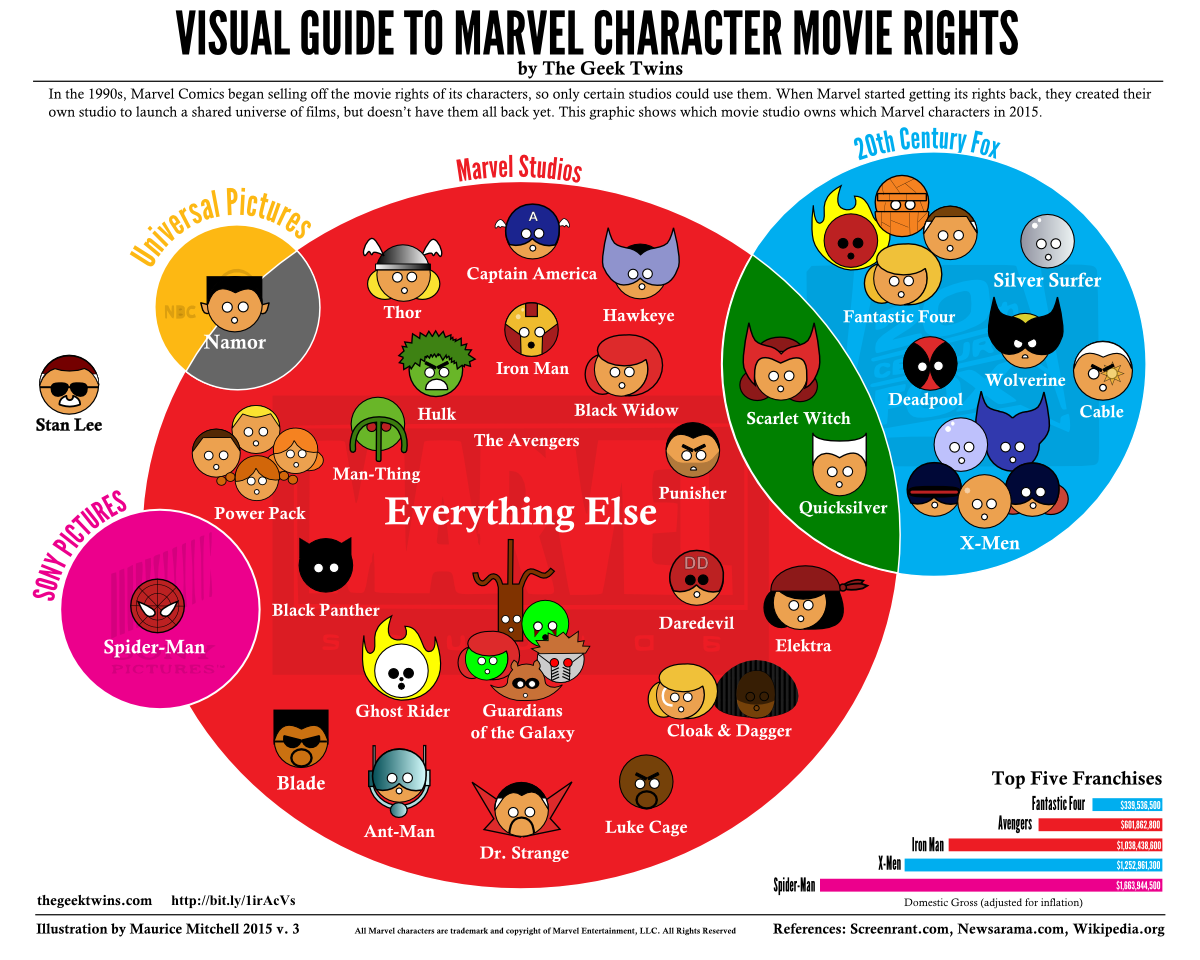
- Because of the ways that Marvel sold off the film rights to its characters, it is highly unlikely that you will ever see crossover movies (with an exception to be mentioned below). The X-Men (licensed by 20th Century Fox) will never be able to be in a crossover movie with Spider-Man (licensed by Sony), nor will Spidey ever be able to fight the Kingpin, or see Ben Urich at the Daily Bugle due to them being part of the Daredevil franchise. Wolverine will never be able to tangle with the Hulk, nor will the Hulk be able to fight the Thing. The X-Men (licensed by 20th Century Fox) may conceivably cross over with the Fantastic Four (also licensed by Fox), but really, why would they?
- In the wake of the success of the Marvel Cinematic Universe, it has been announced by Mark Millar that Fox intends to make their upcoming Fantastic Four reboot in-continuity with the X-Men films, possibly to start their own iteration of the MCU using the Marvel heroes they have the rights to.
- The major exception to this are characters whose rights remain in Marvel Studios: Iron Man, Captain America, Incredible Hulk, The Mighty Thor, Nick Fury, and others; all the above mentioned have their solo movies set in the Marvel Cinematic Universe (apart from Nick, who appears in every film other than The Incredible Hulk), culminating in 2012's The Avengers.
- Since these films aren't in continuity with the X-Men films, however, the films say that Captain America's shield is made of pure vibranium. In the comics, it's made of vibranium and adamantium, the latter of which belongs to Fox due to its use in the X-Men films.
- Particular oddballs in the licensing issues are Scarlet Witch and Quicksilver who, being equally known in comics as mutants and as Avengers, have their film rights licensed to BOTH Marvel Studios and Fox
; the catch is that Marvel Studios cannot have them be mutants in their films and Fox cannot reference the Avengers through them.
- And, of course, according to the contracts for the above licenses, the rights revert back to Marvel if the third-party holders fail to act on them. This is how they got the rights to Hulk and Daredevil back, because Universal and Fox didn't make other movies in time. Similarly, Ghost Rider and The Punisher's film rights have returned to Marvel since their films series don't worth it anymore to the previous rights holders.
- Probably the same reason drove Sony to the recent decisions regarding the Spider-Man movies. Since the development of a fourth episode was tangled in Development Hell and the risk was either losing the license for taking too much time, or rushing to make an extremely disappointing movie (which they'd probably like to avoid after the third), they chose for a Continuity Reboot that started in 2012.
- Marvel made a deal with Sony and regained the animation rights for Spider-Man at the end of The Spectacular Spider Man's run. Hence, due to only regaining the animation rights at-the-time recently, Spidey hasn't appeared on The Super Hero Squad Show despite one: having toys on the SHS toy line and two: most every other prominent Marvel character appears in the series as well.
- Spider-Man can really suffer from this. For the many different Marvel cartoons out there, Spider-Man rarely ever crossed over for any team-ups. He did formally appear on the 70s Spider-Woman cartoon series, but outside of that? Borderline Lawyer Friendly Cameoes on X-Men and Fantastic Four: World's Greatest Heroes. In fact, in an episode of Fantastic Four, viewers can see a cameo of Scarlet Spider instead of ol' web-head. Before 2012, if Spidey was going to team-up with another hero, it had to be on one of his shows instead of one of theirs.
- Video games (at least those in the 6th-7th generations of consoles) are, similarly, not affected by the contracts on virtue of Activision currently holding the video game rights to the entire Marvel comic book universe as well as those to the Spider-Man and X-Men film tie-ins (and before them, there was Marvel vs. Capcom), with one notable exception...
- ...namely, Sierra had the game rights to the comic and film incarnations of the Hulk (by proxy of being owned by Vivendi, which also owned Universal Studios, which held the film rights to the character at the time) meant that only Bruce Banner could appear in Activision's Marvel Ultimate Alliance (They did sneak in the Hulk's arm in the FMV preceding the final stage though); after Activision and Vivendi merged into Activision Blizzard, the Hulk was finally released as a Xbox 360 exclusive DLC character, and is an unlockable character in the sequel.
- Sandman could not appear on Spider Man The Animated Series or the concurrently-running Fantastic Four because he was to be the villain in the aborted James Cameron film. The writers attempted to get around the Sandman ban by using Hydro-Man in his place. Electro was the other villain meant to be used in the Cameron film, preventing his use for most of the series, but the film fell through while the show was still running, so they eventually wrote him in with a completely different identity than his usual one, which had the interesting effect of highlighting just how dangerous someone with Electro's powers would be if they used them intelligently, something the ordinary Electro struggles with.
- Herbie the Robot infamously replaced the Human Torch on The Fantastic Four 1978 cartoon because Universal had the rights to the Human Torch for another project but never used them. It is not the case as rumored that worrying studio executives feared that children would attempt to light themselves on fire.
- George Lucas has placed an Executive Veto on new Wookiee or Hutt Jedi in the Star Wars Expanded Universe. Lowbacca, an existing Wookiee Jedi, was effectively Put on a Bus because of this, and Obsidian had to scrap the plans for making Hanharr a Dark Jedi in Knights Of The Old Republic II.
- It's come to light that there is an extensive internal memo listing all the various species of aliens that are "banned" from Jedi-hood: Gamorreans (pig guards), Sand People (excepting Tahiri and A'Sharad Hett owing to their origins), Ewoks, Vulptereens and other as-yet unrevealed races. The principle reasoning appears to be that these species lack the "mental capacity" to become Jedi. Take that as you may.
- The contract Big Finish have with the BBC stipulated that all elements of the new Doctor Who series cannot be used in their Doctor Who audio dramas. That didn't stop them from throwing in the occasional implied Continuity Nod and Shout Out. For example, the framing story for the Companion Chronicle The Catalyst apparently takes place after the Last Great Time War from the new series, which, for legal reasons, they don't explicitly mention. And a Shout Out to the "What the Shakespeare!" line from the series 3 episode "The Shakespeare Code" appeared in The Kingmaker.*
Along with, possibly a background appearance by the Ninth Doctor, or just someone described as a "big eared northern chap". Nice and vague.
- Initially, the writers of Smallville wanted to do a similar series about Bruce Wayne rather than Clark Kent. They got vetoed because another Batman movie was in the works. This has also prevented them from doing a storyline where Bruce Wayne comes to Metropolis, leading to the recurring 3rd season character Adam Knight (name being a play on Adam West and the Dark Knight nickname) who was a Captain Ersatz of Batman before he was turned evil and Green Arrow/Oliver Queen (originally created in The Golden Age of Comic Books as Batman WITH ARROWS INSTEAD OF BATS!) becoming a recurring character in seasons 6 and 7 and gaining main character status in season 8. As with JLU, other minor DCU characters have gotten the Smallville treatment and thus have been better highlighted. Interestingly, there's a reference to Oliver Queen as early as the very first episode, implying that they'd seen this coming from the start.
- Wonder Woman was also not allowed to appear on Smallville, leading to nearly four seasons where all non-original Superheroes on Smallville were men. Then Black Canary came on board. The final season featured a scene where Chloe Sullivan implied that she had met both Bruce Wayne and Wonder Woman during her globe-trotting adventures, with the implication that they would end up meeting Clark sometime after the show's final episode.
- Eggman Nega has been declared off-limits to the Sonic The Hedgehog comic for currently unknown reasons. The character is acknowledged as existing, has been referenced a handful of times, and has even had some build up as an Ultimate Evil, but has to be called Doctor Nega. According to current writer Ian Flynn, it took a lot of effort just to get permission to use that much.
- It works in reverse too: Sega of America and Sega of Japan have separate copyrights despite being part of the same parent company and nothing created specifically for the comic or the cartoon series it was based on can appear in other mediums; as a result, and Sonic's home planet (Mobius) goes unnamed in Sonic X.
Other/Mixed Reasons
- Hawkman was declared off-limits by DC editorial from 1996-2001, due to the character's Post Crisis Continuity Snarl, caused by the 1989 reboot of the character, even though both Hawkmen were already established in Post-Crisis continuity. For his run on JLA (which featured the old favorites or their Legacy Characters), Grant Morrison created Zauriel as a stand-in for Hawkman.
- In a similar example, one of the very few absolute rules for writers of the Doctor Who New Adventures was a complete ban on use of the Valeyard, simply because the character's vague and confusing origin made him such a walking Continuity Snarl. Later novels in the series did acknowledge his existence without having him actually appear on the page, and he finally appeared in prose Doctor Who in the BBC Books-era Past Doctor Adventures.
- There was a small amount of furor for Super Robot Wars Original Generation after its first Animated Adaptation Divine Wars removed nearly every appearance of the Huckebeins, Humongous Mecha that basically look like Gundams with the Serial Numbers Filed Off. Many fans feared the exile of the entire line, especially after the previews of the Original Generation Video Game Remake on the PlayStation 2 also omitted them, as well as all Huckebeins' model line ceased to sale. These fears ceased when the game itself came out, as all Huckebeins were present and accounted for.
- It's better than that: no one was especially afraid after Divine Wars, because the Huckebein did show up, just briefly in the last episode as blueprints (Though they're just called as MK.3). When a second trailer came out for the remake, the Huckebein animation was removed and replaced with a different unit. At this point, a malicious but clever fan spread rumors then-Bandai (before their merge with Namco) had sued Banpresto over its use of the Huckebein, which for some reason a huge amount of the fanbase believed, despite Bandai OWNING Banpresto and later merging completely with them. Cue massive screaming to the point that Banpresto found out about the rumor and intentionally kept it alive for the sole purpose of amusement.
- It's happening again in The Inspector, the Animated Adaptation of the second game. Brooklyn "Bullet" Luckfield's usual Huckebein MK II he begins with is replaced by a brand new, anime-exclusive machine: a mass-produced Wildschwein (which looks less like a Huckebein). This really doesn't matter in the long run, since Bullet will later acquire a more powerful Super Robot. Most fans believe Namco Bandai doesn't want a knockoff of their popular Gundam Expy making what amounts to a cameo appearance, since most of the cast will be using their character-exclusive Humongous Mecha by the end of the show.
- Fortunately, the show does justify on the disappearance of the Huckebein MK III: the writers simply have The Federation scrap the project. Thus, rather than relegate Ryoto Hikawa to the MK III, he gets to pilot the EXbein, another anime-exclusive unit which, in-story, is the prototype to the intended MK III. Then again, any Super Robot Wars fan isn't entirely fooled to see the EXbein is the MK III: the difference is simply removing the signature V-fin on its head, while adding a pair of giant SRX-like visors around the eyes. The fact the mechanical designer for the EXbein is the same person who designed the Huckebein says something about the similarities between them.
- The EXbein's later topped by Ratsel Feinschmecker's "Guarbein" MK III Trombe, which is essentially his intended Huckebein MK III Trombe/Type R with a Guarlion Custom's head and shoulders. Hilarity Ensues as Ratsel, who's really Elzam von Branstein with a terrible disguise, is piloting a Huckebein with a terrible disguise.
- Vigagi: GuarBein?! Your camouflage can't fool me!
- But now the games are getting into it as well. In OGS2 not only does the Exbein appear but all the Huckebeins (008, both MK.2s and both MK.3s) are all destroyed by Arama's Code Evil. In a really anvilcious way too. They are all just standing there at a base on a map unmanned (granted, they're there for maintanence) and she just shows up and wipes them all out. They even brought back the 2nd MK.2, which hasn't been featured since OG1, just to blow it up. Only the 009 unit (the green one without any special weapons) is intact by virtue of not being there, although it isn't a PC unit anyway. At this point it's either a meanspirited joke or there really is a legal problem.
- Not necessarily, from how Ing's EX-ExBein is portrayed, and some his lines, it seems that the entire thing has been a calculated way to create in-audience emotional build-up for what is effectively the Huckebein MK IV. That said, Ing's lines as he received EX-ExBein can be considered as a Take That to those who're responsible.
- The King Of Fighters has also now suffered from this as SNK is now eliminating all references to the character K9999 who WAS a Captain Ersatz of Tetsuo. Notably for King of Fighters 2002 Ultimate Match, which is a remake of a game that originally had K9999 in it, they replaced him moveset-wise with the new character "Nameless" or Ж'.
- Banjo and Conker were replaced with Tiny and Dixie Kong in Diddy Kong Racing DS, effectively banishing the Microsoft-owned bear and squirrel from the Nintendo-owned Donkey Kong universe (Conker's shift into a Black Comedy character since the original game may also play a hand in this); Tiptup, a recurring Banjo-Kazooie character, is still there. Word Of God was vague on whether their absence was at the request of Microsoft or Nintendo (though it was strongly implied one of the two was responsible). Many of the DKR-exclusive characters are owned by Rare and yet were allowed in anyway, and Tiptup's roles in the Banjo-Kazooie series have been pretty minor (and his character design has been noticeably altered), so it's likely the developers assumed they could get away with it.
- A similar but slightly more amicable example is Geno and the other original characters from Super Mario RPG. While they (especially Geno) proved popular, Square-Enix holds the trademarks to them, essentially cutting them off from the rest of the Mario universe.
- Geno was able to make an exceedingly brief cameo in the first Mario And Luigi RPG game, with permission from Square.
- Expies of the Seven Stars that were the games MacGuffin have appeared in the Paper Mario series.
- When Green Arrow was brought back by Kevin Smith, he insisted on a one-year moratorium that forbade Ollie from showing up in any other titles (despite half the DCU being featured in Kevin Smith's run on the book, including a cameo from the usually exiled Morpheus). The reason? Smith was afraid some moron would botch up his "this'll take a year to resolve" plotline by dropping misleading hints or botching the "amnesia" sub-plot or mucking up the story's timing (the entire 12-issue run takes place over only a very short period of time). It made sense, so DC ran with it.
- The Global Guardians PBEM Universe absolutely averted this trope. If you submitted a character (be it a player or a non-player character) to the setting, it was fair game to be used in someone else's story. Granted, that someone else was required to work with you to do it, and wasn't allowed to turn your character into The Chew Toy without your permission, but you couldn't refuse someone else's requests to use your guy.
- Jean-Paul Valley, the first Azrael, was never seen nor heard from again after his death in Azrael: Agent of the Bat #100, (aside from briefly popping up in Blackest Night, where he did nothing but walk past Scarecrow and kill a few random shmucks.) This is mainly because the editors didn't really know what to do with him after Knightfall ended. This was exacerbated by factors such as that Jean-Paul has never appeared outside of his own title in anything but a Bat-book and one issue of Batman And The Outsiders, where he appeared as AzBats, not ever being particularly popular, and having the exact same creative team for the entire run of his own title. Ironically, Jean-Paul's death took place at the same time as Batman: Hush, which focused on how Batman interacted with his allies, enemies, and loved-ones. Real nice DC.
- During the 90's, Marvel Comics held a contest where readers were able to design a villain for the Thunderbolts title. The winning character, Charcoal, proved popular enough that he was added to the team as a main character. The fan who created Charcoal soon threatened to sue Marvel for ownership of the character right around the time he was supposedly killed off. Though the death was meant to be temporary and the lawsuit never gained any traction, the writers decided to leave Charcoal dead due to the actions of his creator. He has not been seen or mentioned since.
- Pokémon has two examples, one involving a move.
- The Porygon line was never featured (and the evolutions not shown at all, despite the show's nature) after the first form's "involvement" in an incident involving Epileptic Flashing Lights. Qualifies as a combination of Legal and Corporate, as the episode containing the incident in question is under an actual legal ban.
- The move in question is Earthquake
, never used after the 2004 Japan Earthquake (a filler episode was also never aired due to this). A sister move, Magnitude , was used only once in Johto's Tournament Arc, predating this incident.
- It must be noted that these edicts only apply to the Anime. For example, Green in Pokémon Special has a Porygon2
on his main team.
- After Ghost Rider was abruptly canceled in 1998, Danny Ketch made a single appearance in Peter Parker, Spider-Man, where the dangling plotlines from his own book were tied up in a very quick and unsatisfactory fashion, but leaving him still active within the Marvel Universe. His predecessor Johnny Blaze was soon brought back as Ghost Rider, but Danny was barely - if at all - mentioned, and for reasons unknown, never once appeared in any Marvel comic until a decade later.
- Highlander did have Christopher Lambert appear as Connor Macleod in the pilot. However, they couldn't re-use any of the material he shot as flashbacks without paying Lambert another appearance fee, something the budget simply wouldn't allow. So, when footage from the pilot was re-used in a season 4 ep, Lambert/Connor was edited out.
- In the wake of DC's New 52 reboot, former Batgirls Cassandra Cain and Stephanie Brown have been declared off-limits by editorial. Gail Simone pitched a team book that would have starred Stephanie, Bumblebee, Misfit, and Black Alice, but it was not approved, and Steph was subsequently pulled from a scheduled guest appearance in the Smallville comic. Meanwhile, Cass has not been seen or mentioned in Batman Inc, despite the fact that she was one of Bruce's agents (as well as the Batman of China) in the pre-New 52 volume.
- After Crisis On Infinite Earths, Marv Wolfman and George Perez took the opportunity to revise the history of the Teen Titans. While some of the past Titans that they didn't care for got to stay in revamped forms (such as Bat-Girl becoming Flamebird), the character of Duela Dent/Harlequin was one that Wolfman wanted completely gone. She was excluded from the Post-Crisis backstory, and for a time, she was forbidden to be referenced in the comics. Phil Jimenez attempted to set up a plot thread for her in the Team Titans book, but had the story nixed by the editorial team. Duela was finally allowed to be fully re-introduced in the JLA/Titans miniseries, although her past with the Teen Titans was now inconsistent. Some writers retconned her as only being an occasional ally to the original team, while others depicted her as a member in flashbacks.
|
|