
Ah, the wonderful world of medications, drugs, and poisons. Staples of Murder Mysteries and Medical Dramas, and not too infrequently plot devices in Science Fiction (hard or otherwise). Sadly though, there are some writers who never seem to do their homework on the substances in question. Books, screenplays, etc. from such writers often cause those knowledgable of such things to want to ask, "Dude, what have you been smoking?" The absolute worst examples may lead to being Killed Off for Real.
Related to Artistic License – Biology and Artistic License – Medicine. See also This Is Your Index on Drugs and Toxic Tropes. That Old-Time Prescription is a subversion. A visit to Erowid is often recommended as an antidote to this in regard to many drugs.
Subtropes:
- Anti-Radiation Drug: Drug treatments that either instantly cure or entirely prevent radiation poisoning to a degree that is highly implausible in the real world.
- Bitter Almonds: That particular nutty smell and/or taste that indicates that something is poisoned.
- Drugged Lipstick: A cosmetic that puts people under another person's spell through mouth-to-mouth interactions.
- Drugs Causing Slow-Motion: Drugs cause your perception of the surrounding world to "slow down".
- Fantastic Drug: A drug that only exists within a sci-fi or fantasy-based story setting; also sometimes called a designer drug.
- Fingertip Drug Analysis: The old method of dabbing your finger into a substance and then tasting it to see what it is.
- G-Rated Drug: A non-drug substance that is treated with all the properties of a drug.
- Immune to Drugs: A person whom drugs have no effect on, not even to get high.
- Instant Sedation: A person goes out like a light when exposed to or ingested a sedative.
- Love Is in the Air: A drug that causes other people to fall in love with somebody or at least get horny.
- Magic Antidote: An antidote that works instantly on a person.
- Marijuana Is LSD: Effects of certain drugs are exaggerated for the sake of comedy or drama.
- No Medication for Me: A character goes off medication cold-turkey because they feel that the medication was harming them rather than helping.
- One Dose Fits All: The same amount of medicine has exactly the same effect on everyone, regardless of any factors that would require different doses.
- One Drink Will Kill the Baby: Pregnant women are prevented from consuming alcohol because of the dangers it would pose on the developing child.
- Perfect Poison: A poison that is ludicrously easy to kill with.
- Pink Elephants: Hallucinations from alcohol (in reality, alcohol only causes hallucinations if the person is an alcoholic or suffering from severe alcohol poisoning).
- Poison Is Corrosive: Poison so dangerous that it even eats through clothing and human skin upon contact.
- Psycho Serum: A Super Serum that makes you crazy and mentally unstable, among other unpleasant side effects.
- Side Effects Include... (Some fictional medications can have side effects that violate the laws of nature)
- Spice Rack Panacea: The notion that herbal remedies can cure anything.
- Suicide by Pills: Anyone who kills themself by a drug overdose leaves a corpse that looks like they're asleep.
- Super Serum: A drug that gives a person powers such as super-strength.
- Truth Serums: A drug that causes a person to tell the truth, usually used for interrogation purposes.
- Universal Poison: All poisons are the same.
The following examples do not fit any subtropes:
- Death Note features a criminal who, according to his bio, is extremely violent and deranged because he is a marijuana addict. Marijuana's effects do not include violent criminal behavior. This could be due to Marijuana Is LSD, or because marijuana use is highly stigmatized in Japan, to the point where Paul McCartney wasn't allowed into the country for ten years following a pot bust.
- In the English dub of Digimon Adventure, Tai and Izzy search Machinedramon's city for aspirin after Kari develops a fever during the Dark Masters arc. In reality, most pharmacists recommend avoiding the use of aspirin in children under twelve, particularly for controlling viral symptoms, as this can increase the child's risk of developing a serious condition called Reye's syndrome; acetaminophen or ibuprofen would have been safer choices for Kari.
- One Nobunaga no Chef arc involves Kennyo trying to poison Nobunaga by serving him several nutmeg macarons. Nobunaga almost immediately collapsed after eating them, despite the fact that: 1) The number of nutmegs placed in 3 macarons is nowhere near enough to cause poisoning, 2) Fatal nutmeg poisoning is very rare, 3) Nutmeg intoxication takes a few hours after consumption to reach its effects.
- Majin Tantei Nougami Neuro: A chef's food becomes irresistable, due to the secret ingredient... copious amounts of recreational and addiction-forming drugs. The customers show no signs of the drugs' effects other than being addicted to the food. What's more, when the protagonists move to catch the chef, he fills a syringe from a plate of his cooking and inject it into himself, immediately turning into a muscular hulk so he can fight them. Where to even start?
- Every comic book use of drugs fails miserably at pharmacology, especially the Batman villain Scarecrow since his gimmick is a hallucinatory "fear gas". Hallucinogens take 30-90 minutes to circulate to the brain and actually cause hallucinations (and almost all are administered orally). Hallucinations are also extremely unpredictable and are usually caused by setting and expectations before ingesting the drug and most people can easily tell a hallucination from reality, although the Scarecrow does supply some set up by naming it a fear gas. In short, the drug onset is unlikely, the route of administration is atypical, and most importantly, the effects are wrong. Some drugs might fit:
- Salvia Divinorum
 , which can be smoked. Inhalable, rapid onset, etc, etc. Not nearly nasty enough to use as a weapon... but such chemicals do exist and can have most unpleasant effects.
- It also causes a very short period of a sharp decrease in muscle tonus which is usually reported as disconcerting. It may be also pretty surprising for anyone trying to smoke salvia while standing. And hallucinations usually occurs in massive dosages in already phobic or anxious subjects. Hallucinations are endogenous, so it is technically impossible to create a drug that will predictably cause a repeatable horrifying hallucination in every recipient.
- DMT, without an MAO inhibitor, can be smoked - nearly instant onset, incredibly strong effects. Without an MAO inhibitor, it only lasts ten minutes, with one it lasts much longer.
- See also deliriants, such as diphenhydramine and plants from the genus 'datura' (i.e., jimsonweed, belladonna). Deliriants are notorious for producing 'true' hallucinations, often indistinguishable for reality and sinister in nature.
- An important thing to remember about onset time is that it's vastly dependent on route of administration, orally ingested drugs take a longer time to work because they have to be absorbed through the stomach lining and it takes a while for them to filter into the bloodstream, inhalation is much faster as the drug goes directly from the lungs into the bloodstream, most smoked or inhaled drugs will start to show effects within a few minutes possibly even a few seconds, with peak effects kicking in within 5-20 minutes.
- Salvia Divinorum
- The Marvel Comics one-shot title Carnage: Mind Bomb shows the side effects to a Vitamin C overdose as being a severe shock to the nervous system. Dr. Kurtz, after blasting Carnage with a sonic pistol to keep him at bay, injects Cletus Kasady with an overdose of Vitamin C which causes the symbiote to disconnect from Kasady's brain and body. At best, Cletus would suffer indigestion if it had been taken orally but by injection, any excess would be filtered out with no such side effects. This sort of happens as the Vitamin C is metabolized out quickly (in minutes, but the writers had the good sense to tell us that his metabolism was much higher than normal so it didn't seem too much like magic or convenience) and the symbiote reconnects. This use of Vitamin V is just odd, considering that Dr. Kurtz also injects him with "classified" drugs as well to make Carnage more talkative and open, so why not do the same with the first injection?
- Bullet Train: Parts of the plot hinge on boomslang snake venom, which is portrayed as a poison that congeals one's blood and kills in thirty seconds. In real life, boomslang venom can take 1-2 days to produce serious symptoms.
- Amazingly mostly averted in Crank. Although medical professionals do not agree on how long someone could live without adrenaline, all agree that the symptoms are spot-on and the time frame is not that unrealistic. The description of what the Beijing Cocktail did and what he can do to circumvent its effects is also 100% accurate pharmacology.
- But then the sequel kind of dismisses all that.
- In one scene of Meet the Parents, Greg's anxiety becomes so severe he has to treat it by stuffing multiple pieces of nicotine gum in his mouth like a chipmunk and chewing it. Nicotine gum is not supposed to be chewed but instead placed between the gums and the cheek so that the nicotine can be absorbed through the mucosal membranes over a longer period of time. Chewing the gum causes all of the nicotine to be released at once, possibly leading to an overdose which, though not necessarily fatal, can manifest as a number of different symptoms that will make the user very uncomfortable, to say the least.
- Played with in Casino Royale (2006). This trope seemingly is played straight with the scene where Le Chiffre's girlfriend slips the poison in Bond's drink. The substance he is poisoned with, digitalis, generally takes several hours to manifest by which point the salt and water emesis which Bond attempts would have been ineffective. It continues to be played straight as Bond is in tachycardia with a heart rate of 135 BPM; digitalis poisoning generally causes bradycardia or slowing of heart rate. However, the trope is played with and averted in the end, as severe digitalis toxicity can, in fact, produce tachycardia.
- In Albert Brooks' Real Life (1979), a veterinarian requests "two and a half percent halothane" twice during surgery. The nurse administers five percent halothane, and the horse dies. Interpreting a repeated request of dosage as a request to double the dose makes some sense when the drug is administered in discrete doses (it could be interpreted as a request to iterate the administration of the drug), but halothane is a continuously administered inhalation anaesthetic. Moreover, since the mistake was discovered immediately, they could've simply lowered the concentration at once in order to avoid giving the poor horse a fatal overdose.
- In Valley Of Bones, one person treats poison by using an EpiPen (AKA adrenaline). As Midnight Screenings points out, this would spread the poison over the body and kill the person faster.
- More than one classic mystery fiction writer assumed that aspirin was not just a pain reliever but a sedative as well. Ngaio Marsh was especially prone to having characters take aspirin as an insomnia remedy. In one novel, it was even used as a knockout drug. To a certain degree, Truth in Television. Many people treat aspirin as if it's a sedative, and if you have a headache or a backache, relieving the pain will help you get to sleep. The placebo effect works particularly well on problems like insomnia.
- The Hunger Games: Snow used assassination by poison to rise to power. Apparently, the Capitol can neither perform autopsies nor test surfaces for the presence of toxins.note In Mockingjay, Katniss describes morphling as making her feel numb and empty. For opiate addicts (who've begun to grow 'immune' to the effects) this may be the case, but morphine makes non-addicts feel relaxed, warm and happy even through emotional depression.
- The Missus: On their wedding night, Maxim reaches for a condom only for Alessia to stop him and say they don't need one because she's started the contraceptive pill. However, as she only started the pill around three days prior, it wouldn't be all that effective in preventing pregnancy yet (it takes around a month of taking the pill consistently for it to work). It's understandable Alessia may not know this given she's portrayed as quite naive, though you'd think her doctor (whom she saw to get the prescription) would've explained this to her.
- Arrow: It starts becoming a bit of a plot point for a couple of episodes that Laurel is guiltily taking pills every so often from a bottle clearly labelled "Benzodiazepine", and eventually gets caught by the police, where it's found she stole those pills from her father and has tested positive for opiates. However, the first problem is that "Benzodiazepine" refers to a group of drugs rather than one particular drug, and the second problem is that benzodiazepines are sedative drugs used for anxiety and insomnia (Valium and Ativan are two common benzodiazepines), they are most certainly not opiates, nor are they anything like them apart from being potentially highly addictive.
- Chuck: Likes poisons. One particular example had an enemy spy inject herself with a large quantity of ricin to avoid capture because "everyone talks". She dies instantly, despite the fact that ricin can take days to work, slowly shutting down its victim's organs and rendering them in a position of considerable pain. Just tell yourself that the large syringe had hit a major blood vessel and she died of internal bleeding.
- Criminal Minds: You might be intrigued to see a murderer in one episode killing his victims by instructing them to kill themselves, which they do obediently after he blows a certain muscle relaxant at their faces. As this Criminal Minds Wiki entry points out, this was exaggerated from urban legends about scopolamine.
- CSI: The season 12 episode "Brain Doe" features an MMA fighter who uses dimethyltryptamine, DMT, as a performance-enhancing drug. In real life, it's an extremely powerful hallucinogen. Presumably, the writers read about athletes using the other DMT, the designer steroid desoxymethyltestosterone and mistook it for the drug...
- Dexter:
- The sedative he uses on his victims (which also incidentally takes effect immediately) is a real-life tranquilizer, used to sedate elephants. Apparently, getting it on a human's skin can kill them. Maybe he dilutes it?
- Carfentanil (tradename Wildnil), a chemical relative of fentanyl, is the most potent opiate. 10,000 times stronger than morphine, it is used for large animals. Yes, a small amount on your skin can kill you.
- A bottle of water is returned from the lab, analysed as containing "40% alprazolam" — a higher concentration than an alprazolam tablet, and certainly enough that it wouldn't taste anything like water. A swig of it would be a lethal dose.
- Doctor Who usually avoids this by not naming substances or using entirely fictional ones, but "The Mark of the Rani" gets things badly wrong when the Doctor and Peri survive a booby trap claimed to involve mustard gas without ill effects, by wearing minimalist gas masks that only cover their noses and mouths (and look more like medical gas administration masks than anything protective). In reality, the effects of mustard gas on skin and eyes would have killed them. Slowly and horribly.
- General Hospital: An '80s story arc had a character get Easy Amnesia from exposure to a chemical that occasionally produces short term memory loss, but far more often results in crippling brain damage from even mild exposure.
- Homecoming: The Homecoming system is secretly testing drugs on soldiers by slipping it into their food, but this would prevent them from accurately controlling the doses. The show doesn't establish any rules the system has for controlling how much of the drug makes it into each meal, nor for ensuring that soldiers eat all of the food served to them and not share with anyone else. It does establish that harsh side effects will occur when someone skips or doubles a dose, so you would expect that this system would cause problems, especially with soldiers experiencing PTSD whose appetites might be affected.
- Inspector Lynley: This winds up being a plot point in the episode Missing Joseph where Lynley and Havers find it incredibly unlikely that a trained herbalist like Juliet Spence would mistake water hemlock for wild parsnip, which wound up in the meal she made for herself and the local vicar, which killed him but only sickened her since she induced vomiting in herself as soon as she felt ill. For most of the episode, they operate under the assumption that someone else slipped it into the food, but turns out it was Juliet all along, and the whole making herself vomit was part of the plan so they wouldn't suspect her. And the vicar? Her own husband, though she had faked her death years before and killed him because he found out that her daughter wasn't actually hers and had in fact been stolen from her real mother.
- Lost: In one episode Urley is desperately searching plane wreckage for clonazepam, an anti-anxiety drug, to control his hallucinations. It is unlikely this drug would help. Later, Jack, a medical doctor who should know better, describes clonazepam as an antipsychotic, which it definitely is not.
- Merlin: Gaius must be a truly magnificent magician because he is an absolutely terrible herbalist. Valerian would have very little use for an injury. Fenugreek is an herb used to increase a mother's milk supply, not "heal" someone on the brink of death. The list goes on. The writers must have a big piece of paper hung on a wall with a list of herbs they thought sounded cool and a large supply of darts.
- Midsomer Murders:
- In one episode an old lady took a large number of pills, wrote a suicide letter, had tea and then confessed to everything to the detectives before oh-so-conveniently dying before she could be arrested.
- The episode "King's Crystal" has a victim die from ingesting ground glass (quite ironically). Not only was the time it (apparently) took him to die ridiculously short (20 minutes), but according to a variety of literature sources, ground glass isn't deadly (or poisonous) upon ingestion, unless the slivers are large enough that the victim would sense them as he was chewing his food (and they would cut up the inside of his mouth as a result). The odds of dying to ground glass poisoning are, hence, slim to none, unless the victim truly wanted to die (which he didn't).
- In Resident Alien, D'Arcy ends up becoming addicted to painkillers, but the symptoms shown are more consistent with a stimulant.
- Revolution: In the pilot, it's highly unlikely that the asthma inhaler Grace uses to treat Danny has a shelf life anywhere near 15 years, especially without temperature controls. Grace does appear to have access to some high technology and a larger conspiracy, so it's possible new medications are being manufactured somewhere.
- Even old medicine probably still has some of the active constituents in it, due to the half-life effect. The inhaler was probably still better than nothing. Also, asthma attacks will resolve on their own (assuming you don't suffocate in the meantime); medicine just reduces severity and duration.
- Outlander: Claire says monk's hood (aconite) has no known medicinal uses. In reality, it has several, well-known since ancient times, though since it's highly toxic in larger doses other medications are used now. This might be excused as just ignorance, except she is a trained nurse and highly knowledgeable of herbs so you'd expect she'd know this.
- In For Better or for Worse, Deanna gets pregnant with her and Michael's first child, Meredith, by accident. She claimed she was switching birth control prescriptions and didn't know that there would be a period of increased fertility between cycling off the old meds and starting the new. Although not everyone knows this side effect, Deanna is a pharmacist and admits she should have realized the risk.
- Perhaps an example of an unreliable expositor; her husband and sister-in-law are both dubious of Deanna's explanation, and Elizabeth's friend calls it a "planned accident".
- Perhaps an example of an unreliable expositor; her husband and sister-in-law are both dubious of Deanna's explanation, and Elizabeth's friend calls it a "planned accident
- Averted apparently in the d20 games style. It's not a perfect simulation, but the fact that there's an onset time you have to sit out has made some players turn away from poisoned dart guns as a way to convince distant enemies to go to sleep in the modern-set Spy Craft game.
- Want to make a doctor, a toxicologist, and a pharmacist howl in laughter together? Show them the toxins and disease table in the 20th Anniversary Edition of the Old World of Darkness game line. It contains such madness as:
- Methanol is a relatively benign poison, and less dangerous than tear gas (Real world: untreated methanol poisoning will blind you and/or kill you, and even treated it just might)
- You resolve whether or not you get cancer with a roll that takes place in a single turn (3 sec)
- The difficulty of catching a disease and the difficulty of fighting it off are the same, so a lethal disease is always easy to catch, while highly transmissible, not-too-painful diseases don't exist
- Fouled water is a thing. Don't ask what that is, how it's fouled, or with what it's fouled.
- Ebola is apparently airborne since it must be avoided with methods similar to avoiding a cloud of poison gas.
- One Dose Fits All is absolutely in effect.
- It is just as easy to catch HIV as it is leprosy.
- No (non-magical) system describes how to cure these diseases, nor what might be possible with mundane medicine that should be available to the majority of characters in the World of Darkness.
- The game explicitly states that there is no way to do anything but treat the effects of a toxin when several on the list have literal exact antidotes.
- Somehow, in the middle of an opioid epidemic in the United States, in a cartoonishly simple list of toxins, narcotics are nowhere to be seen.
- Somehow, in the middle of an epidemic of deaths from synthetic marijuana in the United States and virtually no cases of death attributed to old-fashioned marijuana, the chart collapses both into just THC.
- Hamlet had a poisoned weapon where it was intended to kill no matter who 'won' (and be slow enough that the poisoner would not be suspected in this case).
- Tsukihime, Kohaku uses the dried crushed seeds of Korean morning glories (aka datura) to give several characters hallucinations and make them think they're going insane. So far so good, but it also depicts the effects of the hallucination as giving the victim a sort of hypnotized pseudo-mind control state, where Kohaku can whisper to them something while unconscious and have them believe her.
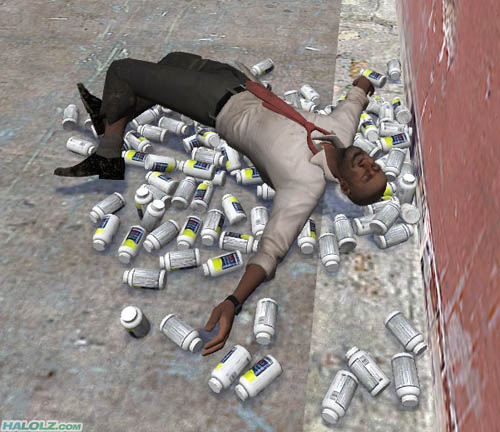
- In Left 4 Dead, painkillers are a useful healing item, and you down the entire bottle in a second without water. Louis is famous because of this.◊
- Judging from the rattling there are only a few pills left in the bottle, making this less likely to just kill the survivor.
- To the Moon: Some beta-blockers, especially propranolol, are indeed used to treat post-traumatic stress disorder (although the treatment is still considered experimental), but they usually do not induce amnesia (what they do is more in the line of allowing someone to relive a traumatic memory without experiencing the trauma). There is no way beta-blockers could have completely erased all the memories of Johnny's life with his brother, except maybe as an incredibly rare and unexpected side-effect. And the idea that it could have been done on purpose in a controlled way, as implied in the game, is even more absurd.
- In the Director's Cut edition of Scratches, the brief sequel/epilogue reveals that the mother of the game's Madwoman in the Attic had been taking Thalidomide, presumably accounting for her child's deformities. But thalidomide is specifically responsible for phocomelia, a birth defect in which the limbs are underdeveloped and flipper-like. Robin may be grotesque, but he does not have phocomelia, and wouldn't be very scary if he were.
- During the RuneScape time-travel quest "Meeting History", you save a character from lifelong throat damage by learning the formula for the cough medicine she takes as an adult and feeding it to her as a baby. Not only would the dosage be different for a baby than for an adult, but the medicine contains raw honey and raw cow's milk, which can make an infant extremely ill. Her father is also rightly concerned that you're a stranger trying to give his daughter medicine without invitation or proof that you are qualified to do so.
- In Quantum Vibe, Bustamante implies acetaminophen is a stimulant; shady as he is, there's nothing to suggest he's wrong about this. There's also some conspiracy theory overtones when Seamus recommends an "old remedy" for post-traumatic stress disorder drawn entirely from the supplement shelf (accompanied by cannabis, but this is explicitly his idea, not part of the "old remedy").
- In The Bird Feeder #198, "Vitamins," Josh claims that vitamin X, which he says is contained in certain bird seeds, gives you shinier plumage. Or Josh is trying to poison Gramps.
- In Lackadaisy, when Mordecai unwittingly sips Rocky's "space coffee", he immediately experiences dilated pupils and hallucinations. In real life, orally-administered hallucinogens take several minutes to absorb and produce hallucinations. Also, Mordecai takes one sip of the "coffee" and immediately spits it out, meaning that he only swallowed a few drops of the liquid at best. Unless the liquid contained a massive amount of a hallucinogenic drug, Mordecai wouldn't have consumed enough of the active ingredient to experience effects.
- The plot of Dangeresque One: Dangeresque Too? involves Dangeresque (played by Strong Bad) trying to recover a serum that will prevent Cutesy Buttons (played by Marzipan) from being kidnapped...somehow.
- In this GoAnimate Grounded video, Arthur dies after overdosing on marijuana. An overdose of marijuana is not fatal, and there are no recorded incidents of marijuana alone killing a person.
- The weblog Polite Dissent often reports on such misuses in comic books and TV shows, primarily pointing out when the wrong drugs are being used, superheroes blandly hand out DEA Controlled Substances, and where the dosages are ridiculously off. The author of the blog is a comic book fan and a licensed doctor, so the articles can be quite informative. He also does surprisingly comprehensive write-ups of House from the same perspective.
- BoJack Horseman: In season 5, BoJack is severely injured after performing his own stunt and is prescribed an opioid. For the most part, his Descent into Addiction is portrayed realistically, but the culmination of his drug abuse in episode 11, "The Showstopper", includes symptoms like paranoia, psychosis in the form of getting Lost in Character as Philbert, and homicidal rage that leads to him nearly strangling Gina to death. All of these effects have much more in common with chronic stimulant abuse than opioid abuse. Even the Nightmare Sequence in this episode where Gina sings "Don't Stop Dancing" is more likely to occur because of stimulants, since having vivid, unpleasant dreams is a common symptom of amphetamine withdrawal.
- Family Guy: In "A Very Special Family Guy Freakin' Christmas", when Stewie manages to calm down Lois after she reaches her Rage Breaking Point and goes on an anti-Christmas rampage, Peter still asks for the police to tranquilize her. Come Christmas morning, she's still loaded with what Peter claims is enough tranquillizer to bring down a bull elephant. Realistically, the police would have needed to ask Peter for Lois's weight to make sure they don't give her more tranquilizer than needed, which would lead to a fatal overdose. Secondly, at least one officer would need to have a taser drawn in case the dart causes the suspect to become violent; contrary to what the cartoon shows, tranquilizers take almost a minute to kick in.
- The Simpsons
- In "The Good, The Sad, and the Drugly", Lisa is put on antidepressants and immediately falls into a blissful and oblivious state complete with hallucinations. In real life antidepressants simply get you back to normal; they don't give you instant happiness. And they certainly don't cause visual hallucinations.
- While it is not the normal reaction, there is a bit of truth to this one. Antidepressants, when given to a bipolar individual, can make them go into a manic episode. They also can cause mood imbalances when they're first started while the body acclimates, but nothing so extreme.
- They also take a while to take effect (sometimes several weeks); it wouldn't be the instant mood lift that Lisa got.
- In "Much Apu About Nothing", Barney is shot with a bear tranquilizer dart. He actually pulls out the dart and drinks the remaining sedative before passing out. When the bear it was meant for is shot with one, he passes out much quicker than Barney did. This is supposedly due to him being an alcoholic, but in reality, alcohol resistance is not related to drug resistance.
- In "The Good, The Sad, and the Drugly", Lisa is put on antidepressants and immediately falls into a blissful and oblivious state complete with hallucinations. In real life antidepressants simply get you back to normal; they don't give you instant happiness. And they certainly don't cause visual hallucinations.
- This article on prescription opiate abuse. "The government's risk management plan is specific to extended release versions of opioid drugs, which come in both pill and patch forms and are designed to give long-lasting effects. That potency carries serious risks when patients abuse them as stimulants." Anyone taking an opiate as a stimulant will be sorely and sadly disappointed. Or, you know, just toss away their troubles and sink into the pipe dream.
Maybe they've read it in The Moonstone, where opium is said to be a stimulant before it makes you sleep, although really, Science Marches On, people!
Side effects may include, but are not limited to, Headache, Watery Eyes, Spontaneous Human Combustion and Dry-Mouth. Ask your doctor if this Trope is right for you...
