
Seven for the Dwarf-lords in their halls of stone,
Nine for Mortal Men doomed to die,
One for the Dark Lord on his dark throne
In the Land of Mordor where the Shadows lie.
One Ring to rule them all, One Ring to find them,
One Ring to bring them all and in the darkness bind them
In the Land of Mordor where the Shadows lie.
With those words, Sauron forged the One Ring, the vessel of his power and the pivot on which the fate of Middle-earth would turn for five thousand years — until the most unlikely of heroes did the one thing Sauron could never have imagined, and brought his dark tower tumbling down.
The Lord of the Rings by J. R. R. Tolkien is too grand and complex to be summarised in full. Succinctly, it is by far the most recent addition to the Canon of Western epic literature and is the epic which set the stage for the entire High Fantasy genre that followed in its wake. Interestingly, the story was originally intended as a shorter sequel to The Hobbit, but as its author famously remarked, "the tale grew in the telling." The Silmarillion, posthumously published in 1977, serves as a prequel to this, though its material was first written of all.
Volumes with Publication Dates
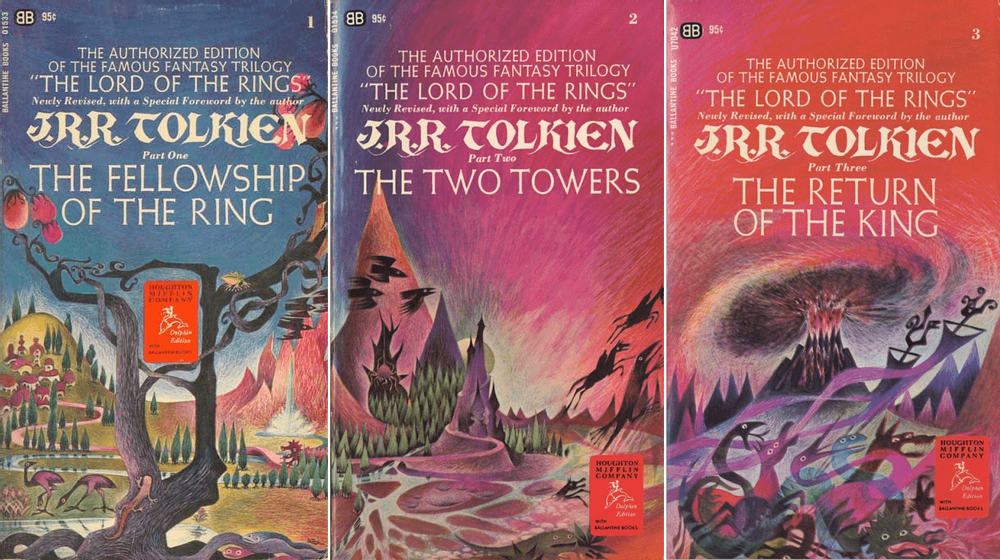
- The Fellowship of the Ring, July 24, 1954
- The Two Towers, November 11, 1954
- The Return of the King, October 20, 1955
All three volumes were revised in 1965, partly because the book had been pirated by an American publisher.
Though it (re-)popularised the trilogy format for fiction, it was written as one book and originally just divided into three for economic reasons. It has also been published in seven-volume editions, as each of the three original volumes includes two Books and the third also has several Appendices.
Adaptations include:
- John Boorman Lord of the Rings (1970) - script for an unproduced film adaptation of the novel by John Boorman, known for taking significant liberties with the source material.
- The Tale of the Ring (1971) - A Swedish two-part adaptation of Fellowship. Based on and featuring music by Bo Hansson.
- The Lord of the Rings (animated) — The 1978 Ralph Bakshi animated adaptation. Intended to be the first of two films,
 in vain.
 - The Lord of the Rings (comic adaptation) — A 1979 three-shot comic book adapting the Ralph Bakshi movie. Notably, it was never published in English.
- The Return of the King (animated) — The Rankin/Bass Productions animated adaptation of the third part, a sequel to their own adaptation of The Hobbit.
- The Lord of the Rings (1981) - Full cast 13-episode radio adaptation produced by BBC Radio.
- The Keepers — A 1991 Soviet adaptation of the Fellowship (the title is its name in the translation used), formerly believed lost after a single broadcast. In 2020, the studio found a copy and in March 2021 uploaded it
 to YouTube.
 - The Hobbits (TV series) — A 1993 Finnish miniseries based on a theatre adaptation.
- A low-budget Ukrainian/Russian miniseries The Rings of Power or the Seventh Ring of a Witch, made in 1998. Uses the general premise and some plotlines of the novels, but completely changes the setting, characters’ names, races and relationships.
- The Lord of the Rings (film series) — The Peter Jackson live-action adaptation as a film trilogy. The most modern (and, by now, easily the most well-known) versions released in 2001, 2002 and 2003 respectively. Followed in 2012-2014 by The Hobbit trilogy, his adaptation of The Hobbit. An anime film The War of the Rohirrim was announced in 2021, with plans for additional film projects confirmed for 2023.
- A 2006 musical with music by A. R. Rahman, Christopher Nightingale, and Varttina and script and lyrics by Matthew Warchus and Shaun McKenna, which closed after a year of largely negative reception.
- The Lord of the Rings: The Rings of Power, a series produced by Amazon set in the Second Age as told in the Appendices. It is not in continuity with the Peter Jackson movies.
In addition, the books have been adapted multiple times for radio (with a 1981 BBC version as the most highly regarded) and theatre (most recently as the abovementioned 2006 musical, retooled for the West End from 2007-2008). The books and adaptations themselves have inspired various video games, tabletop games and card games.
The Harvard Lampoon published a parody titled Bored of the Rings in 1969, which manages to cover the entire journey in under 200 pages. In 1985, Fergus McNeill and Judith Child released an Amstrad CPC Text Adventure game of the same name, which also parodied Lord of the Rings, but was not based on the novel; one year later, they also released a prequel called Boggit. In 1996, Derek Mason made an online interactive fiction game called Quest for the Golden etc... that was also a parody of Lord of the Rings, and of 1980s text adventures in general.
Please note that this is the page for tropes used in the book. See above for the links to pages for the movies. (And Tolkien's Legendarium for the Middle-earth verse in general.)
The Lord of the Rings provides examples of the following tropes:
- Tropes A to C
- Tropes D to F
- Tropes G to I
- Tropes J to L
- Tropes M to O
- Tropes P to R
- Tropes S to U
- Tropes V to Z
- Tropes applied to characters
- Tropes applied to entire peoples
