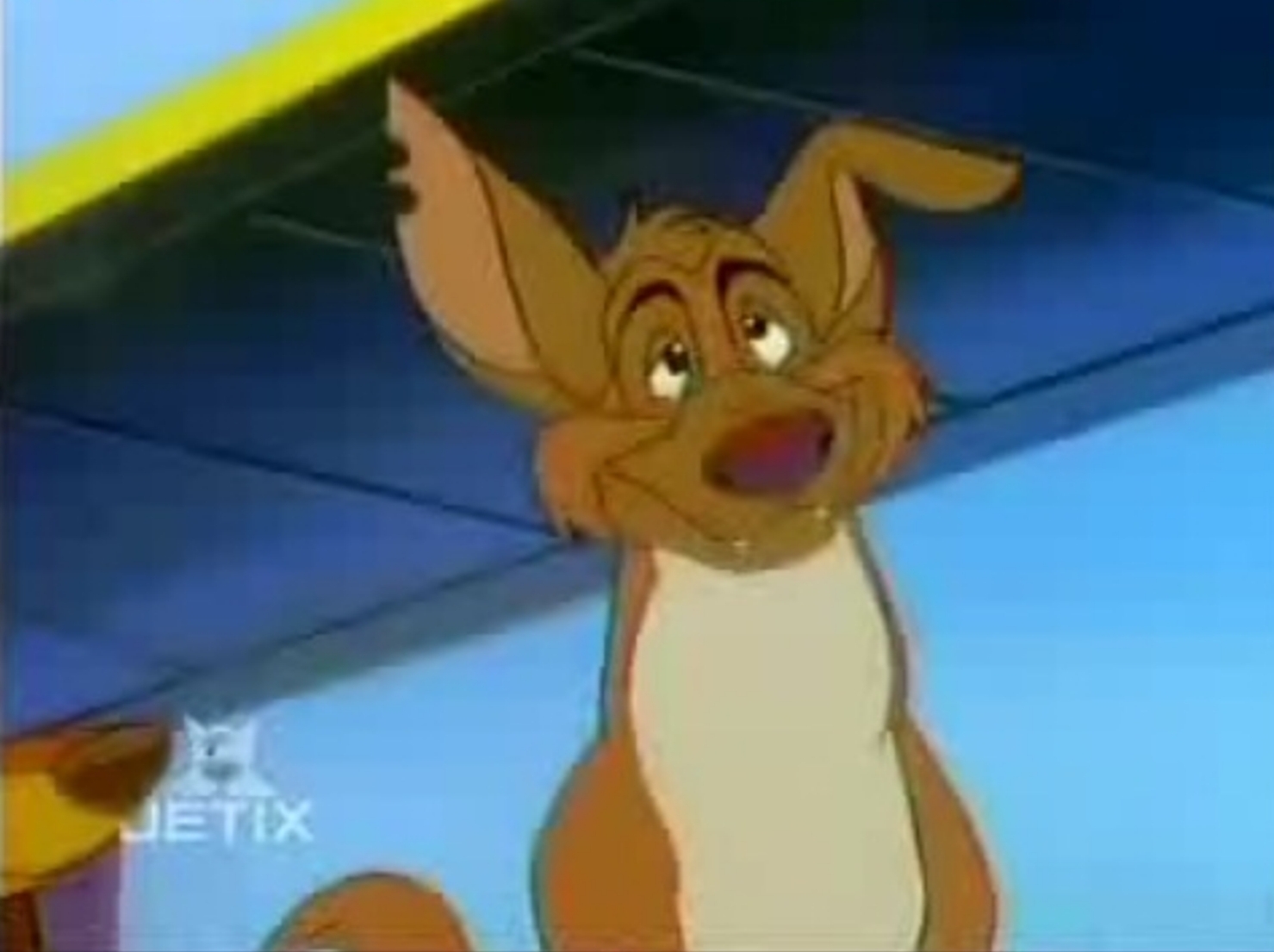
All Dogs Go to Heaven is a Don Bluth film released in 1989, very loosely inspired by the obscure 1943 book by Beth Brown.
The film tells the story of Charlie B. Barkin (voiced by Burt Reynolds), a roguish German shepherd con man "with the heart of a marshmallow." After breaking out of the local dog pound, Charlie confronts his business partner, an unscrupulous gangster named Carface Carruthers (voiced by Vic Tayback in his second-to-last role) to work out an agreement that'll let the two of them split their profits 50/50 so Charlie can start his own business without giving Carface's a bad name. Carface, who got Charlie sent to the pound in the first place and is looking to do away with him permanently, takes him out for a celebration, gets him drunk and murders him via vehicular manslaughter (dog-slaughter?).
Despite showing no moral fiber in life, Charlie lands among fluffy celestial clouds, where he learns that all dogs go to Heaven because dogs are innately good. Quickly tiring of paradise and desperate to get revenge on Carface, Charlie steals the gold watch which contains his lifeline and rewinds it, returning to life. He soon discovers that Carface has been able to keep the casino afloat with a special asset, a young girl named Anne-Marie (voiced by Judith Barsi in her final role) who has the ability to speak to all animals. Along with his friend Itchy (voiced by Dom De Luise), Charlie abducts the girl and uses her talents for money, eventually building his own casino.
But Charlie starts to grow attached to Anne-Marie, an orphan who desperately wants a family, and undergoes a slow change of heart. Meanwhile, Carface has learned that Charlie is still alive and is plotting to kill him again. Charlie also has to ensure that nothing happens to his watch, since he forfeited his place in Heaven and can never return...
If the movie is remembered for much else, it's the fact that it was released on the same day as (and financially massacred by) Disney's The Little Mermaid. Disney reclaiming their spot as top dog in the animation business after years of being shown up by Bluth's independent features effectively ended their rivalry and Bluth would spend the following decade producing a string of flops until semi-retiring in 2000.
Dogs, meanwhile, went on to have a healthy shelf life, becoming the highest-grossing VHS release of 1990. Seven years later, it received a sequel, All Dogs Go to Heaven 2 (par for the course for every animated film ever during that time), and a TV series adaptation, neither of which Bluth had any involvement with.
This animated film and its related works provide examples of the following tropes:
- Actor Allusion: The book of Charlie's life which the angel whippet reads from reveals that his parents were Burt R. Barkin and Loni A. Bowser, named after Burt Reynolds (who plays Charlie) and his then-wife Loni Anderson (who cameos as Flo).
- Afraid of Blood: Killer, which may be why he prefers to "use the pliers".
- All Dogs Are Purebred: According to one song, Charlie is about as mixed as they come, yet he looks like a German shepherd through and through. Itchy identifies himself as a "wiener dog" and Charlie calls Itchy a dachshund during a particular song. Carface appears to be an English bulldog, (although according to the DVD back cover, Carface is a pit bull). The angel dog is a whippet, pointed out by Charlie. Apart from that, a number of minor dog characters look ambiguous enough that they might be mutts, but it's a bit tricky to tell with the art style.
- The Alleged Steed: The Grand Chawhee is a small, slow, scrawny and worryingly witless race horse who has such an abysmal track record that he has 1000 to 1 odds against him. Thanks to Anne-Marie's gifts, Charlie and Itchy are able to get a tremendous payday from betting on him to win.
- Amazing Technicolor Population: The puppies Flo is looking after are all bright, unnatural colors compared to all the other dogs, who have more muted colors.
- Ambiguously Jewish: Itchy. He has a distinctly New York Jewish accent, mentions bar mitzvahs, and sure can kvetch. Ironically, Dom De Luise was Catholic.
- AM/FM Characterization/Car Radio Dispute: When Charlie meets up with Carface after escaping from the pound, Charlie turns on the radio so he can listen to some jazz while they talk, while Carface turns it off so they can just talk business. They go back and forth until Carface has enough and pulls out the knob to turn off the radio for good.
- Anachronism Stew: Killer calls his gun a "Flash Gordon atomic ray gun". Forgetting for a moment that ray guns have yet to become a reality in the 21st century, where did he manage to acquire an atomic ray gun in the year 1939? Justified, considering it was changed to preserve a G-rating and also due to the tragedy surrounding Anne-Marie's voice actress.
- Angelic Transformation: Dogs are issued a halo and wings upon reaching Heaven. What happens when they leave Heaven and how varies by installment.
- Anguished Outburst: Itchy gives a tearful tirade to Charlie over his growing relationship with Anne Marie, whom he blames for everything bad that's happening to them, including Carface's attack on their new casino from which he barely escaped with his life.
- And the Adventure Continues: Carface arrives in heaven, having been eaten by King Gator at some point offscreen, and immediately causes trouble for himself by winding his life clock in order to get revenge. As he’s caught in the act and chased down by the whippet angel (Annabelle) telling him that he can never come back, Charlie appears and assures the viewers that he will indeed return.
- Animal Talk: A variation: animals can only talk to others of their own species, while the orphan girl Anne-Marie is the only character who is able to speak to all animals. This is made explicit when it's revealed that Anne-Marie is being exploited by Carface, since she can inform him who will win in a race. It's mostly adhered to throughout, but has a handful of subversions, such as King Gator and Charlie's musical number and the horses understanding the dog's insults despite the dogs not understanding them. There's also the never-fully-explained language barrier when Anne-Marie says she can't understand the rat minions because they "talk too funny," implying that the sounds they're making are a language, just not English.
- Arc Words:
- "You can never come back," said by the heavenly whippet to Charlie when he winds his watch to go back to Earth, letting him know that he's no longer guaranteed a place in Heaven just for being a dog and that he'll go to Hell if he dies again. During his nightmare, the Hellhound bellows at Charlie "You can never go back!"
- "Surprise". It's first uttered by Carface when he's talking to Killer about murdering Charlie in cold blood. "A big surprise." The scene after he dies, Charlie sings the number Let Me Be Surprised.
- Ascend to a Higher Plane of Existence: Happens to Charlie twice. The first time is his first death, but instead of feeling at peace, he returns to take revenge on Carface. After he dies for the second time, he averts the trope. But since he sacrificed himself, he plays the trope straight again. And just as the title says, this happens to all dogs when they die. Then again with a title like that, you'd probably expect this trope to show up one way or another.
- Ascended Meme: The Blu-Ray cover dedicates an awful lot of space to the literal big-lipped alligator.
- Avoid the Dreaded G Rating: Inverted. Carface's tommy gun was changed to a Ray Gun to avoid a PG-rating.
- Award-Bait Song: Subverted. The song "Love Survives" almost fills all the criteria, except for one beautiful, devastating fact. Instead of being written for awards, the song was written in tribute and dedicated to Judith Barsi, who was murdered by her own father, along with her mother, in a double murder suicide when she was only 10.
- The Bad Guy Wins: Downplayed. Charlie manages to go back to Earth and give Carface his just desserts, but in the end, he's still dead from when Carface murdered him.
- Back from the Dead: Charlie comes back to life the moment he winds his life watch back up, but this forsakes his place in Heaven.
- Big Damn Heroes: King Gator pulls this at the end of the movie, showing up just in time to free Charlie and eat Carface.
- Bittersweet Ending: Mostly, given that Charlie dies while saving Anne-Marie. However, he redeems himself in the process, earns his way back into Heaven, and gets to say goodbye to her one last time.
- Black Comedy: Inevitable in this movie as it revolves around a dog that dies and comes back to life.
- Book Ends: Charlie's death at the beginning and at the end happens to be in the same environment, a watery grave.
- Break-Up/Make-Up Scenario: Charlie has a couple with Anne Marie. First, she tries to walk out on him when he spends more time on his casino than helping to find parents for her and not using any of it to help the poor like he promised. He quickly assuages her by taking her to bring some pizza to Flo's puppies. They have a more serious one later when she overhears him telling Itchy that he doesn't care about her and runs off in tears, but they make peace just before Charlie ascends to Heaven.
- But Now I Must Go: Charlie dies and must return to the afterlife, but he gets to say goodbye to Anne-Marie, telling her "Goodbyes aren't forever."
- Canine Confusion: Killer's entire body goes green after Carface breathes cigar smoke right in his face even though dogs can't become visibly green when they're sickly due to their fur covering up their skin.
- Catch Your Death of Cold: Anne Marie (apparently) catches pneumonia after being in cold water.
- The Cavalry Arrives Late: Near the end, while Charlie goes to Carface's casino by himself to save Anne-Marie, Itchy gathers dogs from all over New Orleans to assault the base en masse. However, by the time they arrive, along with the New Orleans Police and paramedics, the boat is already sinking, Anne-Marie is no longer in immediate danger, and Carface is dead. As is Charlie.
- Chekhov's Gun: Charlie's high-pitched howl. It's first introduced when he uses it to let his presence be known upon returning to Carface's casino. Later, it convinces King Gator not to eat him because he thinks Charlie is singing and loves his voice and signals him during the climax when he's needed.
- "Could Have Avoided This!" Plot: A somewhat tragic version of this, Itchy begs Charlie at the beginning not to go through with this harebrained revenge scheme and start fresh somewhere else. He brings it up again when Carface tracks him down, tries to kill him and burns down their new casino.
- Cowardly Sidekick: Itchy is afraid of Carface, sees Anne-Marie as a liability, and doesn't want any part in Charlie's schemes... but he goes along anyway because Charlie is his friend.
- Crapsack World: Charlie insists on indulging the many vices of the casino business he once shared with Carface, which leads to all manner of betrayal, gluttony, corruption, greed, and murder. His fondness for this kind of life is what eventually leads to the demise of both himself and Carface, and the destruction of their competing enterprises. This is even lampshaded in Let me be Surprised when the heavenly whippet describes earth as a place of used cars, singles bars, and broken dreams.
- Curbstomp Battle: The tiny angelic Whippet destroys the massive Hellhound so effortlessly that it barely looks like a fight; it looks more like the thing simply explodes in her presence.
- Deal with the Devil
- It's implied that Charlie had struck a bargain with the Hellhound so that can see Anne-Marie one last time and say goodbye to her.
- Earlier on in the film, Carface makes Charlie a bargain. If they split up fifty-fifty, then Charlie will go into business for himself and possibly hiding. Unfortunately, he only makes the deal so that he can dispose of and kill him.
- Death's Hourglass: Charlie's pocket watch. When it stops, so does his life.
- Defector from Paradise: Charlie Barkin immediately decides to defect from Heaven upon explanation of its lack of thrill, complete predictability, and cushy lifestyle. It's best described in his song, "Let Me Be Surprised". Carface tries to do this in The Stinger, but the archangel whippet chases him down before he gets the chance.
- Delayed Reaction: After Charlie wakes Itchy up from his nightmare, the Dachshund has a moment of calm from being relieved that it was All Just a Dream. Then he remembers that Charlie is supposed to be dead and freaks out again.
- Deus ex Machina: Moments away from being swallowed by a massive gator, Charlie lets out a high-pitched howl, convincing the gator to let him go because he thinks Charlie has a beautiful singing voice. Whew, that was close!
- Didn't Think This Through: Situating their casino out of a half-sunken ship proves to be a serious oversight on the part of Carface and Charlie, and neither escape with their lives when the ship is inevitably set ablaze and sunk.
- Disney Villain Death: Subverted. Carface survives a high fall from a high platform into the bayou, and is promptly chased after (and implied to have been eaten) by King Gator.
- Dragons Are Demonic: One appears at the end in the form of a billowing, blood-read cloud to take Charlie to Hell. Thankfully, the angel shows up, drives the dragon away, and tells Charlie his place in Heaven has been restored due to his Heroic Sacrifice.
- Earn Your Happy Ending: At the end of the day, Charlie is still dead, but at least he saved Anne-Marie, found her a good home and is allowed to ascend to Heaven after his Heroic Sacrifice earns him his place there.
- Even Evil Has Standards: Even before his Character Development kicks in and Charlie truly grows to care for Anne-Marie, he is utterly indignant when she compares his treatment of her to Carface. Furthermore, many of Carface and Charlie's employees and customers at their casino remark that Charlie treats them better than Carface does.
- Every Proper Lady Should Curtsy: Anne Marie curtsies to Charlie's friends after being introduced.
- Family-Friendly Firearms: Carface's raygun, not without reason: a highly publicized school shooting in California's Central Valley
 , the murder of Judith Barsi, who played Anne-Marie, and the shooting death of actress Rebecca Schaeffer by a crazed stalker all occurred midway through production.
- Averted in the opening scene where Charlie breaks out of prison. While no guns are actually seen, the guards are firing at Charlie and Itchy from off-screen with traditional gunshot sounds.
- Fire and Brimstone Hell: Driven into the ground.
- Fluffy Cloud Heaven: Driven to the moon and back.
- Food Porn: The waffles and the pizza. As a general rule, the food in this movie is tantalizingly drippy.
- Four Legs Good, Two Legs Better: Charlie, a German Shepherd/Collie mix, walks on two and four legs interchangeably. This contrasts with Itchy Itchiford, who walks on all fours because of his Dachshund anatomy.
- Freeze-Frame Bonus: Pausing on Charlie's record in Heaven not only lets the viewer see the names of his parents and a rather cute baby picture, but some very readable text. Apparently, Charlie is "mostly German Shepherd, but also part Collie, part Great Dane, and part whatever." It even mentions that Charlie is "a bad dog." At also labels him as being guilty of gambling, pick pocketing, being a low-life bum, double-crossing, lusting for money, blackmail, loan sharking, tax fraud, extortion, racketeering, being jaded, wanton decadence, being conceited, infidelity and being a scoundrel.
- Friend-or-Idol Decision: Charlie has to save either his watch from sinking and slowing down or Anne Marie from drowning. He chooses the latter. This earns him a place in Heaven.
- Friendly Rivalry: The horses at the racetrack have both a sense of sportsmanship and camaraderie despite galloping to win. It is implied that it is a matter of honor among the competitors that a horse is entitled to a victory during their birthday, which is how Anna Marie convinces them to aid the Grand Chawhee in crossing the finish line first despite the 1000 to 1 odds against him.
- Frothy Mugs of Water: Averted. Carface's plot to murder Charlie relies entirely on getting him too drunk to be suspicious.
- Gallows Humor: Charlie's introduction to Heaven is rife with it. Even the angelic Annabelle brutally, but cheerfully, stresses that he's "stone-cold" dead once he realises where he is.
- Gambling Ruins Lives: At Scarface's casino, the dogs place a lot of bets at rat races, lose their dog bones and get awful stakes.
- Green Gators: A tribe of sewer rats have taken Charlie Barkin and Ann Marie prisoner, and have set them out as a sacrifice to their god: a huge vivid green alligator with a bone through his nostrils. This gator is pure loony, and he ends up doing a Busby Berkeley number rather than devouring the prisoners.
- Good Is Boring: The reason Charlie rejects Heaven. And yet...
- Good Feels Good: The main reason Charlie keeps helping Anne-Marie, after some Character Development.
- The Great Depression: The film's time period.
- Grotesque Gallery: Most of the character designs hover along the ugly cute border, but King Gator's character design is... a bit much. As well as a pink horse.
- Half Dressed Funny Animal: Most of the dogs are unclothed, or just wearing collars and other accessories, though some wear clothes on their upper bodies (but are still quadrupedal). Such as Itchy with his hat and vest, or Carface’s suit, while in Heaven cherubim force Charlie into a gown.
- Hell of a Heaven: The afterlife is perfectly nice, but Charlie declares it too clean and bland for his liking and misses the unpredictability of life. Carface obviously hates it as well, and breaks out at the end. Charlie, for his part, appears to warm to the place at the end, when he realizes it has hot soul music.
- Help Mistaken for Attack: After Charlie rewinds his life clock, he pays Itchy a visit. Itchy, who had seen Charlie get hit by a car, mistakes Charlie for being a vengeful ghost and freaks out. Charlie gets him to calm down, but not before Itchy defends himself with car parts.
- Here We Go Again!: The film ends almost how it began; with some scummy dog in Heaven deciding to rewind his life clock so he can go back to Earth and get revenge on the one who killed him. Only this time, it's Carface wanting to get back at King Gator. When the Heavenly Whippet warns him that he'll never be able to come back if he tampers with the clock, Charlie winks at the audience and says: "He'll be back."
- The Hero Dies: Unusually, Charlie dies at the beginning of the movie, only to cheat his way back to life. He dies for good at the end while saving Anne-Marie.
- Heroic Sacrifice: Torn between the choice of saving his own Soul Jar vs. rescuing Anne-Marie from drowning, Charlie picks the latter. It ultimately costs him his life, but also earns his redemption.
- Heterosexual Life-Partners: Charlie and Itchy, as portrayed by actual heterosexual life partners Burt Reynolds and Dom De Luise. In a surprisingly tragic take on this concept, Itchy's What the Hell, Hero? moment is all about how his love for his best friend is the only reason he goes through with Charlie's crazy schemes which ultimately kills Charlie and almost kills him too.
- Hollywood Natives: The sewer rats, and their leader/god King Gator have bones stuck in their noses. The rats act a lot like the natives from King Kong.
- Holy Burns Evil: After Charlie's Heroic Sacrifice, Annabelle appears as a small glowing ball of light and either banishes or destroys the giant devil hound that had come to take Charlie to Hell.
- Horror Doesn't Settle for Simple Tuesday: Carface murders Charlie during Mardi Gras.
- How Unscientific!: Enforced; the Ray Gun Carface gets his hands on is out-of-place for a story set in The Great Depression, but it was necessary to prevent the film from getting a PG-rating.
- Hypercompetent Sidekick: Itchy. The guy draws up the blueprints for and builds Charlie's casino by himself!
- Ink-Suit Actor
- Charlie is designed with Burt Reynold's thick, expressive eyebrows, as well as a little fluff on his muzzle to resemble Reynolds' mustache.
- Killer, meanwhile, sports Charles Nelson Reilly's comically oversized spectacles and trademark "disgusted" look.
- In Name Only: Invoked. Don Bluth was read the original Beth Brown novel as a child, but he only remembered the title. He sought it out as an adult and wrote a treatment of it under the name "Canine Mysteries," but kept hitting walls with the story until he decided to write a completely different one based around the original title.
- It Is Not Your Time: Quite averted for a story where characters returning from the dead is a theme. Charlie, however, lies to Itchy and tells him this is the case.
- It's Always Mardi Gras in New Orleans: The movie begins in the middle of Mardi Gras, with Careface throwing Charlie's goodbye party inside of a sidelined float.
- Ironic Echo: Annabelle says to Charlie as he is expelled from Heaven, "You can never come back!" Later, in his nightmare of being dragged into Hell, the devil growls to Charlie, "You can never go back."
- Jerk with a Heart of Gold: Charlie is a selfish, greedy con artist, but he cares about his friends and is implied to be a Benevolent Boss to the patrons of his casino. One home release described him as having "the roguish charm of a con man and the heart of a marshmallow."
- Karma Houdini: Plot relevant! As the heavenly whippet says, all dogs go to Heaven because, unlike humans, they're naturally good, loyal and kind. She can't find a single redeeming quality about him while looking over his life. Even Carface—murdering, kidnapping, horrible Carface—ends up there at the end. However, there's a catch: if you try to go back to Earth, you don't get back in to Heaven automatically.note
- Kicked Out of Heaven: When Charlie swipes the pocketwatch representing his lifespan and turns it back, he ends up getting booted out of heaven. While this has the effect of returning him to the land of the living, he is warned "You can never come back": once he dies again, he's destined for the other place. In the end, however, his Heroic Sacrifice earns him his place in heaven again.
- Last Chorus Slow-Down: "Hey! I know we're dead up here, but so's the music!"
- Manly Tears: Charlie sheds a single tear at the end. And Itchy sheds his share while chewing out Charlie.
- Mood Whiplash: A couple.
- Halfway through the movie, a happy sharing song, a sad "I Want" Song, and a nightmare all occur one after the other in the span of about ten minutes.
- After Charlie's ghost says one last goodbye to Anne-Marie and ascends to Heaven, a heavenly chorus sings in the credits right before Charlie demands something a little livelier.
- Mook–Face Turn: Probably applies to Killer, who loyally serves Carface throughout most of the film, but is the one to swim Anne-Marie to safety at the end. Though it may have more to do with the fact that his boss was just eaten by an alligator.
- Never My Fault:
- Carface almost tosses Killer into the Shark Pool for Charlie escaping from the dog pound and surviving being run over by the car, even though both instances were his own doing.
- Carface's memetic "I'M SURROUNDED BY MORONS!" comes after Killer lost control of his Ray Gun, even though it happened because Carface shoved him.
- Never Trust a Trailer: Despite what they say, this is not a lighthearted comedy.
- Nightmare Sequence: Two of them.
- First, Charlie has that ever-so-lovely dream about going to Hell.
- Second, towards the beginning, after Charlie’s first death, Itchy has a nightmare that Carface is strangling him, but then hears Charlie's voice telling him, "Itchy, it's okay! It's okay, little buddy! It's me, Charlie!" and wakes up to discover Charlie, alive and well, shaking him awake.
- No Name Given: The heavenly whippet. She's named Annabelle in the sequel.
- Oh, Crap!: Carface has one when his hideout begins to shake with the approach of King Gator, and his own gang have one when King Gator breaks in to rescue Charlie, cueing a Screw This, I'm Outta Here / Abandon Ship as they flee for their lives. Carface has another when he sees King Gator calling him "delicious".
- Orphan's Ordeal: Anne-Marie lives in a junkyard and gets kidnapped by a gang of gambling dogs to be exploited for her ability to communicate with animals.
- The Pearly Gates: Charlie is introduced to Dog-Heaven when he crashes right through its gates.
- Pet the Dog: A rare example where it is the dog which pets the human. Charlie gets this literally when he says goodbye to Anne-Marie.
- The devil has one when he allows Charlie to do the above before dragging him to Hell.
- Pounds Are Animal Prisons: The opening of the movie, complete with dramatic jailbreak.
- Practical Currency: Dogs appear to use bones and meat as money, or at least they do for the purpose of gambling, as that's what they're shown to wager and win in the casinos (which leads to some punning about how Charlie is entitled to a "cut of the steaks," T-bone and Porterhouse included). However, Charlie uses Anne-Marie to win human money from all sorts of gambling venues, and is somehow able to convert that wealth into the construction of his own casino.
- Punch-Clock Villain: Killer before his Mook–Face Turn at the end of the movie.
- Raven Hair, Ivory Skin: Anne Marie. She has been compared to Snow White.
- Ray Gun: Killer has a "Flash Gordon thermo atomic ray gun" that he and Carface try to use to kill Charlie.
- Recognizable by Sound: King Gator has Charlie between his jaws when Charlie howls in terror. The sound is so melodious to the alligator that he set Charlie free. Later in the story, the evil Carface has captured Charlie, and has caused Charlie to howl in pain. Miles away, the Big-Lipped Alligator hears this cry, and comes to Charlie's rescue in a Big Damn Heroes moment.
- Redemption Equals Death: A variation. Charlie dies while saving Anne Marie, but because he proved that he can care for someone besides himself, he saves his soul from Hell, thus saving his afterlife.
- Reed Richards Is Useless: Killer was somehow able to make a RAY GUN in 1939, yet he only brings it up to let Scarface try to kill Charlie with it.
- Reflective Eyes: Charlie and Anne-Marie at the end when they're saying good-bye.
- Refusing Paradise: A non-heroic example. Charlie tricking his way out of Heaven sets the whole plot in motion.
- Religious Horror: While not a horror movie, per se, the film's more terrifying aspects involve a character attempting to escape divine punishment after being cast out of heaven for defying what's implied to be God's will, which he only escapes through redemption. And as indicated by both Charlie's nightmare and the hell hound who appears outside of Anne Marie's room when Charlie's ghost comes back to her, his punishment will not be a light one.
- Restrained Revenge: Charlie sets out to get revenge on Carface for killing him. Not by killing the pit bull in return, but by running him out of business with an even better casino.
- Resurrection Revenge: After gaining his life pocket watch and leaving the dog Paradise, Charlie comes back from the dead to let his former friend Carface taste his own medicine. He gets better, ultimately.
- Revenge Before Reason: Charlie is willing to forever forsake his place in Heaven to get revenge on Carface for murdering him in the first place.
- Right Behind Me: Near the end, Charlie says that he's only using Anne-Marie and only pretends to be her friend to Itchy, unaware that Anne-Marie is standing on the steps behind him.
- Ring of Fire: Though it doesn't happen IN one, the final fight between Charlie and Carface happens above one, during which Carface falls into it and is eaten by King Gator. Charlie then has to rescue an unconscious Anne-Marie from the burning ring.
- Rodent Cellmates: Anne-Marie's Establishing Character Moment centers around a conversation between her and the rats infesting Carface's lair. It turns out Carface was using her to interview the racing rats and find out which one is most likely to win.
- Sapient Eat Sapient: King Gator only decides not to eat Charlie and Anne-Marie due to Charlie's singing voice, never mind the fact he can apparently communicate with both of them.
- Satan: A giant red dragon-like creature appears to Charlie in a nightmare of Hell and appears outside Anne-Marie's house near the end of the movie, and is implied to be Satan.
- Say My Name: It's astounding how many times people say Charlie's name in this movie - 122 times total!
- Scary Symbolic Shapeshifting: As Carface plots to kill Charlie a second time, his ears curl up into horns and he grows a curly moustache, the scene's lighting suddenly turning red to make him resemble a Big Red Devil.
- Screw This, I'm Outta Here: Carface's goons. One minute, they are gloating at watching Charlie meet his end, but when King Gator busts in to save him, they turn cowardly and flee for their own lives, leaving their boss to meet his end at King Gator's jaws.
- Second-Face Smoke: Carface does this to a rat and Killer.
- Sequel Hook: The stinger, complete with Charlie’s last dialogue.
- Sewer Gator: King Gator, who is worshiped by the sewer rats living with him in the sewers of New Orleans.
- Shark Pool: Carface uses the piranha-filled version of this trope to dispose of Killer after he fails him twice. That is, until Killer mentions he has a gun.
- Shopping Montage: Used to cheer the disillusioned Anne-Marie.
- Shout-Out:
- Anne-Marie's outfit and hair are modeled after Disney's version of Snow White. She also owns a Piglet doll.
- The sequence with King Gator at least starts as an homage to King Kong, up to and including the beast falling for his captive, before completely going off the rails.
- It's a Buck Rogers ray gun!
- The dogs spreading the word about Charlie needing help is very similar to the "twilight bark" scene in Disney's 101 Dalmatians, with one of the dogs in front of Kate and Harold's house even being identical to the Colonel.
- Significant Reference Date: Charlie's birthday is September 13, 1937, Bluth's birthday.
- Slasher Smile: Carface breaks into a twisted one after learning that Killer has "a ray gun" stashed away.
- Soul Jar: Charlie's watch. When it stops ticking, that's the end of his borrowed time... but as long as it remains undamaged, he's immortal.
- Take Care of the Kids: Charlie before he ascends to Heaven, tells Anne-Marie to take care of Itchy. Since Itchy will have no one once Charlie passes, he needs to have a home and a family to adopt him.
- There Is No Kill Like Overkill: How Carface kills off Charlie. By getting him sloppy drunk, blindfolded and lining him up to be hit by a car on a pier. It wouldn't be enough to just lead him into a busy street or drown him, he does both to be one of the few animated villains to actually kill the protagonist early on.
- Through a Face Full of Fur: Killer turns a sickly shade of green whenever Carface blows from his cigar into his face.
- Title Drop: Courtesy of the heavenly whippet who also tells us why all dogs go to Heaven: "Unlike humans, dogs are naturally good and loyal and kind."
- Too Dumb to Live: Carface manages to kill Charlie as he was abominably drunk, completely unaware of the car rushing at him.
- Totem Pole Trench: With two dogs and a human. Amazingly, it works.
- Tuckerization: Anne-Marie was named after animator Anne-Marie Bardwell.
- Undying Loyalty: Itchy to Charlie, to the point of pleading that Charlie dump Anne-Marie because she's really testing his loyalty to Charlie.Itchy: (tearful and angry) I say we should lose the girl, get outta town, Charlie, you and me and call it even!
- Vile Villain, Laughable Lackey: Carface, a menacing pit bull crime lord, has the myopic, neurotic poodle Killer for a minion.
- Villainous Breakdown: Carface after King Gator saves Charlie from a watery grave, pretty much loses what sanity he still has at seeing Charlie was saved and goes ballistic trying to kill him personally, even as his hideout is literally going up in flames after oil spilled on the electric generator and ignited an inferno from the sparks as it shorted out.
- Visual Pun: Charlie's Soul Jar is a watch. He's living on "borrowed time".
- Vocal Dissonance: The Heavenly Whippet speaks in a high-pitched, soft voice... which is Melba Moore, who sounds naturally deep, as shown when she goes to her normal voice when the Whippet either screams, or sings Gospel ("Honey, you know it!")
- Wacky Wayside Tribe: The tribe of sewer rats that captures Charlie and Anne-Marie.
- Watching Troy Burn: Itchy returns to the monastery to chew Charlie out for wasting too much time with the girl (and nearly getting him killed), just in time for both of them to look over the junkyard and see their new casino go up in flames.
- What the Hell, Hero?: Itchy's rant to Charlie after Carface's thugs nearly kill him. Shortly thereafter, Anne Marie hears Charlie telling Itchy that he's going to use her to get all their money back, then dump her in an orphanage, and she bursts into tears while yelling at him that he's a bad dog.
- Wide Eyes and Shrunken Irises: Charlie wakes Itchy from a nightmare where Carface is strangling him. Thinking that Charlie is dead, Itchy starts screaming. Charlie has these for a couple of frames.
- Wild Take
- Killer springing in mid-air, his eyes bulging in and out, and screaming, after he retrieves and puts back on his glasses, when he sees Charlie and Itchy are out of prison clearly enough the second time.
- Carface gets two. The first is when Charlie is freed from the anchor. The second is when he sees King Gator swimming towards him.
- Wingding Eyes: Charlie demonstrates the "dollar sign" version when planning to make a killing using Anne-Marie's talent for talking to animals.
- You Have Failed Me: Halfway through the movie, Carface is lowering Killer into a piranha tank, after discovering Charlie is still alive.Carface: Charlie's alive, and I know he's got the girl. Killer, this is strike two. You're out.Killer: No, wait boss, boss! I get one more strike boss, honest!Carface: Lower him. Nothing personal, Killer. Business.
- Animal Talk / Talking Animal: Charlie, Itchy, and all other dogs can communicate with each other, as well as other animals. But like the second movie, Charlie and Itchy can openly talk to humans, even if they are not the ones Annabelle assigned them to help. Upon first meeting the human, he or she will be shocked to find the two dogs talking. This is justified since they're angels who came to Earth from Heaven.
- Aesop Amnesia: A large mass of episodes involve Charlie acting selfishly or carelessly and needing his ego taken down a peg by Annabelle. The closing episodes do at least show some Character Development sticking, with Charlie at least trying to reign in his worst qualities, as well as Annabelle coming to respect his less "squeaky clean" sense of goodwill.
- Art Evolution: While the first film boasted Don Bluth's trademark lush, classical animation, with the sequel being lower budget but still reasonably fluid, the TV series simplified the characters to be more youthful and easier to animate until they resembled Filmation levels of Limited Animation. Compare this◊ to this, and you'd almost think these were two different characters.
- It's especially noticeable since the opening titles consist entirely of clips from the second movienote .
- While the whole of the series was animated on hand-painted cels like the movies were, two episodes "All Creatures Great & Dinky" and "Haunted Is As Haunted Does" used digital ink and paint.
- "An All Dogs Christmas Carol" was half hand-painted, half digitally-colored. While still much lower budget than the two films, it also has more flourishes of full animation than the TV show.
- Anthropomorphic Shift: In the Christmas special Itchy, Sasha, and Charlie become notably more anthropomorphic while playing the roles of Christmas Past, Present, and Future. Particularly notable with Charlie when he dons his snazzy red suit.
- Artistic License – Biology: The series brings back Killer, who was Carface’s henchman in the 1930s, and is impossibly still alive in The '90s. Same goes for Carface’s mother, whom he decides to pay a visit. Dogs don’t have that long a lifespan.
- Ascended Extra: Annabelle gets a bit more involvement than in the movies, due to recurrently being The Conscience and Trickster Mentor for Charlie. A few episodes (particularly the finale) also develop her relationship with Charlie, showing they've come to meet halfway better and are friendlier than in the films.
- Big "STOP IT!": Belladonna drops one at the end of "Why Not Be Happy Now?" in the series finale.
- Big Word Shout: Carface screams, "STOOOOPPPPPPPPP!" when Timmy, under the control of Belladonna's dog whistle steals a present and goes out the dog door.
- Broad Strokes: To say that the series followed the films... loosely would be an understatement. "When Hairy Met Silly" retcons the entire first movie.
- Canine Confusion: In the TV show, Belladonna has no visible ears, though this could be justified by the fact that she's a demon.
- Continuity Nod: Despite the title of the franchise, the Christmas Carol sees Carface informed by the Ghost of Christmas Yet To Come that he is going to Hell if he dies a villain. In the second film, Carface threw away his one free trip to Heaven to side with Red and, like Charlie in the first film, has to earn his way back in.
- Denser and Wackier: The show really amps up the cartoon antics. Carface, Killer and even Belladonna act more like pantomime villains (though Belladonna far less so), and Charlie and Itchy go through ten times more slapstick abuse that what killed them in the two movies.
- Drama-Preserving Handicap: In the sequel, when sent back to Earth, the dogs were still spirits, needing Red's collars to be tangible. In the series, Charlie and Itchy when acting as "guardian angels" are effectively mortal dogs for the large part, allowing them to be put in dangerous situations (and take lots of slapstick).
- Played with in one instance Annabelle switches with Itchy for an assignment after he and Charlie start bickering. Since she is also Brought Down to Normal as they are, Hilarity Ensues and the two get captured by a pound. As soon as Charlie accepts he misses Itchy however, she reveals she can still switch with him and let him solve the problem.
- Easily Condemned: Reconstructed in "He Barked She Barked", where Belladonna manages to frame Charlie for misuing a miracle dog tag and failing to rescue someone, leaving the court and even Annabelle seriously doubting him. The catch being that, while the evidence and witnesses (namely Carface and Killer) are blatantly flimsy, Belladonna also exploits Charlie's terrible track record throughout the series (complete with a quick Clip Show montage of his real acts of misconduct) and that even in this case, Charlie did break rules by hoarding a miracle dog tag, even if he tried to use it selflessly. After being vindicated, a surprisingly humble and morose Charlie laments that he doesn't really deserve Annabelle's trust after letting her down so many times, though she insists that isn't an excuse for jumping the gun and gives a heartfelt apology to Charlie.
- Equal-Opportunity Evil: Belladonna describes "the other side" as an equal opportunity employer when she's trying to recruit Charlie to her side.
- Evil Counterpart: Belladonna to Annabelle.
- "Freaky Friday" Flip: In "Mutts Ado About Nothing", Annabelle puts Charlie and Itchy's souls into each other's bodies as punishment for their constant squabbling. Even worse, it happens on their double date night respectively with Sasha and Bess.
- Grand Finale: "An All Dogs Christmas Carol", a feature length Christmas Special which culminates in Carface undergoing a Heel–Face Turn.
- Heel–Face Turn: Invoked with Carface in the Christmas Special, where Charlie's plot is to turn him good so that Belladonna's plan could be stopped.
- Heel Realisation: The end of the series has a surprisingly pivotal one between Charlie and Annabelle. Throughout the films and series, the two have constantly bickered and looked down on each other due to their differing ethics, Charlie loathing Annabelle's pious attitude and monotonously orderly and goody-goody management of Heaven, and Annabelle condescending to Charlie due to his many vices, shirking responsibilities and rejecting the afterlife. In "He Barked She Barked" this leads to Annabelle rather quickly distrusting Charlie after Belladonna frames him for misconduct. Charlie vindicates himself, but not before realising how many times he let Annabelle down despite being his Positive Friend Influence, and admits sadly that he doesn't deserve her trust. Annabelle however, realising how quick she was to turn on Charlie for simply not being the "squeaky clean" angel she prefers, apologises and sticks up for him, accepting that she sometimes needs a "rascal" like him on her side. Their relationship is noticably warmer in the Grand Finale Christmas Special.
- Karmic Transformation: In one episode Charlie transforms a dog-hating kid into a dog in order to teach him a lesson.
- Knight of Cerebus: Belladonna, who's episodes are always far more serious in nature and she's considerably more powerful and dangerous than Carface in every way, if still very hammy, and at her worst is comparably murderous to Carface in the first film (her first episode showing her trying to put Itchy through a meatgrinder).
- Mood Whiplash: Practically invoked in "Clean Up Your Act" in the Christmas Carol. It goes back and forth between visions of Heaven and of Hell. It works because its done by the Ghost Of Christmas Future (played by Charlie) and is showing both possible outcomes to Carface's future.
- Origins Episode: "When Harry met Silly", detailing how Charlie & Itchy met and became friends.
- Punch-Clock Villain: Happens with Carface in the Christmas Special, which is also the series finale. Applies because he was working as Belladonna's henchman at the time.
- The Rashomon: "He Barked, She Barked" combines this with a Courtroom Episode where Belladonna accuses Charlie of abusing his miracle dog tag for selfish gain to take a canine widow's steaks while leaving her to presumably die in a sewer pit as it collapsed. Carface's testimony portrays Charlie as a thug more like his pre-Character Development self and himself as a goody two-shoes. Itchy's testimony makes Charlie into an overly heroic figure (complete with a Stetson) and Carface as a Dastardly Whiplash villain. Killer's testimony portrays Carface as his lackey and Charlie as dropping the widow when the "rescue failed". And Charlie's own testimony portrays him as trying to save the widow but dropping her when the miracle dog tag fails to levitate her. The truth is that Belladonna was the widow dog and it was all an obvious scheme to get Charlie's angelic status revoked. And miracle dog tags don't work on hellish beings like her.
- Reality Warper: Charlie and Itchy can use miracles in the form of dog tags to alter reality in a specific way, such as transforming them into cats to sneak into a Crazy Cat Lady’s house. But Annabelle only gives them out so often and Charlie has been known to use them frivolously, so they often have to rely on their wits alone.
- Reassigned to Antarctica: Literally. At the end of “Lance the Wonder Dog” Annabelle tasks Lance the annoyingly by-the-book angel dog with helping the penguins. It turns out she sent him to San Fran in the first place because he was annoying everyone else in Heaven too.
- Retcon: Several from the films:
- Carface, despite being Dragged Off to Hell at the end of the sequel, now resides back on Earth. The second season shows he still has affiliations with the underworld, but under Belladonna rather than the completely absent Red.
- Killer is still working for Carface despite quitting at the end of the first movie. He’s also inexplicably still alive despite the sixty-year timeskip (biologically, dogs don’t have that long a lifespan).
- At the end of the second film Itchy opts to go back to Heaven when he and Charlie are offered a second chance at life. Here he’s on Earth with Charlie.
- Charlie and Itchy’s life on Earth is now conditional on their continuing to perform good deeds instead of a reward for retrieving Gabriel’s Horn.
- Sdrawkcab Name: Subverted with Belladonna and Annabelle. The syllables are reversed, not the letters.
- Series Continuity Error: In a flashback of the episode “Fearless Fido” to when Itchy was a pup, everything still looks the same as it is in the 1990s. Given that Charlie and Itchy were alive in the ‘30s, at best, everyone and the objects during Itchy’s childhood should’ve been reflective of the 1920s at best.
- Sham Supernatural: Supernatural posing as different supernatural version. In An All Dogs Christmas Carol, Itchy, Sasha, and Charlie all pose as the ghosts of Christmas Past, Present, and Future respectively in an attempt to persuade Carface into stopping Belladonna from ruining Christmas for dogs and their owners.
- Surprisingly Realistic Outcome: Dogs from Heaven while on Earth are susceptible to mortal pain. “Cyrano de Barkinac” is one of the only few episodes to avert Hollywood Healing and Amusing Injuries where Itchy takes a severe beating from another dog that he has to get treated at a pet hospital.
- Terrible Trio: Belladonna usually plays this alongside Carface and Killer whenever she appears.
- Time Skip: On account of David turning ten, the series likely takes place two years after the second movie.
- Tiny Tim Template: The Christmas special has an animal version in the form of Timmy, a puppy suffering from a broken hind leg who the other dogs are trying to raise money for his operation.
- Uncanny Family Resemblance: Cousins Annabelle and Belladonna could easily pass for sisters. It doesn't help that they're played by the same actress.
- Vile Villain, Saccharine Show: Belladonna, being quite willing to kill others and ruin their lives For the Evulz. Taken further in the Christmas Special.
- Colonel Dijon from the episode Free Nelly is arguably an even darker Knight of Cerebus as he's one of the few human villains in the franchise and is shown to be abusing an elephant, threatening to starve her if she can't do her act right.
- Villain Decay: Played with, compared to his more sinister and murderous mob boss characterisation in the first film, Carface here plays a buffoonish lackey to Belladonna, with Killer even tamer than he was before. Being equipped with her tactics and powers beyond mortal capabilities however makes some of their plans more dangerous and higher scale.
- Villainous Crush: At times, it seems Belladonna's interest in Charlie is a bit more than just getting him to 'play for her side' (including shaking her rear at him rather seductively in her Villain Song). Though this doesn't stop her from flying into a psychotic rage when she's foiled.
- Villain Pedigree: Continuing the trend of the sequel, Belladonna is the Big Bad after she shows up and is another demon, with Carface Demoted to Dragon and seen as a far lesser threat than she is due to being far stronger.
- Villain Song: Belladonna, Anabelle's demonic cousin gets one in two appearences. The first is in "La Doggie Vita", where she sings "Take the Easy Way Out", an attempt to lure Charlie to her side which works... for a bit. In the Christmas Special, where she's the Big Bad, she takes part, alongside Killer, in "I Always Get Emotional at Christmas Time", about how much she loves ruining Christmas.
- Vocal Evolution:
- Charlie, who's on his third voice actor (Steven Weber) by the time of the TV series. Charlie Sheen's voice for him in All Dogs Go to Heaven 2 wasn't a replica of Burt Reynolds' in the original, though replicated the low-key snarky mannerisms. Weber in turn mimics Sheen's performance to start off with, but plays him much louder and higher-pitched as the show goes on, making the original voice fully lost to translation.
- Similarly Carface and Annabelle's replacement actors (Ernest Borgnine and Bebe Neuwirth respectively) while making a halfway attempt to sound like their original voices in the sequel and early episodes, go into full-on Large Ham mode as the series continues.
- David's voice was slightly deeper in "History of All Dogs".