
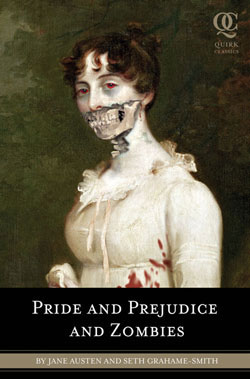
Pride and Prejudice and Zombies is a 2009 parody novel by Seth Grahame-Smith that is, for all intents and purposes, Exactly What It Says on the Tin. Really.
Grahame-Smith took the original text of Pride and Prejudice, and spiced it up a little with Shaolin Kung Fu, katanas, and the "unmentionables," or zombies. However, the basic story is remarkably unchanged.
A prequel titled Dawn of the Dreadfuls was released in 2010; a Spiritual Successor written by another author, Sense and Sensibility and Sea Monsters, was released less than a year after the novel; and a sequel, Dreadfully Ever After, was released in 2011 and wraps up the whole story. Both the prequel and sequel were written by Steve Hockensmith; he was brought in to write the prequel as Grahame-Smith was busy writing Abraham Lincoln: Vampire Hunter.
A film adaptation starring Lily James, Sam Riley, Matt Smith, Lena Headey and Charles Dance, with Natalie Portman as one of the producers (she was originally attached to star as well) was released in February 2016.
With many more books putting genre twists on pre-existing literature, characters or figures being released following this novel's success, it is now considered the Trope Maker of Literary Mash-Ups.
Has been known to show up on the "classic literature" shelves at Target.
Provides Examples Of:
- Actionized Adaptation: Every scene with Passive-Aggressive Kombat in the original is replaced or supplemented with more active-aggressive action scenes, often involving zombies.
- Adaptation Expansion: In a way. Zombies provide the impetus for a number of otherwise unexplained events in the original story, such as the presence of the militia regiment in Hertfordshire. The absence of the Collins couple in the last third is given an explanation here, too.de
- Adaptational Attractiveness: The film does this with a few characters.
- Charlotte Lucas is meant to be very plain in the book, and she only accepts Mr. Collins's proposal because she feels she'll never get another. She's very cute in the movie.
- Mr. Collins is played by Matt Smith in the film, though in this case it's his personality that's off-putting.
- Lady Catherine is usually portrayed as an elderly woman. Here she's played by Lena Headey, placing her in her forties at the oldest.
- Mrs. Bennet is a little younger and prettier in the film than she usually is. In the book, she's meant to be I Was Quite a Looker.
- Adaptational Heroism: As opposed to willingly running off with Wickham like she does in the book, Lydia is kidnapped instead and rescued from him. She also appears to be sorry for her indiscretions.
- Adaptational Karma: In the original Pride and Prejudice, Wickham is something of a Karma Houdini. He gambles, contracts massive debts, and gets them paid off by almost marrying Georgiana and having Darcy hush it up, and later on actually marrying Lydia after eloping to keep it quiet (though marrying Lydia may be the far worse punishment). In this book, he's crippled for life and left to the care of Lydia, who herself has no concept of the fate in store for her.
- Adapted Out: Inverted. The film is one of the few versions of the story to include Louisa Hurst (nee Bingley), Mr. Bingley's other sister. Usually it's just Caroline who shows up in adaptations.
- Amputation Stops Spread: When a carriage driver is bitten in the leg by a zombie, his leg is cut off in an effort to stop the spread. He ends up dying of blood loss, though.
- Badass Longcoat: Mr. Darcy, specifically in the film adaptation - which overlaps with Hell-Bent for Leather, as he wears a very distinct leather longcoat for the entirety of the film; even at his wedding.
- Battle Couple: Elizabeth and Mr. Darcy by the end. They invoke this by fighting together against some zombies that had mistaken a cabbage patch for brains.
- Better to Die than Be Killed:
- In Dawn of the Dreadfuls Lt. Tindale swears that he will never let himself become a zombie. True to his word, when the battle becomes hopeless, he takes a last look at the window where the Bennet girls are watching and shoots himself in the head.
- In Dreadfully Ever After it is mentioned that Lady Catherine has a specific sword that she keeps to commit harakiri with in the case that she ever contract the "strange plague". In the same book, Darcy intends to use that sword on himself after he is infected and realizes that no one can stop him becoming a monster. However, that isn't how it ends.
- Bolivian Army Ending: The film ends with Wickham leading an army of zombies towards the wedding party, the Bennetts prepared to fight.
- The Caretaker: Lydia makes a surprisingly cheerful caretaker to Wickham post "eloping", once Mr. Darcy renders him quadriplegic.
- Crapsack World: Not only do the Bennett sisters have to worry about finding husbands to secure their futures, they have to fight armies of zombies too.
- Cultural Posturing: The Bennett girls were trained by Shaolin masters, while Lady Catherine is versed in the "deadly arts" of Japan. This leads to some tension between her and Elizabeth, who feels she must defend the honor of the Chinese whenever Lady Catherine gloats about their alleged inferiority.
- Deliberate Values Dissonance: Regency England is far more brutal than it was in real life, likely a result of the plague. Duels to the death are common, and servants are often savagely beaten.
- Demoted to Extra: Jane only appears briefly in Dreadfully Ever After and Lydia is only mentioned.
- Dirty Coward: In Dawn of the Dreadfuls Master Hawksworth frequently makes excuses to avoid fighting, and the one time he does join a battle he panics, steals another soldier's horse, and rides for his life, abandoning a hundred soldiers to be eaten by the zombie horde.
- Disproportionate Retribution:
- Elizabeth covertly tries to kill Darcy after overhearing him say she's not handsome enough. And later beats him up for proposing to her.
- Lady Catherine threatens to kill Elizabeth if she doesn't give up on marrying Darcy, and challenges her to a Duel to the Death.
- Double Standard: Kitty recalls her father reminding her during a battle to appear dignified because, even though she is a deadly warrior who can claim more kills than an entire company of soldiers, she will always have more to prove.
- Ensign Newbie: Two appear in Dawn of the Dreadfuls.
- Captain Cannon's adjutant, Lieutenant Tindall, is in his twenties and is a brave yet rigid and untested officer who views Stay in the Kitchen so-called chivalry as more important than effective fighting.
- Ensign Pratt, the third-in-command of the newly arrived soldiers, is a very short and youthful officer who faints the first time he sees a zombie killed up close.
- Feminist Fantasy: Well as the original book was already quite feminist for
 its time, turning the five Bennett sisters into zombie hunters - and making Lady Catherine a veteran warrior - results in this. The women usually save the men more often than the other way around.
 - Fun Personified: Bunny Mac Farquhar. He is described time and again as a fool, constantly indulging in practical jokes, gambling, races, parties, etc. But he's actually one of the most open, happy, guileless characters in the series; all he really wants is to have fun."He tried to put on a serious expression, but, lacking practice, failed miserably."
- The Ghost: Georgiana Darcy is only referenced in the film, never appearing on screen. In this case, Lizzie never visits his house and Lydia's elopement with Wickham happens a little earlier.
- Honor Before Reason: The girls often forgo carrying weapons or combat attire to uphold propriety, which means they frequently run into danger or "enemies" unarmed. Elizabeth at one point ties her dress with a modesty string so she can do hand stands without the skirt falling.
- Indulgent Fantasy Segue: Elizabeth swiftly decapitates Lydia to shut her the hell up. Or not.
- Just Giving Orders: In the prequel, Lord Lumpley weakly tries to disclaim responsibility for the deaths of the many women he impregnated by saying that all he did was tell his butler to make sure they stopped bothering him. This argument fails to save his life.
- Katanas Are Just Better: Other weapons are used, and boot knives are more ladylike, but you can't beat a katana. Even if you trained in a Shaolin temple in China.
- Kill It with Fire: The burning grounds. Also done several times with small incendiaries by Elizabeth and Mr. Bennett.
- Let Us Never Speak of This Again: The Bennett girls come across a zombie mother and infant (which they have never seen before and are deeply disturbed by) and find themselves unable to kill them. Afterward they swear never to talk about it.
- Mercy Kill: Elizabeth considers doing this for Charlotte before she starts turning, but decides against it.
- Misplaced Wildlife: A stampede of critters running from a stampede of zombies includes such North American fauna as chipmunks and skunks. Seth Grahame-Smith is American, where such animals are commonplace.
- Mistaken Confession: In Dawn of the Dreadfuls, Mr. Bennett accuses Captain Cannon of deceiving him, and the officer makes a long speech about how he loves Mrs. Bennett and has been trying to woo her. A stunned Mr. Bennett makes several Let Me Get This Straight... comments and clarifies that he was talking about how Cannon had been deceiving him about how long the zombie infestation has been going on and whether they can expect reinforcements.
- Not a Zombie: No one seems to notice Charlotte is slowly becoming a zombie until the last act of the book. Lady Catherine definitely knew about it. The only reason she kept inviting over the Collins so often was so Charlotte could be fed antidote in her tea.
- Not So Stoic: Several characters have their moments, most noticeably Elizabeth as she is both the main viewpoint character and because she spends so much time maintaining a stoic appearance.
- Not Using the "Z" Word: Played with. Zombies are sometimes referred to as "zombies", but if a character is being proper, they call them "unmentionables" or similar. In the film, they just go ahead and say zombies. 'Unmentionables' is only said once by Jane.
- Old Master: Catherine may be a mean old lady, but she's no coward and gives quite the fight against the much younger Elizabeth.
- One Side of the Story: Several times, most notably from Elizabeth during Darcy's disastrous first proposal to her.
- Our Zombies Are Different: These are the Plague Zombie variant, and they can also move quickly and speak.
- Plot Hole: Many in Dawn of the Dreadfuls, as it was written by a different author. Errors include the girls' entire training, and more minor things such as the age at which Lydia slew her first zombie.
- Redshirt Army: In Dawn of the Dreadfuls, Captain Cannon's company is made up of young men who wear red uniforms and flee from their first several battles. Save for their surgeon and possibly a few men who were wounded earlier, they are wiped out in the last act (albeit during a Hold the Line Suicide Mission, and in a surprisingly fierce Do Not Go Gentle manner). Averted with Lord Paget's regiment in the climax of the same book, who are a Badass Army of cavalrymen, musketeers, and ninjas and also act as The Cavalry.
- Shout-Out: Dr. Keckilpenny's efforts to tame a zombie in the prequel borrow from Day of the Dead (1985).
- Shrinking Violet: Georgiana Darcy is like this around strangers. Jane in Dawn of the Dreadfuls, to the extent that "Jane blushed and looked away" becomes something of a narrative catchphrase for her.
- Skewed Priorities: The period-piece romantic comedy portions are still kept mostly intact. This leads to events like Caroline Bingley becoming irritated at Elizabeth tracking mud and zombie debris through Netherfield rather than praise at Elizabeth's taking out zombies or concern that a trio of zombies were as close to Netherfield as they were.
- Sliding Scale of Comedy and Horror: The film is definitely balanced. As it's mashing a romantic comedy with a zombie invasion, most of the original comedy from the book is intact. Horror elements are mostly played straight, such as the reveal that Wickham is raising a zombie army. However there are many moments that are Played for Laughs in a straight-laced way - as Darcy's Anguished Declaration of Love becomes a kung-fu fight between him and Lizzie.
- Sliding Scale of Gender Inequality: This series falls somewhere between a 3 and 4. It is set in patriarchal regency England, but women are by no means disregarded or not considered important or useful people. And of course, there are female warriors like the Bennets and Lady Catherine who smash the contemporary gender stereotypes to bits. Unmarried female warriors are begrudgingly accepted by society, but for a married woman to carry a sword would be an affront not only to her husband, but to "all English manhood". Most the gender inequality shows up in people mistakenly underestimating or pigeonholing the Bennets.
- Spared by the Adaptation: Parson Collins and Charlotte both survive in the film adaptation (in the novel, Charlotte rather graphically becomes a zombie and Collins hangs himself after killing her).
- Spear Counterpart: While not the same character, of course, Bunny is almost identical to Kitty in personality, (only, you know, a guy) which is part of why she is initially so attracted to him.
- Stereo Fibbing: In the prequel, two human villains try to keep people from going down to a wine cellar where they have several the bodies of murder victims hidden, and simultaneously say that no one can go there because the cellar is flooded and the roof caved in. Even then, they might have gotten away with it in the panic (there are zombies besieging the place) if not for a suspicious servant calling out the lie.
- The Stoic: Nezu, through and through. Invoked frequently with the Bennets, most often by Elizabeth or her father. This was part of their Shaolin training.
- Training from Hell: All the Bennett girls likely went through this at the Shaolin temple. Elizabeth recalls having to hold a handstand for hours on end.
- Undead Child: Quite a few. Once the Bennett girls even see a zombie baby carried by a zombie mother.
- Unusual Euphemism: "Most English parts" is used to refer to male genitalia.
- The Vicar: Mr. Cummings in Dawn of the Dreadfuls. Typically stiff and uptight, and gets so panicked in one scene with a zombie that he reads the wedding ceremony from his prayer book instead of last rites.
- War Is Hell: Especially if the opposing army is made up of the undead who eat your troops rather than just killing them.
- What Do You Mean, It's Not Didactic?: Spoofed to hell and back in the book's discussion guide: Some scholars believe that the zombies were a last-minute addition to the novel, requested by the publishers in a shameless attempt to boost sales. Others argue that the hordes of the living dead are integral to Jane Austen's plot and social commentary. What do you think? Can you imagine what this novel might be like without the violent zombie mayhem?
- World of Badass: Regency England is now full of zombie hunters. To the point that there's snobbery over whether one was trained in Japan or China.
- Zombie Apocalypse: Averted. Zombies are somewhere between a nuisance and an enemy army in terms of threat. Also, they appear to be confined to England. (Which makes sense considering that Great Britain is an island and zombies probably wouldn't be able to swim.)
The setting is functionally a Cosy Catastrophe played for laughs. Other than always traveling in well armed groups at all times to survive random zombie attacks (especially after winter), the characters all live comfortable lives for British middle/upper classes. It should be mentioned though that in the backstory, zombies have completely overtaken Manchester and in the present repeatedly break down the gate of London Sector Six East. England has survived and made gains against them, but they are still a great enough threat that two can take out an entire kitchen staff. - Zombie Gait: Some show more of this than others, depending on how long they have been (un)dead.
