

The World's Mightiest Mortal. The Champion of the Rock of Eternity. The Big Red Cheese.
SHAZAM! (Which used to be his magic word, not his accolade, but is now his official name... mostly.)
You have to understand this before you proceed: comics aren't always just superheroes.
Look — guys in masks only showed up around, say, the mid-Thirties. Superheroes only go as far back as Superman in 1938. Comics about detectives and daredevil pilots had been inherited from the pulps to great success. No one thought costumed heroes would take off like they did. So when National Comics hit paydirt with their costumed super heroes, the initial reaction of Fawcett Publications was "Oh boy! We've got to get some of these!"
So, they brought in C.C. Beck to do a story about a team of six heroes who all got powers from various legendary figures. When this was pitched, it was decided that, while Superhero Speciation was cool, All Your Powers Combined just looks better. The hero was to be called Captain Thunder. Except they couldn't get the name. So they called him Captain Marvelous, and then shortened it to Captain Marvel, because it sounds punchier. The character first appeared in Whiz Comics #2 (February, 1940; #1 was only an Ashcan Copy, never intended for distribution).
Little Billy Batson is a homeless orphan who is led by a mysterious stranger into a deserted train station, where a train with no driver leads him to a wizard's lair. There, the wizard gives him the power of six archetypal figures: the wisdom of Solomon, the strength of Hercules, the stamina of Atlas, the power of Zeus, the courage of Achilles, and the speed of Mercury, which when put together spell F-L-Y-I-N-G B-R-I-C-K. To summon these powers, he must shout the name of the wizard — "SHAZAM!" — which summons down a bolt of lightning and transforms him into a superhuman adult with a bright red costume with a freakin' sweet cape.
Billy Batson goes on to get a job as a radio announcer (yes, a ten-year-old announcer), but as his Superpowered Older Alter Ego, Captain Marvel, fights evil and chaos. He acquired an impressive Rogues Gallery, including diminutive Mad Scientist Doctor Sivana, villainous Super-Soldier Captain Nazi, atomic android Mister Atom, former holder of the "Marvel" mantle Black Adam, and others. But he also had a group of staunch allies known as the Marvel Family, who had also (mostly) been gifted by Shazam; his best friend Freddy Freeman became Captain Marvel Junior, and his long-lost sister Mary Bromfield became Mary Marvel (complete with Minidress of Power). Initially, Mary had her own pantheon of goddesses from which she derived power (including Zephyrus... which was actually a male, but then there aren't many mythological figures whose names start with a "Z"). Later, she switched over to Billy's pantheon. Then there were the Lieutenant Marvelsnote , Uncle Marvelnote , Hoppy the Marvel Bunnynote , and Tawky Tawny the Talking Tigernote ...
This was Captain Marvel's Golden Age. His own title regularly sold over a million copies a month (for comparison, the best selling comics of today usually top out at around 100,000), and Mary and Junior had their own titles when most heroes had to settle for eight-page backups in anthology books. There was even a movie serial, The Adventures of Captain Marvel, which was the first superhero film ever produced. He was arguably the most popular and recognizable superhero of the 1940s.
Then there was a problem. On the one hand, there was Captain Marvel, a black-haired all-American feller in a costume with a lot of bright red, who can punch through cars and stop robbers... and on the other hand, there was Superman, a black-haired all-American feller in a costume with a lot of bright red, who... well, you get the idea. Admittedly, this described a lot of superheroes back then (and even today), but Marvel had the flaw of selling more than his inspiration. DC Comics brought the case to court, and Fawcett fought it out for a while (it didn't help that there was a Fawcett editorial memo directing the artist to make Captain Marvel look "more like Superman"). Eventually, though, the superheroes stopped selling so well, and Fawcett decided to throw in the towel; they closed down their comics division and moved on. The final appearance of the character was Marvel Family #89 (January, 1954). The name "Marvel", however, would return to haunt DC Comics.
A few years later, The Silver Age of Comic Books started up, and superheroes became popular again. Fawcett couldn't take advantage of this, because the settlement with DC had specified that they never publish a Captain Marvel comic again, but eventually, DC themselves expressed interest in the character. Fawcett licensed the whole shebang to DC (with the latter eventually buying the rights lock, stock and barrel), and after a couple of tryouts, they put out a new series in 1973. Unfortunately, they couldn't actually call the series "Captain Marvel", because Marvel Comics had snapped up the name trademark in the meantime (and created their own character, and eventually a string of characters, by that name), so they titled it Shazam! and went ahead.
The series, though never a hot seller, did fairly well and even found a way to update its look from the simple, but dated, cartooniness of C.C. Beck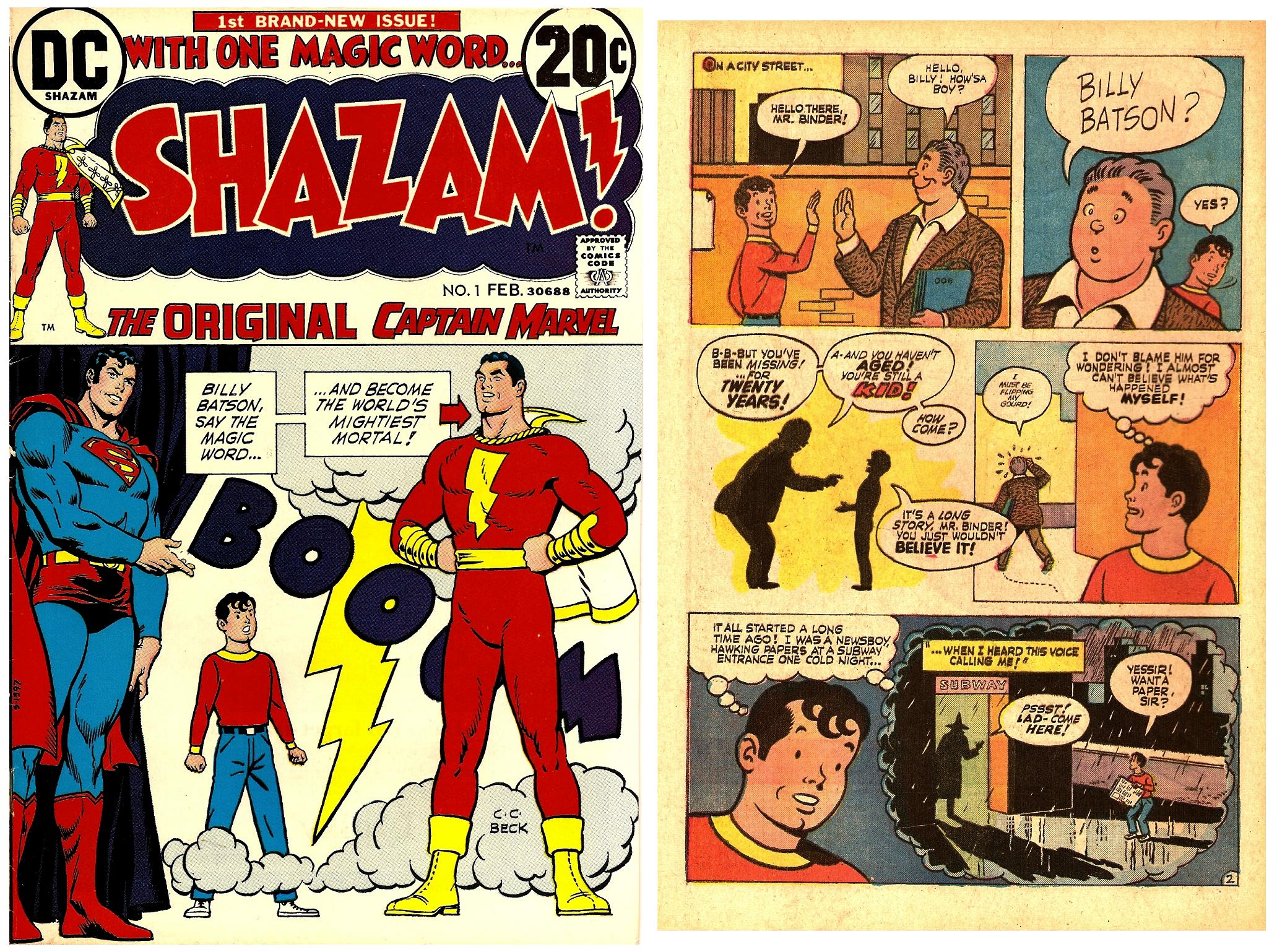 ◊ to the rich illustrations of Don Newton
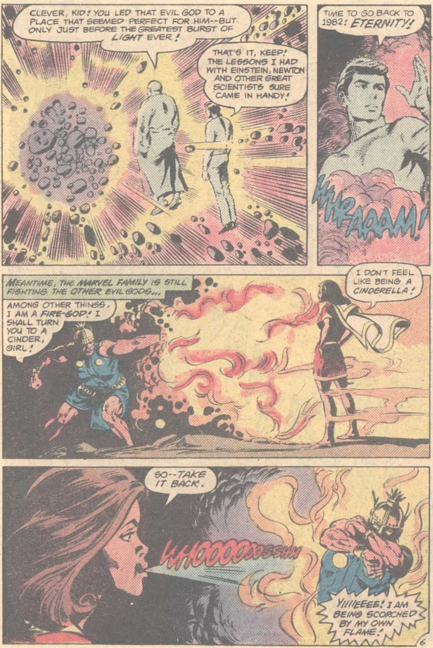 ◊ to fit in the The Bronze Age of Comic Books. The series, finally relegated to being in the back of World's Finest, had the Marvelverse (no relation) slotted into DC's Multiverse as Earth-S, and he occasionally crossed over with DC's other heroes — naturally, the long-debated fight between Cap and Superman was one of the first. Incidentally, it's rather ambiguous who has the edge since Captain Marvel doesn't have Supes' vision and breath powers, but his powers are magic based which is a traditional weakness for Superman.
And then came Crisis on Infinite Earths, merging the DC multiverse, including Earth-S, into a single universe. Hilarity Ensued. The major change is that whereas Billy and Captain Marvel were largely considered two separate people, now Captain Marvel was unambiguously set with Billy's youthful personality. This means to others, this supposedly adult superhero has the personality of a child, albeit guided by the wisdom of Solomon. This has led to awkward situations more than once and when he was forced to reveal his true form to Superman in First Thunder, the Kryptonian made a bee-line to Shazam to confront him about recruiting a child as his champion. Also, the formation of the Marvel Family was reversed with Mary Marvel, who was the last major addition to arrive outside of Mr. Tawky Tawny in the original stories, usually meeting her brother first, then Jr. arrives later with the Lt. Marvels considered strictly afterthoughts if they are included at all. Black Adam was also reimagined as walking the line between Anti-Hero, Anti-Villain, Token Evil Teammate, and so on.
So after a few comics and a brief membership spot in the Justice League of America, Captain Marvel became part of the wider DC continuity. Whenever they needed a Superman-level fighter who was immune to kryptonite or magic, particularly when Superman is being mind-controlled or a similar emergency, he was there. Whenever Wonder Woman needed to hit someone we didn't care about, he was there. Whenever villains needed someone hokey to fight, thus proving they were a Superstitious And Cowardly Lot, he was there. His standard shtick was to represent the sunny, old-timey virtues of Golden Age comics in the darkness of The Dark Age of Comic Books.
On the other hand, despite the stereotype set by those fights, DC Comics also published First Thunder to show that Superman and Captain Marvel actually get along well in the same Universe: Superman appreciates having an ally with equivalent powers to help him fight supernatural foes that could otherwise lay out him with a shrug, and Billy values having the greatest of the superheroes as a mentor to help him through his double life's rough spots. It went even further in the classic limited series Justice (DC Comics), in which Captain Marvel rescues Superman who was being attacked by two supervillains with kryptonite, and together, they chase and rescue The Flash who was running out of control.
Starting in 2005, though, the franchise hit a rough patch. The characters were constantly getting retooled, such as having Captain Marvel take the Wizard's place as "Marvel" and Freddy Freeman taking Billy's place as a hero named Shazam, apparently to get around the fact that I Am Not Shazam. Many of these retools were Darker and Edgier, the most infamous instance probably being "Evil Mary Marvel" in Countdown to Final Crisis. There was a bright spot, though, in that Black Adam was one of the leading characters in the acclaimed series 52, gaining Morality Pets in the form of Isis and Osiris. (They were both killed by the end of the event, but hey, this is comic books, Death Is Cheap, especially for characters named after a dying/resurrecting god and the goddess responsible for said resurrection).
At the same time, a more traditional Alternate Continuity take on the Marvel Family came in Jeff Smith's Shazam! The Monster Society of Evil; this was much-better received, and in 2008, an ongoing series in the same continuity premiered, Billy Batson and the Magic of Shazam. It was assumed, but not confirmed, that this was set on Earth-5, the post-Infinite Crisis version of Earth-S (the later depiction of Earth-5 in The Multiversity suggests not, but there's always Hypertime).
Eventually, Captain Marvel's history was wiped clean by DC's New 52 reboot. He re-debuted in backup stories in Justice League, with these stories focusing on the magical aspect rather than straight superheroics. Billy's personality was changed to make him more of a sarcastic and pessimistic brat at the outset; the kindly Wizard Shazam was replaced with the grumpy Mamaragan, the Australian aboriginal god of thunder; the Marvel Family has been expanded to include three new characters (in addition to Marynote and Freddy, we now have Darla Dudley, Eugene Choi, and Pedro Peña — versions of these three characters were all introduced during the prior Flashpoint crossover); and Billy's powers are more lightning-based than before, with his physical powers still present but toned down considerably. Oh, and DC said "heck with it" and changed his name from "Captain Marvel" to "Shazam".
Moreover, during the Darkseid War event in late 2015, Billy's connection to his original gods was severed and Mamaragan had to scramble to find new gods for Billy to draw upon. Shazam now has the Strength of S’ivaa (a DC original, a god of destruction from outer space), the Fire of H’ronmeer (a DC original, the Martian god of fire), the Compassion of Anapel (a Russian goddess of reincarnation), the Source Manipulation of Zonuz (another DC original, a.k.a. Yuga Khan, Darkseid's father), the Boldness of Atë (Greek goddess of mischief and ruin), and the Lightning of Mamaragan himself. The upshot is that Shazam is even less of a flying brick and even more of a spellcaster and energy blaster.
However, the original Captain Marvel still exists as part of the Multiverse, both on Earth-5 ("The Multiversity: Thunderworld") and on Brainiac's Blood Moon ("Convergence"), so DC has multiple versions of the character to work with.
A new Shazam! (2018) ongoing began in December 2018, with the New 52 Shazam Family figuring out the secrets of the Rock of Eternity and how their powers work. It reverts to the original gods but adds a seventh, !. Yes, the exclamation point in Shazam! is now significant. Billy's father C.C. Batson was also reintroduced in this run, becoming the Shazam Family's Sixth Ranger in the process.
DC Future State introduced a near-future version of Shazam who was connected to the whole "Nevermore" situation with the Titans, and therefore DC Infinite Frontier introduced Billy to Teen Titans Academy with his powers on the fritz (and the rest of the family casually revealed to have lost their powers because he can't risk sharing them right now), to set this up. Once that future had been unhappened, a series called The New Champion of Shazam! began in 2022, starring Mary, with Billy having once again taken the position of empowering entity rather than active hero. The various Crisis level events seem to have altered his history yet again, with several references to his Pre-Flashpoint adventures. A new series began in May 2023 written by Mark Waid and drawn by Dan Mora where Billy is now referred to as "the Captain" in his superhero form, with all of his foster siblings depowered except for Mary, now once again calling herself Mary Marvel after an adventure with Wonder Woman.
A live-action SHAZAM! (2019) movie was released as part of the DC Extended Universe, with Zachary Levi and Asher Angel cast respectively as Shazam/Billy Batson. Additionally, Black Adam (2022) featured Dwayne "The Rock" Johnson as the titular Anti-Hero.
Not to be confused with Kazaam or Shazzan, which are both about genies, the latter of which is also summoned by saying his name.
Parodies and Homages
- Spoofed in the 1979 film J-Men Forever (consisting of Gag Dub Republic Film Serial clips) with Billy Batchit, who becomes 'The Caped Madman' by uttering the magic word "SH-BOOM!" which enables Billy to "take on all the vices of a J-Man of the Secret Service: S for Sneaky, H for Hateful, B for Bigotted, O for Obnoxious, another O for Double-Obnoxious, and M for Mean!"
- Similarly spoofed in a classic issue of
 MAD, where Superduperman got into a fight with him, with "Billy Spafon" becoming "Captain Marbles" by saying the magic word "Shazoom!": Strength, Health, Aptitude, Zeal, Ox, power of, Ox, power of another, Money!
 - DC Comics themselves had a character called Captain Thunder, a Captain Marvel Expy (real name Willie Fawcett) with an origin based on Native American spirits and the magic word "Thunder!" (Tornado, Hare, Uncas, Nature, Diamond, Eagle and Ram) who teamed up with Superman before Earth-S made its debut.
- Nutty, The Dandy and The Beano parodied the character with the spoof superhero "Bananaman", who was summoned when his Billy Batson expy ate a banana.
- Issue 8 of Sonic the Hedgehog (Archie Comics) had a plot where Dr. Robotnik builds a number of superhero robots based on non-Archie properties. One of them was "Captain Mar-bot", who says "Shazham!". Sonic defeats it with ease.
- In Alan Moore's Supreme run, which turned the title into a Homage to Silver Age Supermen, "Mightyman" is the Captain Marvel Captain Ersatz.
- After the copyright lawsuit shut down the original American Captain Marvel, the comics' British publisher created their own Captain Ersatz Marvelman, whose comic strip ran for many more years. In the 1980s, it was revived in Darker and Edgier style by Alan Moore as Miracleman, helping to set the agenda for The Dark Age of Comic Books.
- Prime, from The Ultraverse, was pretty explicitly inspired by Shazam, though his creation predated DC's Power of Shazam revival by a few years. Alex Ross's painted cover for the "Prime Time" trade paperback ran with it, being a direct homage to Whiz Comics #22.
- A dark parody of Billy appears in The Boys: Dear Becky in the form of a Dirty Kid rapist.
Shazam/Captain Marvel T for Thor, R for Ravgga, O for Olorun, P for Pilumnis, E for Enlil, S for Sumugan:
- Aborted Arc: Jerry Ordway seemed to be going somewhere with a story in Justice Society of America where — post Freddy's Trials of Shazam and Mary turning evil — the wizard just took all their powers away. The story also revealed there was an Evil Counterpart to the Rock of Eternity called the Rock of Finality. For a while this left the Marvel family in a holding pattern as other writers waited to see where Ordway wanted to take this. Then the New 52 happened and Shazam got completely reinvented.
- According to Newsarama,
 What Could Have Been: "the tale would have involved a depowered Billy Batson reclaiming the scattered powers of the wizard Shazam from different individuals who had received them and were misusing them. One of these, a black youth, would actually use his powers wisely, and Billy would allow him to keep his powers, turning him into Vulcan, the first black member of the Marvel Family – modelled after the Black Vulcan, a character from the Super Friends cartoon."
- According to Newsarama,
- Action Girl: Mary Marvel.
- Adaptation Name Change:
- Billy Batson's deceased parents were originally referred to as "Merrill" and "Jocelyn" in the Pre-Crisis days, but modern origins have his father named "Clarence Charles "C.C." Batson" (after Captain Marvel's creator, C.C. Beck) and his mother named "Marilyn".
- Kid Eternity originally had No Name Given, and was only ever referred to as "Kid." Eventually, some Canon Welding with Shazam made him Freddy's brother, Christopher "Kit" Freeman.
- Adolf Hitlarious: In the wartime-produced content, Hitler and the Nazis in general were always portrayed as comedically incompetent ninnies.
- Alternate Company Equivalent: Originally Fawcett's version of Superman. Now effectively an expy, since DC now owns both characters.
- Analogy Backfire: Peter David's comment on the "Wisdom of Solomon": "Question: God directly orders you to build no temples to other gods. Do you build temples to other gods? If you said yes, congratulations! You have just displayed the Wisdom of Solomon!" Worth noting is that having wisdom and using it are two different things.
- Animated Adaptation: The one-hour block where it ran alongside Hero High.
- Arbitrary Skepticism: A lot of Golden Age stories had the good captain be outright dismissive of things like curses, demons and prophecies of doom, despite the premise of the entire franchise being that a wizard gave a kid the power to magically transform into a living demigod. Which is before even getting into the numerous other stories that revolved around wizards, magical doodads and had the Devil as a power behind the scenes.
- Arch-Enemy: Sivana and his family.
- Attack of the 50-Foot Whatever: Sabbac these days.
- Awesome Anachronistic Apparel: Captain Marvel's Impossibly Cool Clothes are inspired by the court dress of English noblemen. The white and gold cape was originally a short braided jacket worn as part of the Bling of War Custom Uniform of Hussars.
- Awesome, but Temporary: In the New 52, Justice League #21 had Billy accidentally sharing a portion of his power with Mary, Freddy, and the other foster children instead of Black Adam as intended. He later shares the same power with Tawny, his pet tiger, at the cost of the others losing some of their power. Due to Billy's incomplete mastery of the magic, his foster siblings and the tiger soon lose their powers by the end of the issue.
- Badass Family: Billy and Mary.
- Badass Crew: What they become once you throw Freddy into the mix.
- Bald of Evil: Ibac, Sabbac and Sivana.
- Beauty Equals Goodness: Sivana's evil children, Georgia and son Thaddeus Jr, are vaguely gargoylish like their father. His good children, the Meaningfully Named Beautia and Magnificus, take after their mother's side of the family and look like pin-ups.
- 52 plays with this notion somewhat, depicting the former as still being fundamentally insecure and awkward teenagers, while showing Venus and her offspring to be not outright malevolent, but rather, extremely shallow and spoiled people (Venus even casually uses a racial slur at the dinner table).
- An issue of Marvel Family also had the evil Space Ghoul coming to Earth to exhume corpses to feed on. The heroes assumed the more human-looking alien they met was good, and the ugly monster chasing him was bad. It turned out the ugly one was actually a space cop sent to capture the other one, the real Space Ghoul.
- Big Good: Captain Marvel is often treated like this, even in comparison to Superman, possibly due to Children Are Innocent. It's explicitly stated in the comics that Billy Batson would be Marvel full-time to help people, if not for the wizard Shazam insisting that Batson himself deserves some happiness in his life, too.
- Bound and Gagged: Almost every climax in the Golden Age revolved around the villain trussing and gagging Billy — either to prevent him saying the magic word, or just because they didn't want a nosy kid snooping around — and whether he could manage to get it off in time to save himself from a deathtrap; the Nigh-Invulnerable Captain Marvel beating the bad guys to a pulp was, naturally, a Foregone Conclusion. This also happened frequently to his teammates, Mary and Freddy.
- Over the years, Billy has improvised gag-removal implements as varied as a jagged piece of glass, a burning stick, a human skull (this was pre-Comics Code) and Freddy's leg brace, with Freddy in it and swinging his legs at Billy with that in mind (they were hung by their wrists).
- Brains Evil, Brawn Good: Captain Marvel and Dr Sivana.
- Although played with. In the Golden Age nearly all of Cap's foes were ones he could defeat with a single punch once he got close enough. Whenever he fought someone with super-powers of their own, they tended to be exactly as powerful as he was, so battle was pointless, and he had to get tricky.
- Broad Strokes: His New 52 origin story has been pushed into this by recent materials referencing Pre-Flashpoint stories such as Underworld Unleashed and Batman/Superman: World's Finest showing he operated as a solo hero before staying with the Vasquez family.
- The Brute: Ibac.
- By the Power of Grayskull!: He and Mary say Shazam, Freddy says Captain Marvel. Basically, say the name of your benefactor, and off you go. Ibac and Sabbac say, well, Ibac and Sabbac in order to get similar results.
- Call a Smeerp a "Rabbit": Gloppo, Beautia's Sapient Pet giant frog, is referred to as a "Glomper" from Venus.
- Canon Discontinuity: Several versions of the main character have been here and gone by this point. But one of these vanished within the same continuity. After 1987's Crisis Crossover Legends, the post-Crisis version of Captain Marvel was given a new origin in the Roy Thomas penned Shazam!: The New Beginning, which was followed up on in the then-anthology series 'Action Comics Weekly'. Among the highlights were Sivana's character being merged with Billy's Uncle Ebenezer, Captain Nazi being a modern white supremacist, and Fawcett City being replaced by San Francisco. The continuity never caught on, and was disregarded in favor of the later far more popular The Power Of Shazam!.
- The Cape: Captain Marvel obviously, but Mary and Jr. likely qualify too.
- Captain Ersatz: One of the weirder Golden Age stories note was full of characters like these, such as "Clubman and the Bird", "Flapear" and "Zartan the jungle man" who were treated like actors in the stories of their respective comic strips, but were getting fed up with their roles and tried to branch out into other pursuits. The story was about Captain Marvel forcing them to return to their routines because of all the G.I.s serving overseas who depended on their stories to maintain morale. Yeah, weird.
- Captain Superhero: If not the Ur-Example then surely the Trope Codifier.
- Card-Carrying Villain: Dr. Sivana. He regularly describes himself as evil ("The World's Wickedest Scientist!"). In one late Golden Age issue (specifically, Captain Marvel Adventures, issue 130, the cover story "Double Doom") he even gets into a fight with King Kull (Sivana wants to enslave the human race but Kull wants to exterminate it), and as Cap drags the both of them to jail they're still arguing over which of them's the most evil.
- Carpet of Virility: Captain Marvel villain Ibac is usually depicted as a Type 1.
- Chained to a Railway: Ben Strang does this to a group of freshmen as part of the hazing ritual, necessitating some Train Stopping by Captain Marvel.
- Changing Clothes Is a Free Action: Their powers being magic-based, all the Marvels' street clothes, along with their keys, phones, wallets etc and Freddy's crutch just disappear when they power up and rematerialize when they power down.
- Clark Kenting:
- Freddy Freeman/Captain Marvel, Jr/Captain Marvel III. The only difference between his real appearance and his alter ego is that the former is crippled and the latter isn't. Mary did this in her early appearances, but now changes into an adult, like her brother.
- During Jerry Ordway's run, Billy occasionally used his adult form to convince the school he wasn't a minor living alone. No one noticed that "Uncle Ebenezer" looked like Cap in civvies with a beard. On the other hand, long-time Fawcett residents frequently note that Cap looks a bit like the late C.C. Batson.
- Cloud Cuckoo Lander: Sunny Sparkles, a boy with the ability to temporarily turn bad guys nice.
- Coattail-Riding Relative: Uncle Marvel and Freckles Marvel.
- Comically Invincible Hero: In the '70's comics, Cap's sheer overpowering advantage over just about everything he fought was a constant source of jokes, with him often standing around yawning while the bad guys took swings at him and getting bored when being shot with death rays.
- Cool Old Guy: Uncle Dudley Marvel in the Golden Age comics. The entire Marvel family would qualify for this trope after being frozen in 1952 and reviving in the present day.
- Corrupted Character Copy: Villain King Kid is one to Peter Pan; both of them live in fantastical worlds that provide a home to lost children, have mystical powers, and never grew up. But while Peter Pan is a mischievous but altogether good-natured soul, King Kid is a tyrant who let his hatred for adults consume him to the point where he keeps the Funlands running by using everybody over the age of seventeen as slave labor, something Peter Pan would never stoop to.
- Criminal Doppelgänger: In her first story in Captain Marvel Adventure #67, Billy Batson's Secretary Joan Jameson is impersonated by her evil roommate.
- #125 has Doctor Jonathan Swope, who looks like Sivana apart for his beard, which Sivana tries to take advantage of.
- Daddy's Little Villain: Two of Sivana's children, daughter Georgia and son Thaddeus Jr. (to give Mary and Freddy, respectively, archenemies of their own). His other two kids, Beautia and Magnificus, turned good. Played with when the Sivana Family was brought back in 52. Georgia and Thaddeus are both budding evil scientists, but they're mostly just harmless and want to use their dad's inventions to go back in time and warn their younger selves about certain stuff so they won't become socially awkward. They're treated like crap by their mother and older siblings, and the mom is pretty much racist while Beautia and Magnificus are beautiful and vapid morons.
- Davy Jones: Mary Marvel befriends Davy Jones in "Mary Marvel Dives to Davy Jones' Locker!". This Jones is a 3000-year old survivor of Atlantis. At the time, the Atlanteans invented artificial gills to breathe underwater and they even could return life to a recently drowned person. However, the gills are permanent and prevent the wearer from breathing air. In the past millennia Davy Jones has been running an organization, his famed locker, to save and house drowned people. He uses sunken ships and their cargo to create more living space. Recently, two saved souls have been sinking ships to get a starting fortune with which to return to the surface, unaware that they can't breathe air anymore. It makes it a simple case for Mary.
- Death by Origin Story: Freddy's grandfather was murdered by Captain Nazi in the middle of a battle with Captain Marvel.
- Demon Lords And Arch Devils: Sabbac is powered by six of them: Satan, Any, Belial, Beelzebub, Asmodeus, and Crateis.
- Depending on the Writer: While most of the time Shazam/Cap Marvel is just Billy in another shape, sometimes it is handled more in a Split Personality/Sharing a Body-manner. The former is generally the case post-Crisis, while the latter is generally the rule with pre-Crisis and Fawcett Captain Marvel. Convergence: Shazam and Multiversity: Thunderworld go with the Golden Age approach.
- Jeff Smith's ''Monster Society of Evil" series initially had Billy and Captain Marvel as separate personalities (with them even de-fusing when they visit Shazam at the Rock of Eternity), but as the story goes on their personalities merge and they eventually reach an equilibrium.
- Crossover Relatives: Captain Marvel: The Secret of the Freeman Brothers in World's Finest #280 reveals that Quality comics character Kid Eternity lives on Earth-S with the Fawcett characters and has the real name Kit Freeman; he's Freddy Freeman/Captain Marvel Jr's long-lost brother. This was probably undone by the Crisis, or at least glossed over in Eternity's Vertigo Comics book.
- Determined Expression: In his first Golden Age battle with Sabbac, Captain Marvel Jr. actually scares one of the demons empowering him into going all Screw This, I'm Outta Here with one. The other five soon follow.
- Diesel Punk: One of the earliest comic book examples. Sivana uses a handheld Ray Gun, travels in a Retro Rocket spaceship, dives a Raygun Gothic Flying Car, communicates with a Video Phone, and leads an army of Nazis equipped with hover tanks and missiles.
- Billy's backpack-mounted remote broadcast unit probably qualifies too.
- Distaff Counterpart: Mary Marvel to Captain Marvel.
- Dressed Like a Dominatrix: Mary Marvel once ran into an evil, kinkier, Mirror Universe version of herself who wore a suit consisting of a shiny black leotard, knee-high boots, fishnet stockings, long fingerless gloves, and wore her hair in a ponytail.
- Dumb Muscle: Ibac. Which is weird since his second patron is supposed to give him Cunning. During the Monster Society storyline Cap even has to remind him how one-sided their previous battles have been.
- Dynamic Akimbo: He does this trope often, for two reasons. One, he's a Superman expy, so of course he uses one of his most famous stances. And two, the dynamic pose helps contrast him with the younger and more modest Billy Batson.
- Embarrassing Nickname: The Big Red Cheese. It evolved from Dr. Sivana calling him "Big [insert insult here]" (such as "Big Lump of Muscle"). One issue had Sivana calling him "Big Red Cheese Cake" then a later issue had him being called "Big Piece of Red Cheese". From there "The Big Red Cheese" was born.
- "His name...is Captain Sparkle-Fingers!"
- Meet the fierce and terrible Ibac, a villain empowered by Satan himself with the vices of four of the most evil men who ever lived. His nickname? "Stinky."
- Embarrassing First Name & Embarrassing Middle Name: Thaddeus Bodog Sivana. No wonder he's evil.
- Thaddeus is a common Eastern European name, and Bodog is of Hungarian origin. Sivana is derived from the god Shiva. The presence of two Funny Foreigner Austrian businessmen rejecting Sivana's revolutionary invention seems to imply that Sivana is an Austro-Hungarian citizen (see Ruritania) of Indian and Hungarian descentnote .
- Enemy Mine: In one story, Sivana briefly teams up with Captain Marvel to defeat a trio of Nazis (albeit only because he's furious that the Nazis are muscling in on his territory).
- Even Evil Has Standards: As bad as they are, even the collective Sivanas of the multiverse are put off by "Lecter" Sivana in Multiversity, a masked, blood-spattered villain who went back in time to kill his Billy Batson before he could become Captain Marvel, and who wants to mess up the other Marvels.
- Evil Costume Switch: When Mary acquires Black Adam's powers, her costume turns black and she gains a new level in moral ambiguity.
- And a much higher hemline! And since her good costume has her in a miniskirt... hello Panty Shot!
- Evil Counterpart: Black Adam. Though Adam's "evilness" tends to vary. A lot. Then there's Ibac, who gains his powers from four brutal historical figures, and Sabbac who takes his abilities from six Demon Lords.
- An early issue had Sivana creating "Mister Z", who was Marvel, but dressed in blue and a big Z on his chest.
- Evil Laugh: A lot of Captain Marvel's recurring enemies do this. In some of the older comics he's able to recognize what villain he's currently up against by their distinctive laugh alone.
- Expy: In Love and Capes, Captain Marvel's analogue is Major Might. Mark gets grouchy around him because he thinks he's a "copycat", until the Major's child self reveals that he chose powers like the Crusader's out of admiration. Awww.
- Expy Coexistence: Ever since DC added Captain Marvel to their lineup, he and Superman have coexisted in the same canon.
- Fish out of Temporal Water: Pre-Crisis Billy went through this at a teen dance shortly after having spent 20 years in suspendium.
- Flying Brick: One of the earliest.
- DC later emphasized the Marvel family's magical and lightning associations in an effort to make them more unique.
- As Shazam, the former Captain's powers are almost entirely lightning-based, with his physical capabilities (strength and invulnerability) toned way down.
- After the Darkseid War, he can shoot fire as easily as lightning, but he's even less of a flying brick, since none of his new gods provides invulnerability.
- For the Evulz: As Merlyn once put it, "Joker and Sivana do it for kicks."
- Four Eyes, Zero Soul: Besides his Bald of Evil, Sivana also sports a pair of coke bottle-ish glasses.
- Fun with Acronyms: There are quite a few of these, besides just the Marvel Family. Black Adam and Ibac are just two villainous examples who get their powers from saying specific acronyms.
- Gendered Outfit: Mary Marvel's outfit has a skirt, unlike the rest of the Marvel Family.
- Goldfish Poop Gang: Ben Strang thinks he is terrifying, but Billy sees him as a Harmless Villain. Billy is Genre Savvy enough to know that the supposed red hot poker jabbed into his back is just an ice cube, and the 20 ft drop is a harmless leap from a small wooden box.
- Gone Horribly Right: In one story, Sivana manages to turn Marvel evil, only for the evil Marvel to become The Starscream and attempt to execute Sivana. Sivana is forced to flee to the Rock of Eternity and beg Shazam to turn Marvel back to Billy (Shazam agrees on condition that Sivana does not hurt Billy).
- Grandfather Clause: The Big Red Cheese is about as old-school idealistic a superhero as you can get, but the idea of a child transforming into an adult superhero by a magic lightning bolt summoned by a single magic word never gets old.
- Heel–Face Brainwashing: Sunny's special power.
- Heel–Face Turn: Beautia because of her crush on Captain Marvel.
- Henshin Hero: Billy has to switch between his normal form and superhero form by using a magic word. In the New 52, Billy must say the word with good intentions or it will not work.
- Hoist by His Own Petard: Captain Marvel sometimes used his magical lightning as an attack, but if he is struck by it he reverts to his mortal alter-ego. As such, many fights have ended with him trying to hit an opponent but winds up hitting himself.
- Homage: The Post-Crisis reboot had several to Calvin and Hobbes, including Mr. Tawky Tawny being a stuffed tiger brought to life and Billy having a teacher modeled after Mrs. Wormwood (she was even called that name by Uncle Dudley).
- I Am Not Shazam: Trope Namer. In-Universe. No longer applies to the main universe version of the character. As of the New 52 relaunch, he's now called Shazam. Captain Marvels still exist out in the multiverse though, as shown in Multiversity: Thunderworld, Convergence, and even a 2016 Scooby-Doo crossover.
- In the Hood: The New 52 incarnation turns his cape into a full cloak.
- Jerk Jock: Ben Strang, captain of the high school football team who enjoys pranking and hazing new members. He is also a Jerkass because he looks down on Billy for being a poor orphan, and resents him for getting better grades.
- Jerk with a Heart of Gold: Billy in The New 52. He starts out as just a Jerkass, although he shows sign of that "heart of gold" thing pretty early on.
- Karma Houdini: The Bully Ben Strang is never punished for picking on the freshmen, and eventually makes a Heel–Face Turn when Captain Marvel saves his friends from a Runaway Train.
- Kick the Dog: Captain Nazi, in the middle of a battle with Captain Marvel, took time off to murder Freddy's grandfather and cripple him. Why? For the heck of it. He later came back and tried to finish Freddy off. Why? Once again, for the heck of it.
- And between these two acts, he took the time to telephone Hitler himself to boast about how much fun he was having. Even the Fuhrer seemed a little frustrated by his agent's pettiness.
- Knight Templar: Mary after gaining Black Adam's powers. Black Adam himself a lot of the time.
- Legacy Character: The Captain Marvel title is bestowed on a Champion selected by the previous wielder. The Sabbac title has also been passed from Timothy Karnes to Ishamel Gregor, at the latter's insistence (Timothy, needless to say, did not survive the transfer).
- In one version, Billy's successor in The Future is a girl named Cecebeck from the planet Binderaan, who can transform into the hero Thunder. She joined the Legion of Super-Heroes.
- Legion of Doom: The 40s had The Monster Society of Evil, the Ur-Example.
- Let's You and Him Fight: Whenever he's in a comic with Superman.
- Lightning Can Do Anything: As long as you say the word.
- Certain Golden Age stories, in defiance of Magic A Is Magic A, also made a point of showing that, if Billy was in danger and unable to speak, any strong electric shock (whether magic or not) could still potentially transform him. When a crazed descendant of Thor once hit Captain Marvel with a reforged Mjölnir, the blow only changed him back to a kid; despite knowing exactly what had happened, the man proceeded to gag Billy and strike him again, hoping that it MIGHT kill him this time. Except that Billy transformed back into Captain Marvel. Cue Curb-Stomp Battle.
- Lightswitch Surprise: An inversion was how enemies would sometimes escape the invincible heroes in the Golden Age, turning off the lights and sneaking away while it's dark.
- Limited Wardrobe: Unlike most modern comic characters, iterations of Billy usually follow this trope. Lampshaded in Superman/Shazam: First Thunder, when a still-homeless Billy says that he managed to buy 12 identical shirts for $1.
- Played for Laughs in Superman/Shazam: The Return Of Black Adam, when Billy pauses to pick between multiple identical outfits hanging in his closet. He has a Superman shirt that he wears to bed, though.
- Literal Bookworm: Pre-Crisis Mister Mind is one of the Marvel Family's greatest archfoes... and yet he's an alien worm whose initial design borne of this trope. He's a cartoonish green worm with spectacles and a voicebox around his neck. Though he's not directly linked to literature, as his name indicates, his greatest power is his mind in contrast to the Marvel Family of Physical Gods.
- Longer-Than-Life Sentence: Subverted. Captain Marvel, Jr. had a foe called Greybeard. As a young man, he was sentenced to 99 years in prison, to which he sarcastically told the judge how considerate he was to not make it a life sentence. However, he served out his entire sentence and, once free, began a crime spree based on the theme of old age.
- Long-Runner Tech Marches On: Billy's broadcast career has gone from radio to TV to podcasting, the last a turn towards realism due to the much lower bar of entry in Real Life.
- Mad Scientist: Sivana and his family.
- Manchild: Captain Marvel often comes across this way, but for a different reason—he's a young boy (or sometimes teenager) named Billy who can transform into an adult superhero. Early on the two forms had different personalities, but most modern interpretations make them the same person, acting like a Cheerful Child in both forms (though Marvel gets a bit of maturity from having the Wisdom of Solomon as one of his powers).
- Mars Wants Chocolate: One 1970s story featured aliens who invaded Earth to get their hands on chocolate and candy. They were driven off when they learned what cavities are.
- Minidress of Power: Mary.
- Misaimed Marketing: The series' branding issues began way back in the Fawcett era with Captain Marvel Junior. Sure it makes sense in-universe, but that doesn't change the fact that his plotlines and art style were Darker and Edgier while the title implied a "junior" version of Captain Marvel.
- Mistaken for Pedophile: The New 52 version of Billy Batson's origin has him assume that Mamaragan is a creep who wants to molest him at first, threatening to knock out the remainder of his teeth if he gets too close.
- My Greatest Failure: For the wizard Shazam, Black Adam.
- Mythology Gag: Two notable ones in the 2018 series:
- The Darklands are home to a family of zombie superheroes who use the Captain Marvel name and pre-Flashpoint costumes.
- The Wozenderlands are a mashup of the Land of Oz and Alice's Adventures in Wonderland. Pre-Crisis, a similar dimension was the setting of the Captain Carrot and His Amazing Zoo Crew! miniseries The Oz-Wonderland War, which co-starred Hoppy the Marvel Bunny.
- New Powers as the Plot Demands: The extremely vague attribute of "wisdom" is often used this way, variously defined as granting, among other things, super-intelligence, mastery of all known languages (written and spoken), and even mild hypnotic powers.
- "Power" was even more vague before he started fighting enemies with powers of their own on a regular basis, and some clarification was required. One Bronze Age comic claimed it acted as an add-on to his other powers; he was as wise as Solomon and Zeus, he was as strong as Hercules and Zeus, and so on.
- In one Golden Age story, it was explicitly said what the Power of Zeus did: it made him invulnerable. The Courage of Achilles (which is what his invulnerability is attributed to in more modern stories) instead gave him Achilles' fighting skills as well as literally making him fearless. So the "Power" confusion is not so much New Powers As The Plot Demands but New Powers Because The Writers Forgot What His Old Powers Were. Though to be fair, most omnipotent heroes' powers tended to vary some from chapter to chapter in the Golden Age, and how the gods and their contributions to Marvel's efforts worked weren't always consistent.
- In one Golden Age story
- "Power" was even more vague before he started fighting enemies with powers of their own on a regular basis, and some clarification was required. One Bronze Age comic claimed it acted as an add-on to his other powers; he was as wise as Solomon and Zeus, he was as strong as Hercules and Zeus, and so on.
- Non-Standard Character Design: Characters designed by C.C. Beck (and Pete Constanza, working in Beck's style) generally tended to be much more cartoonish and simplified in appearance then those from Mac Raboy, Jack Binder, and other artists; until the final issues of the 70's Shazam title, however, they were almost always drawn "on-model", particularly Billy with his classic Black Bead Eyes. The trend is most noticeable in the finely detailed work of Kurt Schaffenberger◊, where Billy often looks bizarre and inhuman next to the realistic Freddy and Mary. When Don Newton took over as artist, he changed Billy and Captain Marvel to have more realistic faces like the others.
- Some non-DCU spin-off media (such as Batman: The Brave and the Bold) still use the Beck designs, even if the other characters are less cartoonish looking.
- Older Alter Ego: Captain Marvel to Billy, and, in some versions, Mary Marvel to, well, Mary. Averted with Captain Marvel Jr/CM3 who looks exactly the same age in and out of uniform.
- Old Soldier: When Sivana turns the US Army into babies, Billy takes the de-aging potion and gives it to a gathering of Civil War veterans. Their Colonel Badass leads a charge on horseback to scare away Sivana's Mooks.
- Outdated Outfit: When Billy awakens in the present day after being frozen by Sivana, he wears his 1940s clothes until the third issue.
- Out of Focus: In scope of the larger DC Universe. In the New 52, he got an origin story, and then was immediately demoted to a background character, with his own supporting cast disappearing entirely. It wasn't until year 3 of DC Rebirth, about 7 years after the origin story, that the Shazam! cast finally got an on-going series.
- Patron God: The titular character gains his powers from six patron gods as their champion with the help of the Wizard. Through their blessings he gains the wisdom of Solomon, the strength of Hercules, the endurance of Atlas, the power of Zeus, the courage of Achilles, and the speed of Mercury.
- Pimped-Out Cape: Captain Marvel's cape is different than most considering it's fairly short and looks best when it's slung over a shoulder with his arms akimbo.
- Playing with Fire: Sabbac gains flames from one of his sponsors.
- Product Placement: Going back to the Golden Age. "The Mechanix Illustrated Adventure" appearing in Captain Marvel #65 (Sept. 1946) was essentially a seven-page house ad for that Fawcett title.
- Promotion to Parent: Happens to Mary in The New Champion of Shazam! #2 in 2022, because the family's foster parents the Vasquezes have disappeared. She's 18 by now, and has to come home from college to look after four of her five foster siblings - Billy was already missing.
- Punny Name: Helen Fidelity (from The Monster Society of Evil and Billy Batson and the Magic of Shazam).
- Rascally Rabbit: Hoppy the Bunny, depending on the author.
- Ret-Canon: When the TV series was running, the Shazam comic duplicated the setup, with Billy Walking the Earth in a lightning bolt RV and communing directly with the Elders. The main difference was that Uncle Dudley subbed for Mentor.
- Robot Buddy: Timmy Tinkle, a robot introduced in Captain Marvel Adventures #125.
- Run the Gauntlet: One of the earliest in comic books, from the Golden Age even, featured Mister Mind gathering over twenty villains, some not even Captain Marvel enemies, another first, and took about two years of comics before the Monster Society was put away.
- Scary Shiny Glasses: Sivana.
- Sealed Cast in a Multipack: Captain Marvel and all his supporting cast, including villains, were put in suspended animation for 20 years thanks to one of Dr. Sivana's experiments Gone Horribly Wrong. (This was how DC explained the characters' twenty-year absence from publication.)
- Seven Deadly Sins: In the original comic, Shazam had the Seven Deadly Enemies Of Man trapped in stone from inside the Rock Of Eternity (changing some of the sins in the process: Anger, Sloth, Gluttony, and Lust were replaced with Hatred, Laziness, Selfishness, and Injustice). Modern day stories seem to switch between the classic Enemies Of Man, and the typical Deadly Sins Depending on the Writer.
- Shock and Awe: Kingdom Come introduced the tactic of Marvel using the magic lightning to strike foes, such as Superman.
- Shout-Out: In one issue of The Power of Shazam, Captain Marvel is shown strange alternate versions of himself that might exist if history changed. These include: Captain Thunder (DC's former Captain Ersatz Marvel), a Captain whose limbs and head detach from his body (M.F. Enterprises' Captain Marvel), a Billy Batson who transforms into Captain Marvel by striking a pair of wristbands together (Marvel Comics' Rick Jones and Captain Marvel), and Hoppy the Marvel Bunny.
- Sliding Scale of Silliness vs. Seriousness: Compared to most other superhero comics of the day, Golden Age Captain Marvel stories veered very much to the silly side of the scale, and they sold tremendously well because there is absolutely nothing wrong with that. Post-Crisis, the writers of super hero comics deperately wanted to prove that the genre could be deadly serious, and Billy and co. got pulled into that mindset. Shazam's adventures still tend to be more lighthearted than those of his peers, but (Elseworlds stories aside), these days his writers scarcely ever get to cut loose with the wildly imaginative, sheer cartoony goofiness of his heyday.
- Superhero Speciation: The obvious redundancy with Superman has finally been worked out in modern times with Supes valuing an ally whose similar, but magic and gods based, powers makes him very welcome company against supernatural foes while Cap enjoys him as a mentor.
- The Shazam: Monster Society of Evil and Magic of Shazam continuity tries to do this within the family: going with the older idea that Mary's powers are derived from different (female) figures than Billy's, they work a bit differently, such as Mary being faster but Billy being stronger, and Mary able to detect life signs in the surrounding area.
- Superheroes Wear Capes: Until the New 52 reboot, where he wears a hooded cloak instead of a cape.
- Superhero Team Uniform: The Shazam family all wear bodysuits with golden belts, boots and cuffs and the iconic golden thunderbolt Chest Insignia. They are also Color-Coded for Your Convenience, with Billy and Mary wearing red (in some incarnations Mary wears white), Freddy wearing blue, and later characters Paco wearing green, Eugene wearing grey, and Darla wearing purple. Mary's costume is also distinguished by having a skirt.
- Super Family Team: With Mary and Freddy at the very least. Uncle Marvel and the three Lieutenants Marvel are also sometimes included.
- Superman Substitute: Just count how many times the guy's mentioned on this page.
- Super Power Lottery: A major winner.
- Super-Soldier: Captain Nazi is an evil version, and Captain Marvel Jr's arch-nemesis. He's super-strong and bulletproof (and absolutely loyal to the Third Reich), but he's no match for Junior.
- Swiss-Army Superpower: In the Post-Crisis stories, Billy has learned that the lightning bolt he uses to change can have other uses. For instance, it can break spells imposed on the Marvels in their human form, and can power up equipment if it's hardy enough to absorb so much energy suddenly. It's a powerful attack if they say their magic word close to an enemy and dodge the resulting bolt, causing it to hit their opponent instead (as seen in Kingdom Come and homaged in both Justice League Unlimited where Marvel lost because Superman switched with him in the nick of time, and Mortal Kombat vs. DC Universe as a heroic brutality and a grab move, the latter of which is also used in LEGO Batman 3). It can even be used as a Magical Defibrillator, providing there are two Marvels, one to call down the lightning, and one to absorb it safely; otherwise this works the same as the attack. That, or have a physiology that can stand up to the power of the lightning (which is how Black Adam saved Atom Smasher, whose body regrows itself when he changes height and so could deal with the power).
- Take Over the World: Sivana wants to be a Time Lord.
- Take That!: Captain Marvel's first cover in Whiz Comics #2 was one to Action Comics #1. Superman picking up a car and smashing it? Feh. Marvel is throwing the same car — with the baddies still in it!
- Teens Are Monsters: Georgia Sivana and Thaddeus Sivana Jr. are their dad's henchmen in most stories.
- Averted hard by the main characters themselves.
Superman: "The Marvels are responsible to a fault! My Smallville days make me look like a drunken sailor in comparison.” - Those Wacky Nazis: Captain Nazi, his Mad Scientist brother, and his equally evil niece.
- In the Golden Age comics Sivana's general is a stereotypical Nazi Nobleman Prussian officer, complete with monocle and flashy uniform, and the troops wear Stahlhelms.
- Took a Level in Badass: Tawky Tawny went from being a Funny Animal to, well, an anthropomorphic tiger who will remind you exactly what tigers can do.
- Ungrateful Bastard: Freddy and his grandfather saved Captain Nazi from drowning. He promptly killed the latter and crippled the former. Why? As he puts it, "Might as well ask, 'Why is the sky blue?'"
- Ur-Example: Many other franchises have admitted to being influenced (or outright cribbing) elements from this series, from the Filmation He-Man cartoon (the same studio did an Animated Adaptation of the comic right before He-Man) to some of the heroic Magical Girls. Even the silver-age Flash's costume was said to be loosely based on Captain Marvel's.
- Vibration Manipulation: Back when he was still known as Captain Marvel, Shazam displayed the ability to phase through matter by vibrating his molecules. This was years before Superman or any of the various Flashes displayed this ability. However, Shazam has not used this power since WHIZ Comics #16.
- Wearing a Flag on Your Head: Minuteman wears the stripes on his shirt, and the stars on both sleeves. Captain Nazi has the swastika on his chest in most appearances.
- Will They or Won't They?: Him and Stargirl, again. They nearly kiss in the most-recent JSA/Marvel story, but it's broken up, and she goes back to crushing on Atom Smasher shortly. Even during the courtship, difficulties arose because unless you knew the Cap's secret, it looked very much like Cap (an ostensibly 25 to 35 year old man ) was making moves on a teenaged girl.
- Worm in an Apple: When Shazam finally comes face-to-face with Mister Mind for the first time, he nearly misses him anyway because he doesn't know what the villain looks like and the miniature laboratory he's supposed to reside in is empty. A civilian finds his lunch box open nearby and wants to eat the apple he'd brought along, which just so happens to be Mister Mind's makeshift hiding place. It is then that Shazam learns that Mister Mind is a worm.

Oh, and by the way, HE WAS NOT SHAZAM.
...but he is now.
...except when he isn't.
